New York City
The King in YellowNew York City is the principal urban setting of the opening narrative: a city remade into a disciplined, prosperous, and visually impressive capital of the alternate United States. Its widened streets, parks, underground railways, public institutions, and monumental government architecture advertise civic progress, but beneath that polished surface lie asylums, lethal state policy, militarized authority, and private obsessions. The city therefore functions not merely as a backdrop but as a material expression of a society that calls coercion tranquility and turns death into an administered public service.
Urban Transformation and Civic Order
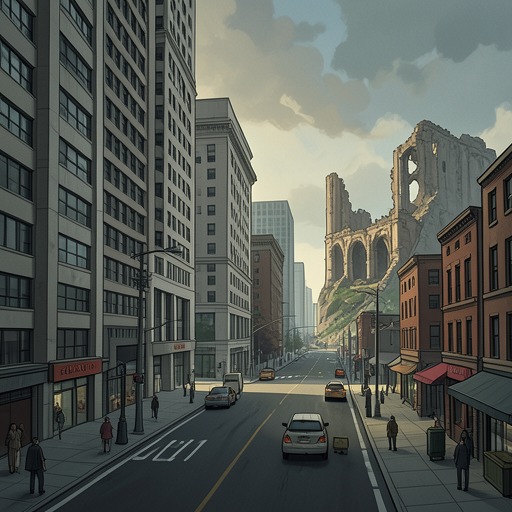
New York City is described as having undergone a sweeping programme of improvement. Streets have been widened, paved, and lighted; trees and squares have been added; elevated structures have been demolished and replaced by underground roads. The stone quays surrounding the island have been converted into parks, providing the population with open space, while new government buildings and barracks are praised for their architecture. The city’s public culture has also been reorganized through subsidized theatre and opera, and the United States National Academy of Design has become comparable to European institutions of its kind.
This beautification is linked to a wider national programme of centralization and self-preservation. New York is the visible local proof of a country that believes it has solved its political and social problems through regulation, military preparedness, controlled immigration, new naturalization laws, and the gradual concentration of executive power. The city’s apparent decency is thus not simply organic urban improvement; it is part of a governmental ideal in which order, efficiency, and aesthetic refinement reinforce one another.
Washington Square and the Lethal Chamber
The most revealing transformation occurs in Washington Square. In 1920, the Government’s first Lethal Chamber is established on the square’s south side, between Wooster Street and South Fifth Avenue. The site had previously been occupied by shabby buildings used as cafés and restaurants by foreigners. The Government acquired the block, demolished those establishments, enclosed the area with a gilded iron railing, and remade it as a garden of lawns, flowers, and fountains.
At the centre of this garden stands a small white building in severe classical style. Six Ionic columns support its roof, a single bronze door gives access to the structure, and a marble group of The Fates stands before it. The sculpture is identified as the work of the young American sculptor Boris Yvain, who died in Paris at the age of twenty-three. The setting produces a deliberate contrast: the state’s facility for ending life is surrounded by classical proportion, cultivated nature, ornamental metalwork, and fine sculpture. In New York City, lethal administration is made to look like civic architecture.
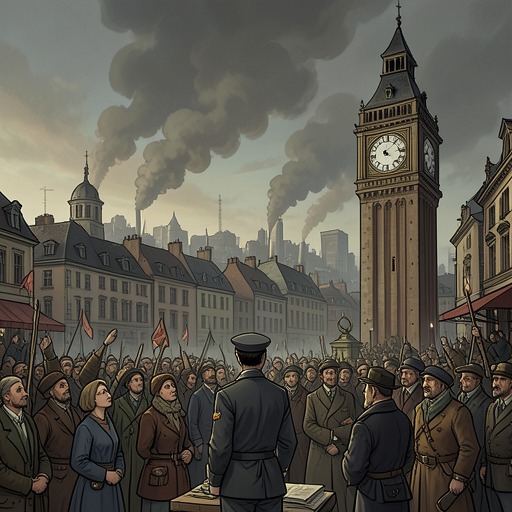
The inauguration is conducted as a formal public spectacle. Police prevent ordinary spectators from approaching, while a regiment of United States lancers forms a hollow square around the building. The Governor of New York occupies a raised tribune facing Washington Square, accompanied by the Mayors of New York and Brooklyn, senior police and military officers, the commander of the New York fleet, the Surgeon-General, the staff of the National Free Hospital, senators, and the Commissioner of Public Works. Hussars of the National Guard surround the tribune. The breadth of this official attendance binds medicine, policing, armed force, elected government, and urban administration into one ceremony.
The Governor’s address gives the policy its stated rationale. The laws prohibiting suicide and punishing attempts at self-destruction have been repealed, and the Government claims to recognize an individual’s right to end an existence made intolerable by physical suffering or mental despair. It further argues that the community will benefit when such people are removed from its midst. The policy is presented as humane relief, but its language also reduces despairing people to a troublesome class whose disappearance benefits the social body. The plan to establish a Lethal Chamber in every city, town, and village extends the logic of Washington Square across the country.
Private Interiors and Institutional Power
The city’s institutional order is mirrored in the private spaces inhabited by its characters. After visiting Dr. John Archer on Madison Avenue, the narrator walks through New York City carrying the memory of having been wrongly confined in the doctor’s private asylum. Four years earlier, a fall from a horse had left him unconscious on the pavement; his horse was shot, and Dr. John Archer, believing the narrator’s brain affected, placed him under treatment for insanity. Although the doctor later declared him recovered, the confinement remains a grievance and a source of suspicion.
Another urban institution appears in the dilapidated building where Mr. Wilde lives. The narrator climbs three neglected flights of stairs and enters through a small door at the end of a corridor. Mr. Wilde double-locks the door and pushes a heavy chest against it, turning the room into a fortified enclosure. His body—small, immensely muscular, missing an ear and the fingers of his left hand—contrasts sharply with his intelligence and knowledge. The room and the man both resist the city’s official division between normality and madness: the person widely called insane is judged by the narrator to be as sane as himself, while the respectable physician has exercised the power to confine another man on the basis of a mistaken diagnosis.
The narrator’s own rooms in the Benedick overlook Washington Square. There he repeatedly opens a steel safe whose time lock requires three and three-quarter minutes to release. Inside lies a golden, diamond-studded diadem, which he handles with increasing delight and imagines as suitable for a royal servant of The King in Yellow. The safe’s ritual turns a modern urban apartment into a private throne room. New York City’s public institutions promise rational administration, while the narrator’s domestic life converts technology, wealth, and secrecy into instruments of delusion and ambition.
Streets, Churches, and Contested Public Space
New York City is also experienced through movement across adjoining streets and public landmarks. After leaving Mr. Wilde, the narrator passes Hawberk’s door, where Hawberk is still working on armour, steps into Bleecker Street, follows it to Wooster Street, skirts the Lethal Chamber, crosses Washington Park, and returns to his rooms. The route places ordinary errands, private conspiratorial life, military craft, the lethal institution, and the public park within a single walkable urban sequence. The city’s modern surface is therefore densely layered with incompatible activities and meanings.
The Church of St. Barnabé occupies another important position in this urban fabric. Its vespers, clergy, choir-boys, Suisse, preacher, congregation, and organ create a highly ordered ceremonial environment. Yet the narrator also experiences the neighboring church through irritation and sensory disturbance. A loud exhorter’s voice seems to echo into his rooms, while an organist’s altered interpretation of familiar hymns becomes nearly intolerable to him. The church is both a respectable institution and an intrusive presence, demonstrating how New York City’s public and private spaces continually penetrate one another.
The city’s social composition is marked by similar tensions. The former cafés and restaurants for foreigners on Washington Square are erased to make room for the Government’s garden, while the national programme elsewhere celebrates restrictions on foreign-born Jews and limits on immigration. Urban beautification is consequently inseparable from exclusion: the removal of visibly foreign commercial life helps produce the city’s new appearance of calm. What is called decency carries a political cost, and the clean public surface preserves traces of the populations and activities it has displaced.
Atmosphere, Perception, and Narrative Significance
New York City’s physical beauty repeatedly conflicts with the instability of perception. The narrator can look from his study across Washington Square toward elms, maples, fountains, pigeons, gardeners, flower beds, and a lawn mower drawn by a fat white horse. This cultivated scene suggests spring, leisure, and civic peace. Yet the same city is inhabited by a man who has been confined for insanity, a doctor who becomes the object of revenge, a secretive Mr. Wilde, and a narrator whose royal ambitions are tied to The King in Yellow and the Yellow Sign.
The city also becomes a field of ominous recognition. A watchman seen near a church provokes in another urban narrative an involuntary comparison to a coffin-worm, showing how an ordinary public figure can be transformed by perception into an object of physical horror. Elsewhere, the sounds of New York City—music, Mass, and the roar of Broadway—release memories of distant landscapes and emotional states, including a Breton forest and Sylvia. Urban experience is consequently not stable or purely empirical; sound and sight open passages between present streets, remembered places, and threatening imaginative worlds.
New York City’s decisive literary role lies in this contradiction between civic confidence and concealed disorder. Its squares, hospitals, churches, schools, military formations, asylums, and lethal facilities display a society convinced that human suffering can be organized administratively. At the same time, the city’s institutions misdiagnose, confine, exclude, and ceremonially normalize what they claim to control. The result is a landscape in which classical beauty and bureaucratic violence stand side by side, making New York City the clearest spatial emblem of an alternate modernity whose tranquillity is less a resolution of crisis than its most polished disguise.