Opening of the first Government Lethal Chamber
The King in YellowThe Opening of the first Government Lethal Chamber is the decisive public enactment of a new American policy toward death: the state repeals laws prohibiting suicide and formally offers its own facilities for ending an intolerable existence. Held on April 13, 1920, on the south side of Washington Square, the ceremony combines civic pageantry, military discipline, medical authority, and an explicitly utilitarian argument that despondent people may be removed from the community for the supposed benefit of all.
Causes and Political Background
The opening is presented as the culmination of a long political agitation. The dismantling of the Elevated Railroads in New York during the summer of 1899 and the removal of the Dodge Statue in 1900 mark earlier stages in a broad national transformation; in the following winter, agitation began for repeal of the laws prohibiting suicide. That movement produced its final result in April 1920, when the Government Lethal Chamber opened on Washington Square. The event therefore belongs to a sequence of institutional reforms rather than appearing as an isolated architectural project.
The policy is justified through a language of self-preservation and public order. The Governor explains that punishment for attempts at self-destruction has been abolished because the Government recognizes a person's right to end an existence made intolerable by physical suffering or mental despair. The stated social rationale is colder: the community is believed to benefit when such people are removed from its midst. The ceremony thus joins compassion to administrative exclusion, treating unbearable suffering as a condition to be processed by government rather than solely a private crisis.
Site and Physical Arrangement
The first chamber occupies a block acquired by the Government in the winter of 1898. The former cafés and restaurants serving foreign residents were demolished, and the entire block was enclosed by a gilded iron railing and remade as a garden of lawns, flowers, and fountains. At its centre stood a small white building in severely classical style, surrounded by thickets of flowers. Six Ionic columns supported its roof, while a single bronze door controlled the entrance.
The setting makes death appear orderly, beautiful, and official. Before the door stood a marble group of The Fates, created by the young American sculptor Boris Yvain, who had died in Paris at the age of twenty-three. The sculpture supplies the ceremony with an antique emblem of allotted destiny, while the modern building and government enclosure convert that emblem into a regulated institution. The contrast between flowers, fountains, classical architecture, and the function of the chamber gives the site an especially unsettling composure: death is not hidden in a penal or medical interior but displayed as a civic amenity.
Ceremony and Participants
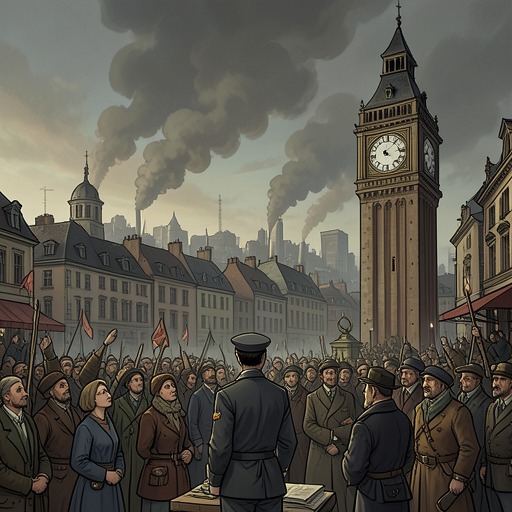
The inauguration ceremonies are already in progress when the narrator crosses University Place and enters the square. A silent crowd fills the surrounding space, but a police cordon stops him at Fourth Street. Around the chamber, a regiment of United States lancers forms a hollow square. On a raised tribune facing Washington Park stand the Governor of New York, the Mayors of New York and Brooklyn, the Inspector-General of Police, the Commandant of the state troops, Colonel Livingston as military aide to the President of the United States, General Blount commanding at Governor's Island, Major-General Hamilton commanding the garrison of New York and Brooklyn, Admiral Buffby of the fleet in the North River, Surgeon-General Lanceford, the staff of the National Free Hospital, Senators Wyse and Franklin of New York, and the Commissioner of Public Works. A squadron of National Guard hussars surrounds the tribune.
This arrangement distributes responsibility across nearly every visible branch of public power. Police control access, cavalry secure the perimeter, military commanders provide ceremonial force, medical officials authorize the language of painless relief, elected officials speak for the state, and public-works administration is represented among the dignitaries. The institution is therefore introduced not as a marginal experiment but as a coordinated national system backed by the full hierarchy of government.
Official Declaration and Immediate Course
The Governor finishes his reply to a short speech by the Surgeon-General by announcing that the prohibitions and punishments directed against suicide have been repealed. He states that the Government has acknowledged the right to end an existence made intolerable by physical suffering or mental despair, and reports that the number of suicides in the United States has not increased since the law was passed. He then announces a larger plan: a Lethal Chamber is to be established in every city, town, and village in the country. The Washington Square building is consequently both a first facility and a model for nationwide expansion.
Turning toward the white chamber, the Governor addresses the intended user of the institution. He describes a painless death awaiting anyone who can no longer bear life's sorrows and invites those who welcome death to seek it there. He then turns to the President's military aide, declares the Lethal Chamber open, and repeats the declaration to the crowd. The formal act is brief, but its implications are extensive: a private decision is converted into a public route, a legal prohibition into a recognized entitlement, and a personal despair into an administrative category.
The silence surrounding the announcement is broken by a sharp command. Hussars follow the Governor's carriage, the lancers wheel into formation along Fifth Avenue, and mounted police move after them. The spectators remain to stare at the white marble Death Chamber, while the narrator leaves the crowd, crosses South Fifth Avenue, and proceeds toward Bleecker Street. The ceremony therefore ends in a carefully choreographed withdrawal of authority, leaving behind an institution whose quiet appearance contrasts with the force that has just authorized it.
Narrative Context and Significance
The event is filtered through a narrator whose history makes the new policy personally resonant. Four years earlier, he had fallen from his horse, been found unconscious on the pavement, and carried to Dr. John Archer. Because the doctor judged his brain affected, he placed him in a private asylum and subjected him to treatment for insanity before eventually deciding that he had recovered. The narrator insists that his mind had always been as sound as Dr. John Archer's, if not sounder, and regards the earlier medical judgment as a mistake. His presence at the inauguration therefore places the official promise of relief beside the danger of institutions defining a person's condition for him.
The narrator also says that the fall changed his character, turning him from a lazy young man about town into someone active, energetic, temperate, and ambitious. That recovery complicates the ceremony's claim that suffering can be resolved by institutional removal. A person once classified as mentally affected may later understand himself as restored and purposeful; the boundary between intolerable despair, illness, and misjudgment is not as stable as the state's language suggests.
The opening's broader significance lies in its fusion of humanitarian vocabulary with bureaucratic power. Its garden, marble sculpture, military cordon, and solemn proclamation make death appear painless, dignified, and socially useful, while the nationwide plan turns an exceptional facility into a normal civic provision. The event is not merely the opening of a building. It is the moment when the Government publicly declares that administering death can be presented as an act of compassion, a mechanism of social order, and an ordinary responsibility of the modern state.