Paris
The King in YellowParis is not merely a setting but the governing urban presence of the narratives: an intricate city whose streets provide refuge, pursuit, artistic fellowship, religious ritual, romantic possibility, and the visible pressure of war. Its spaces can be intimate and cultivated, as in the Rue Sainte-Cécile and the Church of St. Barnabé, or oppressive and uncanny, as in the Court of the Dragon; during the siege, the same city becomes a frozen military enclosure where bombardment, starvation, flight, and death transform ordinary movement into a collective ordeal.
Urban Form and Social Boundaries
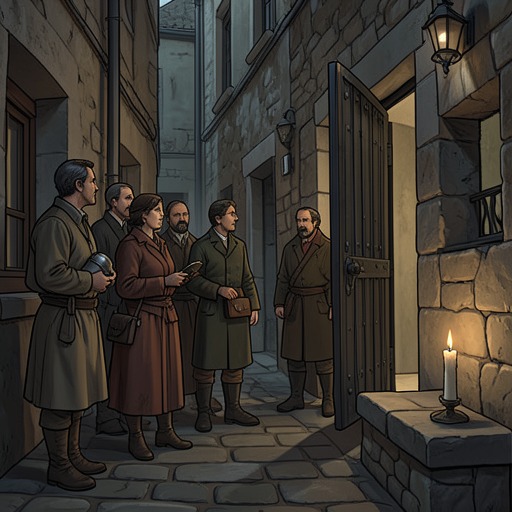
Paris appears as a city organized by sharply contrasting quarters and passages. The Court of the Dragon is an impasse connecting the Rue de Rennes with the Rue du Dragon, open only to pedestrians. An iron dragon supports the balcony over one entrance, while tall old houses close in the space from both sides. During the day, deep archways admit light and traffic, but after midnight huge gates close the court, forcing late arrivals to use small side doors and ring for admission. Its sunken pavement gathers foul pools, steep stairways descend toward doors, and the ground floors hold second-hand shops and ironworkers whose hammers and metal bars fill the passage with noise.
Yet the Court of the Dragon is not reduced to squalor. Above the workshops there is cheerfulness, comfort, and strenuous honest work. The vertical arrangement makes Paris socially and morally double: an unsavoury lower level coexists with a livable world above it, while the locked gates turn an ordinary neighborhood into a threshold space after dark. The passage is therefore both a home and a trap, a practical route through the city and an architectural image of enclosure.
The Street of Our Lady of the Fields occupies another kind of marginal position. It is neither fashionable nor shabby, but a social outcast among streets, belonging to no recognized Quarter. The Avenue de l’Observatoire treats it as beyond the aristocratic pale; students of the Montparnasse Quarter consider it pretentious and reject it; students from the Latin Quarter regard its respectability with suspicion. Strangers seldom enter except when students use it as a route between the Rue de Rennes and the Bullier, or when parents and guardians visit the convent near the Rue Vavin. In bright June weather, however, Hastings finds it pleasant, and its quiet resembles that of a Passy boulevard. Paris thus defines identity through neighborhood allegiance, even when the street itself resists classification.
Art, Religion, and Domestic Life
The city shelters artistic collaboration as well as social observation. In the hotel on the Rue Sainte-Cécile, Alec works on the decorations for Geneviève’s boudoir, while Boris and Alec labor according to their own fitful rhythms. The three young companions spend much of their time together, with Jack Scott also included in their idleness and creative fellowship. The bathing-room embodies that shared artistic life: its rose-colored marble, tessellated rose-and-grey floor, sunken square pool, sculptured pillars, frescoed ceiling, and marble Cupid are the joint work of Boris and Alec. The room is at once a private interior and an artistic composition, converting a lived space into evidence of friendship, labor, and youthful confidence.
Paris also offers ritualized religious spaces whose intellectual and sensory richness can become psychologically unstable. At the Church of St. Barnabé, vespers have ended, the clergy have withdrawn from the altar, choirboys have taken their stalls, and a Suisse in rich uniform advances down the south aisle, striking his staff against the stone pavement at regular intervals. The preacher Monseigneur C—— mounts the pulpit after the congregation reseats itself and the organ voluntary ceases. The organ music is learned, scientific, controlled, and distinctly French in its taste, but its cold intelligence does not necessarily console the listener. The church’s order and refinement instead become the background against which private disturbance breaks through.
Outside the church, Paris briefly seems radiant and communal. Spring sunlight falls on the Rue St. Honoré, where a flower barrow displays yellow jonquils, pale violets from the Riviera, dark Russian violets, Roman hyacinths, and mimosa. Sunday pleasure-seekers fill the street. The abundance of flowers and the easy movement of the crowd form a sharp contrast with the narrator’s sense of threat, showing how the city’s public beauty can persist beside an intensely private terror.
Pursuit and Psychological Geography
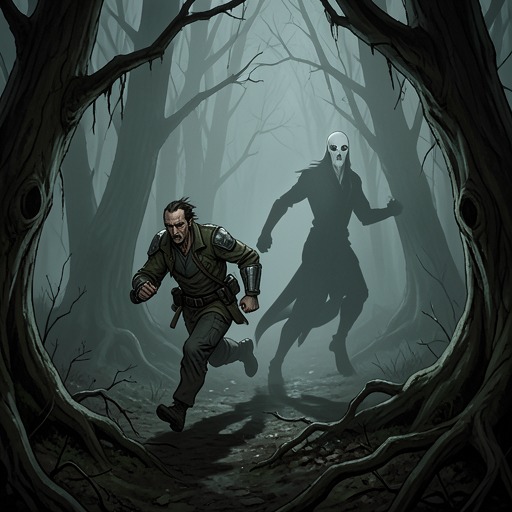
The streets of Paris become a map of pursuit when the narrator repeatedly encounters a man whose white profile and eyes express what he perceives as deadly malignity. The figure passes without turning, yet the narrator interprets his lithe back and every departing step as part of an errand connected with his destruction. The encounter transforms familiar civic space into a chain of threatened thresholds: the Rue St. Honoré, the Rue de Rivoli, the Place de la Concorde, the riverside, the Cours la Reine, the Champs Elysées, the Arc, and the broad avenue each become stages in an approach toward an anticipated fate.
The city’s openness does not release the pursued man. He sees the threatening figure among children and young mothers on a bench, apparently no more than a Sunday lounger, but the harmless social scene intensifies rather than dispels the menace. The narrator tries to escape through the Bois and beyond it, wandering until nightfall and physical exhaustion erase his ability to think. Paris therefore functions as a psychological labyrinth: its crowds conceal danger, its landmarks fail to guarantee safety, and movement across monumental spaces only deepens the sense of being driven toward something long forgotten.
That pursuit also connects urban architecture with guilt. As the narrator flees, a responsibility for something forgotten begins to awaken, accompanied by the suspicion that the threatened punishment may be deserved. The streets do not simply contain an external pursuer; they draw an inward history into the open. Paris becomes the visible form of a memory or accusation that has lain dormant and now moves through the city with him.
Absence, Return, and Memory
Paris is also marked by the emotional force of abandoned interiors. After the deaths of Geneviève and Boris, Alec returns to the house he has known so well and finds everything in order, but the silence is terrible. He cannot enter the marble room, goes instead to the smoking-room, and turns away from the spinet when he sees a small lace handkerchief lying on its keys. He locks the doors, windows, and three front and back gates, then leaves the city for Constantinople on the Orient express. The familiar Parisian house becomes uninhabitable not because its structure has changed, but because memory has made every room a witness.
During the two years of wandering through the East, letters gradually reintroduce the names of Geneviève and Boris. Jack Scott questions Alec’s account of seeing Boris bending over him during illness, touching his face and speaking to him, because the experience occurred a fortnight after Boris’s death. The impossibility remains unresolved: Jack suggests delirium or dreaming, but acknowledges that the explanation satisfies neither of them. Paris consequently persists beyond physical absence, carried through correspondence, recollection, and the unstable border between grief and apparition.
Jack’s later letter draws Alec back toward Paris. Although Jack has no financial anxiety and sells his paintings successfully, he is consumed by restlessness and a strange expectancy. He dreams repeatedly of Alec and Boris, wakes with his heart beating, and feels the excitement increase throughout each day until sleep returns. His exhaustion leads him to insist that they meet, either in Bombay or Paris. The city thus becomes the destination of a shared unresolved condition: return is not tourism or homecoming, but an attempt to confront a memory that has resisted explanation.
Paris Under Siege
In the wartime narratives, Paris is transformed from a city of artistic and social circulation into a frozen organism under bombardment. The December cold makes breathing painful and movement an effort; sounds from the streets become sharp and metallic, while a distant rumbling swells and recedes like surf. The sadness of the sky enters the squares, avenues, palaces, bridges, and narrow streets of the Latin Quarter. Fine sleet powders the pavement, and the city’s towers, domes, quays, bridges, and spires stand within a landscape of cold, exhaustion, and foreboding.
The siege is experienced through shortages as much as through artillery. A nearly naked gamin hovers over a sewer opening on the Boulevard, held together by a rope from which hangs a warm, bleeding rat. He tells Jack Trent that another rat is still inside and asks how much the animal is worth. The scene reduces survival to a transaction while exposing the social degradation produced by hunger. The city’s infrastructure, ordinarily hidden beneath the pavement, becomes a source of food, and the street becomes a marketplace for desperation.
As night falls, the bombardment grows furious. Prussian cannon produce a steady rolling thunder, heavy shocks come from Mont Valérien, shells cross the sky like shooting stars, and blue and red rockets flare above the horizon from the Fort of Issy while the Fortress of the North burns like a bonfire. Crowds pour into the streets upon hearing supposed good news, shivering and chattering with shrunken eyes. Their gathering shows how rumor and spectacle alter urban time: citizens wait for signals because they have no reliable control over what is happening beyond the walls.
The waiting population understands that every signal may mean a different collective fate. They may be summoned to a sortie, in which case they will go gladly, or they may be left to starve; surrender is not considered because there is no time to think of it. The city’s inhabitants are described through the competing claims of heroism, hunger, freezing, and obedience. Paris becomes a shared moral pressure chamber in which private choice is subordinated to the uncertain rhythm of military news.
When midnight sounds from the belfry of St. Sulpice, the gates remain choked with fragments of what was once an army. The troops enter as a starving, exhausted horde, initially silent and orderly, then increasingly confused as cavalry, artillery, infantry, Mobiles, officers, ambulances, horses, and jolting caissons struggle for passage. The crowd watches dumbly while the remnants of battle surge through the gates. The military collapse is therefore staged as an urban invasion in reverse: the defeated army does not protect Paris from outside, but pours its misery into the streets.
The violence continues within the city. West, Braith, and Colette emerge from a cellar through a damaged iron door beneath a yellow petroleum light, cross gardens and streets illuminated by burning buildings and shell flashes, and pass pillagers among the debris. They encounter women crazed with drink and men whose blackened faces and hands reveal their participation in the destruction. At the Seine, Braith decides to return because he is uncertain about Jack and Sylvia. In the crowd, Colette recognizes Hartman behind a file of bayonets; a volley sounds from the barracks, and the city’s public space becomes the scene of an execution witnessed through lantern light, gates, and the pressure of onlookers.
The surviving troops and civilians then stream across Paris in fragments, followed by women and children, while a murmur of defeat passes through the Arc de Triomphe and down the dark avenue: the city hears itself named as lost. Paris’s decisive significance lies in this accumulation of contrasts. It can make marble, music, flowers, friendship, and quiet domestic life possible, yet it can also convert streets into corridors of pursuit, homes into sealed memorials, and monuments into resonant frames for military ruin. Its beauty never cancels its violence; instead, the continual proximity of the two gives the city its unsettling narrative power.