Paris sortie and battle
The King in YellowThe Paris sortie and battle transforms the siege from a condition of privation into an immediate experience of mass violence. Promised as a desperate attempt to break the encirclement, it draws Jack Trent from the freezing streets into the ranks, where artillery, fog, hunger, and panic dissolve the distinction between soldier, civilian, and witness. Its decisive result is not liberation but slaughter: the surviving fragments of the army stagger back through the gates, while Paris receives defeat as a spectacle of exhaustion and grief.
Causes and Background
The sortie is introduced as an operation ordered by General Trochu after the city has endured prolonged cold, hunger, bombardment, and uncertainty. When Trent asks about it, he is told that it is planned for the week; his immediate response is that it will be terrible, while his private judgment is harsher still, anticipating slaughter and feeling relief that he will not be among the participants. The contrast establishes the event's central tension before the battle begins: public language presents a military necessity, whereas private consciousness recognizes the likely human cost.
The city itself has already become a war zone. December darkness is hemmed in by the high roofs, sleet powders the pavements, and the cold is so intense that breathing hurts and movement becomes an effort. Sounds from the streets break with metallic sharpness, while distant booming rises and recedes like surf. The siege therefore supplies the battle with its atmosphere and its pressure: the sortie is not an isolated decision but an eruption from a population already sick, starved, freezing, and waiting.
Rumor intensifies the expectation. Crowds gather to await signals, and people speculate that the Army of the Loire has signalled Mont Valérien. An American Ambulance surgeon recalls that the previous sortie overwhelmed the small corps with the work of fifty ambulances and warns that the next one may require volunteers. His abrupt instruction that Trent take care of madame keeps the domestic sphere within the military crisis. The sortie threatens not only the men who march but also those who remain behind, including Sylvia Trent, who is growing increasingly nervous.
Mobilization and Advance
On the night before the battle, the bombardment becomes furious. Prussian cannon fire rolls steadily, the shocks from Mont Valérien answer it, shells cross the sky like shooting stars, and rockets flare blue and red above the horizon. The Fort of Issy and the Fortress of the North blaze against the darkness. What might have been read as encouraging signals instead fills the streets with shivering, anxious people whose excitement is inseparable from fear.
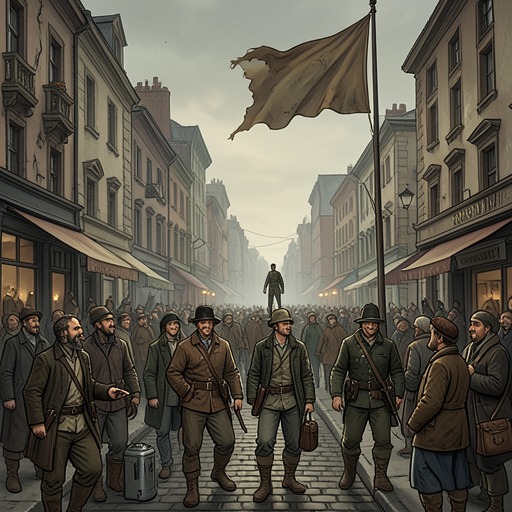
Trent's movement toward the battle is rendered as a psychological passage as much as a physical one. Under the Arc de Triomphe, he is haunted by the face of Hartman, which appears to him alternately terrified and triumphant. A sudden fog then fills the streets and seems to populate them with phantoms. Trent is carried along by spectral crowds toward a barred gate, where the fog clears enough to reveal bayonets, guns, cavalry, and an army flowing out into the darkness. The vision blurs memory, hallucination, and military reality, but it also gives the sortie a ritual quality: an entire city seems to pass through a threshold toward violence.
At the gate, Trent recognizes Philippe and asks whether there is room for him, but Philippe waves him away and disappears with the marching column. The gesture marks Trent's separation from ordinary civilian life. He assists a woman who is forcing a loaf of black bread into a soldier's haversack, holds the soldier's rifle while she opens the sack, and tests the sharpness of its bayonet. That small act of handling the weapon becomes the point at which observation turns into participation. His desire to join the fighting is sudden and imperative, arising amid the hunger, movement, and collective departure.
Course of the Battle
The advance proceeds through sodden meadows and fog, with columns moving parallel across the railroad embankment. Lines detach from the formations and swing east and west as firing begins. A battery gallops into action; fortifications answer with a mighty roar; officers shout commands that Trent cannot catch. The fog repeatedly conceals and reveals the battle, making the front seem to advance and retreat at once. Men imagine ghostly horsemen in the vapors, and even the possibility that they are Uhlans remains entangled with the uncertainty of sight.
The battalion crosses the embankment and moves along twisted rails. When the mist lifts briefly, Trent sees the first battalion, neighboring regiments, and the larger deployment before the fog closes again. Drums and bugles signal movement, and the battalion advances while firing. Ambulances hurry toward the rear, while hussars pass and repass like apparitions. At the front, shells burst along the embankment and cover the troops with frozen slush; cries, groans, and volleys come from close at hand. The battle is thus experienced not as a legible maneuver but as a fluctuating field of sound, smoke, mud, and partial glimpses.
Trent's fear grows as the unknown front approaches. Cannon shocks sicken him, and the fog glows dull orange under the explosions. When the colonel orders the advance, Trent follows despite trembling. A blast nearly stuns him, and after the men beside him fall he reaches for support and catches a gun-carriage wheel. A combatant springs from behind it and strikes at him with a rammer; the man stumbles onto Trent's bayonet and dies. Trent realizes that he has killed, but the realization does not restore control. Surrounded by fighting men, he strikes blindly with the rammer until it breaks.
The struggle becomes entirely physical. A man bears Trent to the ground, but Trent throttles him and rises onto his knees. He sees a comrade's skull crushed against a cannon and the colonel fall from his saddle before consciousness leaves him. When he awakens among the twisted rails, men are fleeing through the fog. He helps a wounded comrade whose jaw is bandaged, only for the man to die in the freezing mire; later another identifies himself as Philippe before a sudden volley kills him. The battle therefore converts recognition into loss, repeatedly bringing familiar human presence into view only to erase it.
Consequences and Aftermath
The sortie's aftermath is visible at the gates of Paris at midnight. The entrances are choked with fragments of what had been an army. Cavalry, artillery, infantry, officers without men, men without officers, Mobiles, and ambulances press through in a chaotic mass. Horses plunge, caissons jolt, and ambulance wheels groan under their loads. The troops enter spattered with slime and faint from hunger and exhaustion, while the crowd at first parts silently before confusion and disorder spread through the night.
The returning army is not presented as a victorious force regrouping but as a broken population seeking shelter inside the city. Ambulances have been arriving throughout the day, and ragged spectators shiver and whimper by the barriers. By noon, the crowd has multiplied tenfold, filling the squares around the gates and swarming over the inner fortifications. The military defeat thereby becomes an urban event: the entire population is made to witness the material consequences of the sortie.
The same collapse is echoed elsewhere in the city. As Braith, West, and Colette move through streets illuminated by burning buildings and shell flashes, they encounter pillagers, drunken violence, and the remnants of military authority. A platoon passes the d'Orsay barracks with Hartman among the figures; a volley follows behind the gate. Across the Place de la Concorde and through the surrounding streets, fragments of the battle continue to arrive, pursued by women and children and accompanied by the cry, "Perdus! perdus!" When Trent finally emerges from the shadowy ranks and is recognized, West seizes him, white with terror. The sortie has ended not with a strategic reversal but with the city's public recognition of annihilation.
Narrative Significance
The event binds together three scales of wartime experience. At the private scale, Sylvia's anxiety and Trent's obligation to return home show how military decisions enter domestic life. At the civic scale, rumor, signals, crowds, rationing, and the sight of returning ambulances turn the sortie into a collective psychological ordeal. At the bodily scale, the narrative records hunger, freezing mud, crushed skulls, shattered jaws, bloodied uniforms, and the effort of chewing bread for a wounded man who cannot eat it himself.
Trent's role gives the battle a particularly unstable perspective. He begins as a reluctant observer who privately rejects the sortie, then crosses into the ranks almost by accident, handles a rifle, feeds a starving soldier, kills in confusion, and survives without any sense of triumph. The fog externalizes this instability: it hides the enemy, distorts movement, generates phantom horsemen, and makes comrades recognizable only momentarily. The battle's moral movement is equally dark. The expectation of heroic action gives way to involuntary violence, and the promised sortie becomes a scene in which courage, duty, terror, and mere survival cannot be cleanly separated.