Philip—Jeanne d’Ys
The King in YellowPhilip—Jeanne d’Ys is a cross-temporal love relation built on a collision between immediate desire and impossible historical distance. Philip, lost on the moors near Kerselec, finds refuge through Jeanne d’Ys, a mysterious falconer whose presence turns an ordinary rescue into a passage beyond linear time. Their love is confessed and returned almost at once, but the relation ends when Philip is bitten by a viper and awakens beside the ruins of Jeanne’s vanished home, where an inscription identifies her as a young woman who died in 1573 for love of a stranger named Philip.
Encounter on the Moor
Philip’s first sight of Jeanne d’Ys occurs after a day of wandering across the moors. As evening approaches, he sees a magnificent falcon standing on a dead hare, its talons fitted with a leash from which hangs a round piece of metal like a sleigh-bell. Jeanne enters the covert, lifts the bird from its prey with a gloved hand, places a hood over its head, and carries it on her gauntlet while securing the hare to her girdle. Her controlled handling of the falcon gives the meeting an arresting, almost ceremonial quality: Philip is not merely rescued by a stranger but drawn into an unfamiliar world governed by old practices and unexplained signs.
Jeanne initially appears wary when Philip steps into her path and explains that he is lost. She asks whether he truly came from Kerselec, and Philip notices that her voice has neither the Breton accent nor any accent he recognizes, although it seems strangely familiar, like the theme of an old song. Her speech immediately unsettles ordinary geography. When Philip hopes that returning to Kerselec will take no longer than his journey out, Jeanne answers that coming is easy and takes hours, whereas going is different and may take centuries. The remark changes the relation from a chance encounter into a meeting shaped by a hidden temporal disparity, though Philip decides that he must have misunderstood her.
Mutual Recognition and Confession
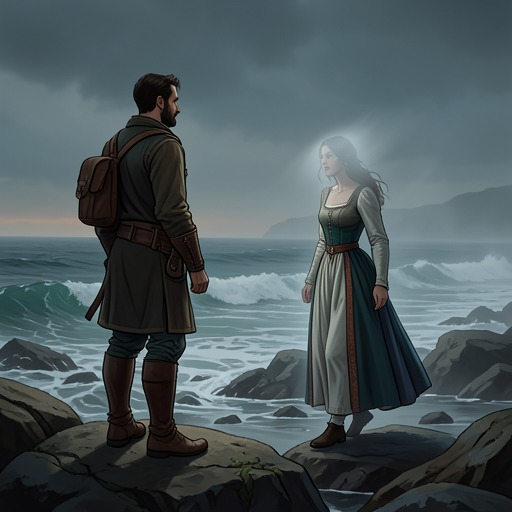
Jeanne responds to Philip’s exhaustion with practical hospitality. After summoning assistance with a whistle, she tells him to sit and rest because he has come a long distance. Later, she crosses herself and breaks bread while Philip watches her white hands without daring to raise his eyes to hers. The meal becomes the setting for his sudden recognition of love. He understands that, from the moment he looked into her dark eyes on the moor, he had loved her and would give his life to touch her hands.
Philip’s confession is deliberately framed as a self-condemnation. He tells Jeanne that he is ill at ease for love of her, calls himself unworthy of her thoughts, and admits that he has answered hospitality with bold presumption. Jeanne does not reject him. Instead, she leans her head upon her hands and tells him that she loves him and that his words are dear to her. Their relation therefore moves directly from first sight to mutual declaration: Philip’s passion is sudden, but Jeanne’s answer gives it reciprocal force rather than leaving it as an isolated or deluded attachment.
The names they exchange crystallize this transformation. When Jeanne says Philip’s name and he whispers Jeanne’s, she sighs that this is all she wished: Philip and Jeanne. She offers her hand, and he touches it with his lips. Her repeated instruction that Philip must win her now carries the assent of both body and soul. The scene presents love as a recognition preceding explanation. Neither character resolves the mystery of their circumstances, yet the relation becomes certain to them through naming, touch, and returned speech.
Time, Difference, and the Threat of Death
The relationship is shadowed by a temporal difference that Philip cannot yet comprehend. Jeanne’s warning that departure may take centuries sounds like a paradox at the time, but the later discovery turns it into a literal disclosure of her condition. Her unfamiliar voice, archaic falconry, religious gestures, and attachment to a walled court all acquire retrospective significance once Philip finds the ruins and the memorial inscription.
The decisive physical danger arrives while Philip and Jeanne are together near the stream and flat rock. Jeanne becomes afraid of something in the grass and asks Philip not to examine it. When he asks whether she is afraid for him, she answers that she is, because she loves him. Philip takes her in his arms and kisses her, but a viper strikes his foot and then his ankle. He tears the snake away and crushes its head, yet the venom leaves him weak and numb. His last sensations before losing consciousness are of Jeanne’s white face bending over him and her arms around his neck.
The viper bite converts the relation’s emotional intensity into mortal crisis. Philip’s act of killing the snake saves neither the shared moment nor the world in which it occurred. The lovers’ embrace continues as Philip’s consciousness fails, so that tenderness and death become inseparable: the final contact he experiences in Jeanne’s presence is also the threshold at which that presence disappears.
Ruins and the Historical Revelation
When Philip opens his eyes, Jeanne is gone. The stream, the flat rock, and the crushed viper remain, but the hawks and blocks have disappeared, and the garden, fruit trees, drawbridge, and walled court have been replaced by crumbling, ivy-covered ruins through which great trees have grown. The falcon also returns in altered form, sailing from the treetops above the ruins before vanishing into the clouds. Its disappearance echoes the earlier encounter while marking the collapse of the enchanted or historical scene.
Philip’s cry for Jeanne dies unanswered, and he falls on his knees before a shrine to the Mother of Sorrows. Beneath the carved Virgin, cross, and thorns, he reads that the demoiselle Jeanne d’Ys died in her youth for love of Philip, a stranger, in A.D. 1573. The inscription supplies the relation’s decisive reversal: Jeanne’s declaration of love was not merely a present promise but the recurrence of a love already concluded by death centuries earlier. Philip has encountered the dead woman whose memorial records the very attachment he has just begun to experience.
Yet the ending does not reduce the relation to a trick or hallucination. Upon the icy stone lies a woman’s glove, still warm and fragrant. This concrete remnant preserves a material trace of Jeanne after her body and dwelling have vanished. It leaves Philip with proof that resists the ruined setting’s apparent finality, while also intensifying the tragedy: the glove is intimate evidence of contact, but not a means of restoring the beloved.
Narrative and Thematic Significance
Philip—Jeanne d’Ys joins the plot of sudden mutual love to the structure of forbidden love, discovery, and sacrifice. The lovers’ social or personal incompatibility is less important than their separation by historical time. Philip seeks ordinary directions and a night’s shelter; instead, he crosses into a world where return is measured in centuries. The relation’s central conflict is therefore not a quarrel between the lovers but the incompatibility between their shared emotional present and Jeanne’s already completed historical life.
The story also treats recognition as something bodily before it becomes intellectual. Philip’s silence, his reluctance to look at Jeanne, his impulse to touch her hands, the kiss, the embrace, and the numbness spreading from the viper’s bite all carry the relation forward before its meaning is explained. The later inscription supplies knowledge, but it cannot replace the immediate experience through which the lovers recognized one another. Their love is first felt as physical intensity and only afterward understood as a connection crossing centuries.
The ending subverts the expectation that mutual confession will lead to a sustained union. Jeanne does say that she loves Philip, and Philip believes he can win her, but the relation’s apparent promise is overturned by venom, disappearance, and memorial history. The warm glove offers a final sign of continued connection without granting a happy ending. Philip and Jeanne remain joined across time, but only as lovers whose meeting confirms a death rather than preventing it.