Poverty
The King in YellowPoverty in the book is not a single background condition but a recurring pressure that alters bodies, relationships, and moral decisions. It appears in the solitary life of Mr. Wilde, in the outcasts around the Lethal Chamber, and most extensively in besieged Paris, where hunger and cold turn the city into a place of bodily exhaustion and ethical emergency. Across these episodes, deprivation reveals both the fragility of social protection and the unevenness of private compassion.
Poverty and Social Abandonment
Poverty is first associated with isolation and dependence. Constance Hawberk describes Mr. Wilde as living alone year after year, poor, crippled, and almost demented, and regards Alec's repeated visits as an act of unusual kindness. Alec rejects that judgment of Mr. Wilde's mind, insisting that his intelligence and knowledge remain extraordinary. Yet the physical facts of Wilde's existence are unmistakable: he is very small, has no ears except for wax substitutes supported by displaced silver wires, and has a left hand that is absolutely fingerless. His disability is not merely an abstract symbol; it governs how others see him, how they speak about him, and how much of his life is spent shut away from ordinary society.
Wilde's body also exposes the instability of the boundary between disability, eccentricity, and social condemnation. His artificial ears are a conspicuous substitute that has failed to remain securely in place, while his malformed head leads many people to call him insane. Alec, however, regards him as sane. The contrast shows that poverty and bodily difference are intensified by the judgments imposed upon them: the physical impairment is real, but the further exclusion of the disabled man depends on other people's assumptions that he is either helpless, vicious, or mad.
That exclusion is complicated by Wilde's own conduct. He keeps a surly cat and repeatedly provokes it until the animal attacks his face, producing a violent struggle in which both creature and keeper scratch and claw at one another. The scene makes Wilde's room feel like a closed world in which deprivation, confinement, and eccentric power have become inseparable. His poverty does not make him morally simple or merely pitiable; it coexists with intelligence, cruelty, physical strength, and the ability to dominate another vulnerable person.
Outcasts, Charity, and the Lethal Chamber
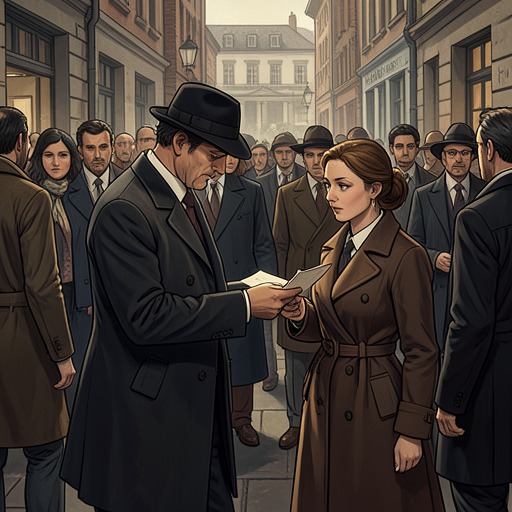
After leaving Mr. Wilde's rooms, Alec encounters a half-starved creature standing across the street from the Lethal Chamber. The man tells a tale of misery, and Alec gives him money without fully understanding why. The gesture is charitable but uncertain: it relieves an immediate need without changing the condition that produced it, and the recipient leaves without thanking him. An hour later another outcast approaches with a similar complaint. Instead of money, Alec gives him a blank sheet marked with the Yellow Sign. The man studies it stupidly, folds it with exaggerated care, and places it in his bosom.
The juxtaposition turns poverty into a test of perception and responsibility. One beggar receives material assistance; another receives an object whose meaning is obscure and potentially threatening. The scene places ordinary destitution beside the institutional presence of the Lethal Chamber, suggesting a society in which the poor are visible in public but not necessarily protected. The chamber stands as a cold administrative counterpoint to the personal, improvised act of giving money: both are responses to human suffering, but only one is intimate, and neither addresses the larger structure of abandonment.
The same social vulnerability appears in the account of Thomas, whose encounter with a disfigured man leaves him horrified. When Thomas struck him, the man seized Thomas's wrists, and a twist caused one of the man's soft, mushy fingers to come off in Thomas's hand. Thomas thereafter avoids him, saying that seeing him makes him ill. The incident presents bodily impairment as a source of fear and revulsion, but it also shows how quickly the impaired person becomes socially unreadable: the narrative preserves Thomas's horror more clearly than the other man's identity or circumstances. Poverty, disability, and stigma therefore overlap, making certain bodies objects of avoidance rather than recipients of care.
Siege, Hunger, and the Economy of Scarcity
In the Paris siege narrative, poverty becomes collective and political. The cold is piercing, the city is nearly silent except for sharp metallic sounds, and the air itself seems weighted with a black pall. The physical environment makes deprivation palpable: movement is an effort, breathing is painful, and yesterday's slush has hardened into flint. This is not a temporary inconvenience but an altered urban existence in which weather, war, and scarcity reinforce one another.
The poor are especially exposed. A wretchedly dressed gamin hovers over a sewer opening while a rope around his waist holds his rags together; from the rope hangs a rat that is still warm and bleeding. He calls out that another rat remains below and asks Trent how much he will pay. The exchange turns vermin into food and poverty into a grim market transaction. Hunger has not erased economic calculation; it has forced calculation into a world where survival depends on whatever can be extracted from the sewer.
Scarcity also governs the lives of people who retain some social connection or former wealth. Trent brings food into a household where portions must be divided, tells others that he is never hungry, and gives away what he has. He reproaches Fallowby for spending money during the siege, explaining that he must supply Fallowby's funds until the siege ends and that the supposedly wealthy man will not receive more money before then. Trent offers to share what he possesses but refuses to see it thrown away. His anger distinguishes generosity from indulgence: charity is possible only when resources are preserved rather than squandered.
The meal itself is reduced to an inventory of rare staples: dried prunes, white bread, currant jelly, tea, and coffee. The list gives scarcity a domestic form. Food is no longer an incidental part of social life but the organizing principle of conversation, friendship, and moral judgment. Trent's concern for Fallowby is therefore practical rather than sentimental; he recognizes that the siege has transformed private wealth into a limited communal reserve.
War, Waiting, and the Poor City
The siege makes poverty inseparable from uncertainty. As the bombardment intensifies, shells cross the sky, Fort Issy flashes blue and red, and the Fortress of the North burns like a bonfire. Crowds emerge in response to rumors of good news, but the people are described as shivering, chattering, and physically diminished. Their public excitement is inseparable from starvation and fear. A man summarizes their condition as waiting while sick, starved, and freezing, uncertain whether the army is preparing a sortie or whether the city is simply being left to starve.
That waiting changes the moral meaning of endurance. The Parisians are not romanticized as untouched heroes; their courage exists alongside bodily depletion and the absence of meaningful alternatives. They go gladly if there is a sortie and starve if there is not, because surrender is not presented as an ordinary choice that can be calmly weighed. Poverty here is produced by a military state of exception in which civilians and soldiers alike are reduced to endurance, rumor, and obedience to events beyond their control.
When the remnants of the army return through the gates at midnight, poverty becomes visible as a broken military procession. The troops are spattered with slime, faint with hunger and exhaustion, and increasingly disordered as cavalry, artillery, infantry, officers, ambulances, and stragglers force their way into the city. The crowd watches in silence while the army becomes a mass of damaged bodies rather than an organized institution. The defeat therefore distributes impoverishment across the whole city, stripping soldiers of strength, officers of control, and civilians of confidence.
The aftermath continues through urban destruction and institutional violence. West, Colette, and Braith escape through a cellar while fires and shell flashes illuminate streets filled with pillagers and damaged buildings. They encounter people crazed by drink and figures whose blackened faces and hands reveal their participation in destruction. At the barracks, Hartman is seen among a measured platoon before a volley sounds behind the gate. The scene links deprivation with lawlessness and execution: once ordinary protections collapse, the poor, the displaced, and the defeated are exposed to both predation and official force.
Meaning and Narrative Function
Poverty repeatedly tests the distance between seeing suffering and acting upon it. Constance sees Mr. Wilde's deprivation and praises Alec for visiting him; Alec gives money to a half-starved stranger; Trent shares food and controls a friend's spending; the besieged city turns every ration into an ethical decision. These responses differ in effectiveness and motive, but together they show that poverty is measured not only by lack of money or food but by the availability of another person willing to recognize the sufferer as fully human.
At the same time, the book refuses to make deprivation morally pure. Mr. Wilde's poverty coexists with violence, the outcasts remain vulnerable to manipulation, Fallowby's former wealth does not prevent waste, and the siege produces pillagers as well as victims. Poverty can generate solidarity, but it can also intensify fear, disgust, selfishness, and coercion. Its decisive significance is therefore structural: it strips away the comforting idea that social identity is stable, exposing how quickly disability becomes stigma, wealth becomes rationed obligation, and hunger becomes a force capable of reorganizing an entire city.