Repeal of the United States anti-suicide laws
The King in YellowThe Repeal of the United States anti-suicide laws is the legislative turning point that removed punishment for attempted self-destruction and made death a publicly sanctioned form of relief. Initiated by agitation in the winter after 1900, the repeal reached its practical and ideological culmination in April 1920, when the government opened the first Government Lethal Chamber on Washington Square in New York. The event changes the meaning of suicide within the story: what had been prohibited by law becomes an authorized service administered in the name of individual suffering and social benefit.
Causes and Historical Background
The repeal emerged from a prolonged political agitation rather than from a single private tragedy. The dismantling of the Elevated Railroads marked the summer of 1899 in New York, and the removal of the Dodge Statue marked the summer of 1900; in the following winter, agitation began for repealing the laws prohibiting suicide. That movement bore final fruit in April 1920, linking an apparently abstract legal controversy to a concrete institutional transformation in the city.
The wider political setting is one of intensified state consolidation and proclaimed national calm. The narrative associates public prosperity with immigration restrictions, new naturalization laws, the centralization of power in the executive, the solution of the Indian problem, and the Congress of Religions. Against that background, the repeal is presented as another measure of governmental management: the state does not simply tolerate private despair but reorganizes the legal and administrative treatment of people who can no longer endure life.
Legal Reversal and Government Policy
The Governor explains the new policy as a direct reversal of the former law. The laws prohibiting suicide, together with the punishment imposed for attempts at self-destruction, have been repealed. The Government thereby acknowledges what the speech calls the right of a person to end an existence made intolerable by physical suffering or mental despair. In legal terms, the value of life changes from an obligation enforced by punishment to an existence whose termination may be recognized as legitimate.
The speech gives the repeal a utilitarian justification as well as a language of individual rights. The Government claims that the community will benefit from removing such people from its midst, while also insisting that the number of suicides in the United States has not increased since the law was passed. The argument therefore joins compassion to social purification: suffering individuals are offered relief, but they are also described as a class whose disappearance benefits the collective. The apparent liberation of personal choice is thus inseparable from an administrative judgment about which lives have become burdensome.
The repeal leads directly to a national program. The Government determines to establish a Government Lethal Chamber in every city, town, and village in the country. The law is consequently not merely permissive. It creates the legal conditions for a standardized network of state facilities, converting a formerly clandestine or criminal act into an organized public procedure.
Opening of the First Government Lethal Chamber
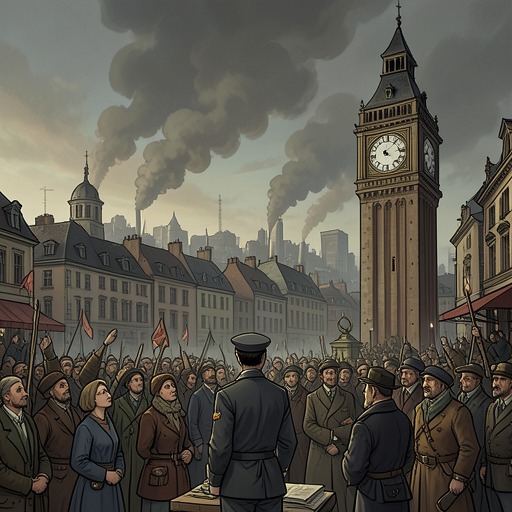
The policy becomes visible in a carefully staged ceremony on Washington Square. The narrator walks down from Dr. John Archer's house on Madison Avenue and enters the square while the inauguration is under way. A silent crowd is held back by police at Fourth Street, and a regiment of United States lancers forms a hollow square around the Government Lethal Chamber. The building itself is repeatedly characterized as white, while the surrounding military formation gives the supposedly humanitarian institution the spatial discipline of a ceremony of state.
The platform gathers the Governor of New York, the mayors of New York and Brooklyn, senior police and military officers, Colonel Livingston as military aide to the President of the United States, General Blount of Governor's Island, Major-General Hamilton commanding the New York and Brooklyn garrison, Admiral Buffby of the fleet in the North River, Surgeon-General Lanceford, the staff of the National Free Hospital, Senators Wyse and Franklin of New York, and the Commissioner of Public Works. A squadron of hussars from the National Guard surrounds the tribune. The concentration of civic, military, medical, and administrative officials makes the opening a collective assertion of governmental legitimacy rather than a private act of mercy.
The Governor first responds to a short speech by the Surgeon-General, then turns toward the chamber and declares that a painless death awaits anyone who can no longer bear the sorrows of life. He invites those for whom death is welcome to seek it there and then formally declares the chamber open. His words give the new institution its official moral vocabulary: physical suffering and mental despair are treated as grounds for relief, while the state presents itself as the agent capable of delivering that relief without pain.
Immediate Consequences and Public Spectacle
The proclamation produces a solemn silence, followed by a sharp military command. The hussars file away after the Governor's carriage; the lancers wheel into formation along Fifth Avenue to await the commandant of the garrison; and the mounted police follow. The ceremony therefore ends not with intimate consolation but with coordinated military movement, reinforcing the tension between the chamber's promise of painless personal release and the coercive pageantry surrounding its inauguration.
The narrator does not enter the chamber. Instead, the crowd is left to stare at the white marble Death Chamber while the narrator crosses South Fifth Avenue, walks toward Bleecker Street, and stops before a dingy shop. This departure places the ordinary and the bureaucratic side by side: the grand public institution remains behind as an object of collective fascination, while the narrator turns toward a shabby commercial setting and the next movement of the story.
Narrative Significance
The repeal establishes a legal order in which the state's protection of life is withdrawn from people defined by unbearable suffering, even as those people remain subject to state supervision and institutional procedure. The rhetoric of rights and relief masks a second logic in which despair becomes administratively classifiable and death becomes a public service. That contradiction is central to the event's significance: the law appears to enlarge personal freedom while simultaneously enlarging the government's authority to define, organize, and normalize death.
The opening ceremony also makes an intimate existential crisis into a national spectacle. Individual pain is invoked as the reason for reform, but the final scene is dominated by police cordons, lancers, hussars, governors, generals, admirals, senators, and medical officials. By presenting death through the visual language of inauguration and military order, the narrative makes the familiar act of suicide strange again, forcing attention onto the political machinery that surrounds a supposedly private decision. The repeal is therefore both a plot-world reform and a disclosure of the society's governing principle: what cannot be cured, reintegrated, or made socially useful may instead be relieved, removed, and ceremonially administered.