Siege of Paris
The King in YellowThe Siege of Paris is the central historical catastrophe behind the book’s Paris narratives, enclosing civilians, soldiers, artists, and foreign residents within a city whose ordinary life is progressively transformed by artillery, starvation, fear, and uncertain hope. The siege is experienced not as a single battle but as a pressure that enters homes, streets, bridges, hospitals, and private relationships, until the distinction between military danger and daily existence nearly disappears.
Causes and Historical Setting
The siege belongs to the Franco-Prussian War as represented by the book’s historical fiction. Paris is encircled while German forces bombard the city, and the inhabitants wait for relief, a sortie, or the possibility of surrender. The narrative repeatedly joins public military news to domestic anxiety: a planned sortie is discussed as an approaching slaughter, while rumors of the Army of the Loire briefly persuade starving Parisians that rescue may be near.
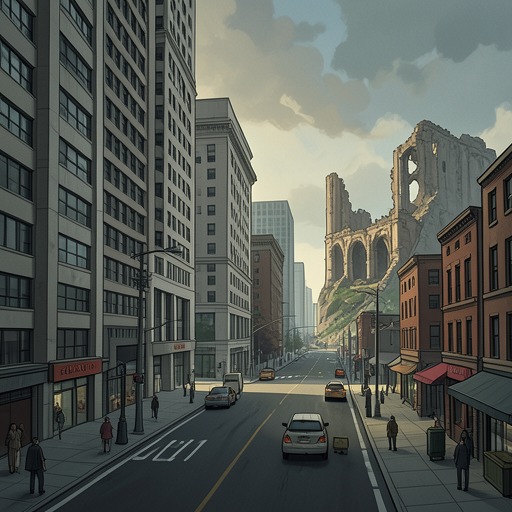
The war is also part of the book’s larger alternate history. In the framing account, the later United States remembers its own war with Germany over the Samoan Islands as a victorious conflict with no visible scars, while Europe has been left in Anarchy. Against that apparently prosperous future, the Paris episodes preserve the bodily and emotional reality of war: hunger, exhaustion, bombardment, wrecked buildings, displaced troops, and civilians waiting for news that may never arrive.
Life Under Bombardment
The siege alters the texture of time and space. In the Latin Quarter, cold becomes physically punitive: the air is difficult to breathe, movement requires effort, and every sound from the street is sharp and metallic. The distant rumble of the battle swells and recedes like surf, while the city itself seems burdened by a black, motionless weight. Artillery is not merely seen; it is heard before it is understood, turning the atmosphere into an instrument of threat.
The bombardment reaches directly into domestic life. While a girl works on a baby garment, the windows vibrate under a loud humming, and a shell screams through the clouds overhead. Her companion, Jack Trent, tries to reassure her that the projectile probably fell near Montmartre and that the Latin Quarter is not worth attacking. His cheerfulness is an act of protection rather than evidence of safety: the next shell makes the danger immediate, while the scene shows how civilians preserve ordinary gestures even as war presses against the walls.
Hunger is equally present. On the frozen streets, women move in tattered military capes, and a badly dressed gamin guards a sewer opening where he has hunted rats. The animal hanging from his rope is still warm and bleeding; he reports that another rat remains below and asks Trent how much he will pay. The episode reduces the city’s food crisis to a transaction in the street, making starvation visible through a child’s scavenging and through the casual economy that deprivation creates.
The siege also produces a cruel contrast between private celebrations and public ruin. Trent invites friends to dine because Sylvia Trent’s nineteenth birthday is approaching, even as the bombardment grows furious and the sortie is expected. The invitation is an attempt to preserve fellowship and ceremony, but it unfolds beneath the steady thunder of Prussian cannon and the heavy shocks from Mont Valérien. In Paris under siege, a fête and a military emergency occupy the same evening.
Rumor, Hope, and the Promised Sortie
The sortie becomes one of the siege’s most important suspended events. Trent hears that General Trochu has sent orders and that the operation is planned for the week. He anticipates slaughter and is relieved that he will not participate, revealing the gap between patriotic rhetoric and personal fear. Yet when rumors spread that the Army of the Loire has arrived, the city’s emotional balance changes within minutes.
Trent follows the crowd through the rue de Seine toward the river as rockets rise above the horizon. Signals flash from the Fort of Issy and the Fortress of the North; the batteries at Montmartre and Montparnasse answer with cannon fire. People pour into the streets asking whether the sortie has begun and whether the army can be seen from the Pont Neuf. A child asks whether victory will mean white bread tomorrow, while an old man sways and mutters as though overcome by madness. The rumor is therefore both military report and food promise: relief is imagined as the return of bread.
On the bridge, the crowd waits without confirmation. They are sick, starved, freezing, and still willing to go if a sortie is underway; if the city must continue starving, they will starve. Their waiting turns the bridge into a collective theater of suspended judgment, where cannon flashes provide the only visible movement and hope rises and falls with the rockets. The siege controls not only bodies but also perception, making hearsay, distant lights, and artillery noise the materials from which people construct knowledge.
The expectation finally collapses into dread. Trent returns through dark, deserted streets while the crowd remains gathered at the river. A black cloud of cannon smoke stretches over the fortifications, drifting across spires, domes, quays, bridges, and the river. The smoke obscures the city even as it records the battle, and the people’s communal hope gives way to the sense that they have been waiting inside a catastrophe already decided.
Defeat and the Return of the Army
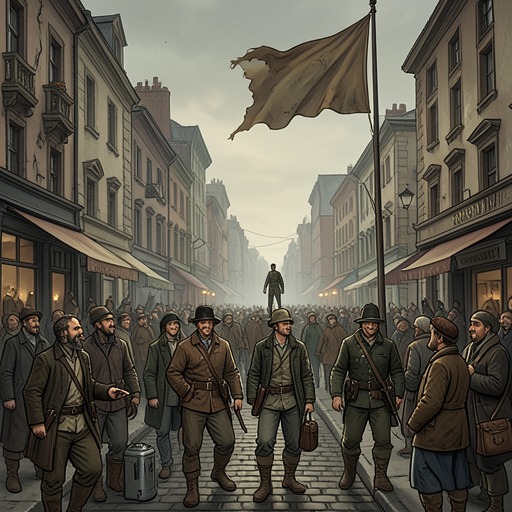
The military outcome is shown through the return of what remains of the army. At midnight, the gates of Paris are still blocked by fragments of a defeated force. The troops enter as a sullen, hungry, exhausted horde, initially quiet but increasingly chaotic as cavalry, artillery, infantry, officers, ambulances, and stragglers force their way through the gates. The army is no longer presented as an ordered national instrument; it has become a mass of damaged bodies and broken formations.
Civilians watch the procession in silence while ambulances continue arriving. By noon, the crowd around the gates has multiplied tenfold and covers the squares and inner fortifications. The spectacle makes the siege’s cost public: defeat is not an abstract change in military position but a procession of wounded men, exhausted animals, overloaded vehicles, and survivors unable to restore the order they once represented.
The defeat also accelerates civil disorder. At four o’clock German batteries suddenly cover themselves with smoke, shells fall rapidly on Montparnasse, houses in the rue de Bac are struck, and the first projectile then lands in the Latin Quarter. Buildings become unsafe, pillagers move among the wreckage, and residents must escape through improvised routes. Braith, West, and Colette flee through a damaged cellar and across gardens lit by burning buildings and shell flashes; they pass looters and people driven mad by drink and destruction.
The violence reaches its starkest point when Colette recognizes Hartman among a marching group near the barracks. Lantern light reveals his deathly face before the crowd moves on, followed by the clang of a volley. The scene compresses the siege into a brief sequence of recognition, disappearance, and gunfire: a person is identified only to be swallowed by military punishment and the larger collapse of the city.
Consequences and Narrative Significance
The Siege of Paris makes public disaster inseparable from intimate life. A woman’s work, a child’s hunger, a birthday dinner, a doctor’s rumor, and a friend’s attempt to reach home all continue beside the artillery. This structure prevents the war from remaining distant background. The siege enters domestic rooms through vibration and sound, enters the streets through scarcity and fear, and enters relationships through the constant possibility that someone will not return.
Its repeated sounds create a memory of collective trauma. Shells scream overhead, cannon roll across the city, rockets flare, bells mark the hours, and crowds repeat questions for which no one can provide certainty. Waiting recurs as the siege’s governing action: people wait for signals, for bread, for a sortie, for news, and for the guns to stop. The repetition changes waiting from a passive interval into a condition that governs thought, morality, and bodily endurance.
The event also supplies a historical counterweight to the book’s later American confidence. The future United States can describe war, military organization, and national prosperity in triumphal terms, but the Paris narrative preserves the costs that official history tends to smooth away. The siege is therefore both a military episode and a cultural archive of deprivation, exposing how quickly modern systems of defense and patriotic hope can fail when measured against hunger, cold, bombardment, and human exhaustion.
In the book’s final structure, the siege remains one of the experiences through which violence, memory, and identity are transmitted. Its armies may eventually disappear from the streets, but its sounds and images persist: the freezing city, the starving crowd on the bridge, the smoke over the fortifications, the shattered houses, and the remnants entering through the gates. Paris is not simply surrounded; it is transformed into a landscape where every private act bears the pressure of collective catastrophe.