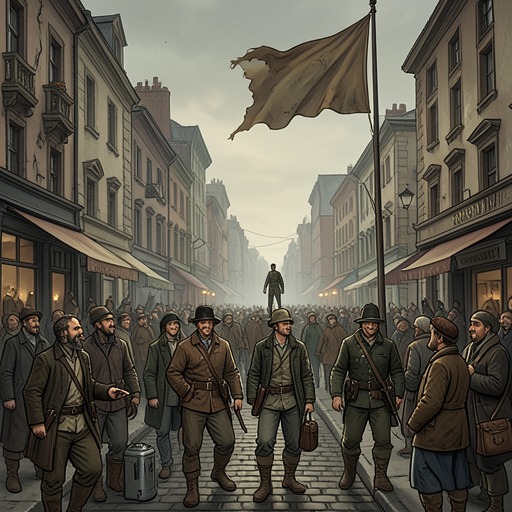
Street of the First Shell
The King in YellowStreet of the First Shell is a street in the Latin Quarter of Paris transformed by the siege into a register of bombardment and civilian endurance. Its defining mark is the child’s cinder inscription, “HERE FELL THE FIRST SHELL,” written on a bank wall after the fighting has torn open the surrounding quarter. The street is therefore both a physical location and a remembered point in the city’s catastrophe: an ordinary urban passage becomes a historical marker, a domestic threshold, and the route by which Jack Trent reaches Sylvia after fearing that the bombardment has destroyed their home.
Definition and Wartime Setting
Street of the First Shell appears under that name as the bombardment intensifies around Paris. The surrounding city is held in a bitter December cold: daylight disappears behind the high roofs, sleet powders the pavement, and the river and streets seem frozen into a hostile landscape. Sounds arrive from a distance as muttering and pounding, then sharpen into the metallic clatter of sabots, shutters, and rare human voices. The street belongs to this wider atmosphere of cold, deprivation, and suspended dread rather than to a stable peacetime neighborhood.
The siege makes distance within Paris newly measurable by artillery. A shell screams overhead, windows vibrate, and the inhabitants try to judge whether the next projectile has fallen nearby or passed toward Montmartre. The uncertainty is part of the street’s character: residents remain in their rooms, listening for trajectories they cannot control, while ordinary work and domestic conversation continue under interruption. The place is thus defined not only by masonry but by the altered soundscape and time-consciousness imposed by the guns.
The First Shell and the City’s Ruin
The street’s name acquires its literal explanation after the German batteries begin firing directly into Paris. By late afternoon, shells have struck Montparnasse, hit a house in the rue de Bac, and then reached the Latin Quarter. Later, as Jack Trent crosses the damaged quarter, the bombardment has ceased, but the entrance to the rue de Seine is blocked by smoking bricks. A café has become splinters and glass, a book-store is ripped from roof to basement, and a bakery bulges above slate and tin. The street is encountered as the aftermath of a process that has erased the ordinary businesses and landmarks used to navigate it.
On a bank wall beneath a shattered gas lamp, a child writes the words “HERE FELL THE FIRST SHELL” with a piece of cinder. The inscription converts destruction into a public record, but its childish execution also exposes the strange mixture of play, witness, and memorial created by the siege. The child who writes it is the same ragged rat-killer who has been hovering over a sewer opening and boasts that another rat is still inside. In this setting, the first shell and the killed vermin belong to the same compressed world of hunger, scavenging, and violence.
The title’s memorial gesture does not tame the destruction. When Trent passes the writing, the rat-killer sees his bayonet, screams, and flees; women engaged in pillage emerge from holes and crannies in the ruins, cursing him. The street is therefore occupied by frightened civilians, scavengers, and looters as well as by soldiers. Its destruction releases social disorder: buildings collapse, fires illuminate the route, and the debris becomes both shelter and evidence of the collapse of ordinary authority.
Route Through the Bombardment
The street is part of Trent’s urgent return journey. After hearing the city’s signals and the crowd’s expectation of a sortie, he has moved through a Paris described as waiting, sick, starved, freezing, and uncertain whether the army will attack or surrender. The bombardment grows furious, with the Prussian cannon rolling continuously and Mont Valérien answering with heavy shocks. Rockets flare above the horizon from the Fort of Issy, while the Fortress of the North burns like a bonfire. Against this military panorama, the Street of the First Shell gives the war a close, navigable scale: a corner, a wall, a fire, and a damaged house.
When Trent reaches the street, the danger is no longer only the shells. The pavement is torn by holes, the buildings burn, and pillagers move among the wreckage. He must climb over steaming bricks and cross a neighborhood that has become physically discontinuous. The route’s obstacles externalize his fear for Jack and Sylvia: each missing building and blocked passage threatens to turn the search into a final separation.
The larger military collapse reaches the same urban space. The gates of Paris are choked with remnants of an army, and exhausted troops, cavalry, artillery, ambulances, and disordered mobs stream through the city. Hartman is seen among a platoon near the d’Orsay barracks and disappears behind a volley, while fragments of the battle pass under the cry “Perdus! perdus!” The Street of the First Shell consequently lies within a city where front and home have ceased to be separate spheres. Military defeat enters domestic streets, and domestic survival becomes inseparable from the movement of troops and refugees.
Domestic Threshold and Survival
Trent initially cannot locate his house. Tears blur his sight as he feels along the wall, reaches the door, and sees the concierge dead beside the lantern in the lodge. The ascent is marked by successive signs of devastation: plaster covers the second-floor stairway, the third-floor landing is torn open and stained with the concierge’s blood, and the door of Trent’s own apartment hangs from its hinges while the walls gape apart.
The street’s decisive emotional turn occurs beyond that broken entrance. Trent creeps into the ruined room and collapses beside the bed; instead of finding Sylvia dead, he feels two arms around his neck and sees her tear-stained face seeking his. His cry of recognition and hers answer one another across the wreckage. The Street of the First Shell therefore carries him from public catastrophe into a private survival that the preceding journey has made nearly impossible to believe.
This reunion does not cancel the siege. The dead concierge, the ruined rooms, the fires, the looters, and the artillery remain embedded in the scene. Survival is presented as precarious and costly rather than secure. The street’s meaning lies in that contrast: it is the place where the first shell is recorded and where the consequences of later shells are endured, yet it also leads to the living presence of Sylvia.
Narrative and Thematic Significance
Street of the First Shell gives the Paris siege a durable local memory. The official dimensions of the conflict include batteries, forts, sorties, regiments, and the remnants of an army; the street reduces those abstractions to a cinder sentence on a wall. Its name preserves not a general account of the war but one precise impact, anchoring collective history in a visible urban trace.
The location also joins several forms of witnessing. The child records the shell, the inhabitants hear and endure it, the looters expose the breakdown of civic order, and Trent reads the ruined street while searching for the people he loves. The place makes the city itself a witness: walls, lamps, shops, pavement, and thresholds register what the characters cannot fully control or articulate.
Its strongest structural function is the movement from anticipation to confirmation. Earlier, residents listen to shells and argue about how near the danger is; later, the first shell is named, the street is shattered, and the threatened household is reached. The location thus turns siege suspense into a concrete geography of consequences. It embodies the war’s destruction while preserving the possibility that, beyond the ruined door, human attachment may still survive.