The Dragon's Court pursuit
The King in YellowThe Dragon's Court pursuit is the central supernatural action of the episode: while the narrator sits physically in the Church of St. Barnabé, a dead or transformed enemy hunts his soul through an uncanny architectural space. Its decisive significance lies in the collapse of ordinary perception. The narrator appears to escape the pursuer in the church, yet the pursuit has already reached him in another realm, where memory, guilt, death, and the geography of Carcosa become inseparable.
Origin in the Church
The pursuit begins during vespers at the Church of St. Barnabé. After the clergy leave the altar, the choir-boys settle in the stalls, and a Suisse in rich uniform leads Monseigneur C—— toward the pulpit. The organ has stopped, the congregation is resettling, and the church retains its disciplined, ceremonial order. This public ritual provides the ordinary setting against which the supernatural interruption becomes more disturbing: nothing in the surrounding scene prepares the narrator for an intimate attack directed specifically at him.
The narrator first notices the stranger emerging from behind the organ and moving along the gallery. The movement is impossible within the time available, since the narrator has watched the man leave and knows there has not been enough time for him to return without being seen. When the stranger reaches a point directly opposite, he fixes the narrator with a look of hatred described as intense and deadly. The encounter is not a conventional confrontation. No words are exchanged, and the stranger does not need to approach physically; his gaze establishes the pursuit as a force already operating beyond ordinary social rules.
The effect on the narrator is immediate and strangely emotional. He experiences the discovery that an unknown man hates him as a wound, with grief initially stronger than fear. The incongruity of the hatred then drives him toward explanation. The pursuit therefore begins not with a visible attack but with a crisis of recognition: an apparently meaningless expression becomes the sign of a connection the narrator has tried to keep outside conscious memory.
The Pursuit Through the Court
After the sermon, the narrator remains among the slowly departing congregation, intensely aware of small gestures and sounds. He sees the stranger again on the gallery and perceives only the thin, bent arm beneath its black covering. The figure resembles a devilish instrument from a medieval torture chamber, turning the body itself into an emblem of old violence. Although the narrator seems to have escaped the man in the church, that apparent escape is immediately undermined by the return of the remembered power associated with him.
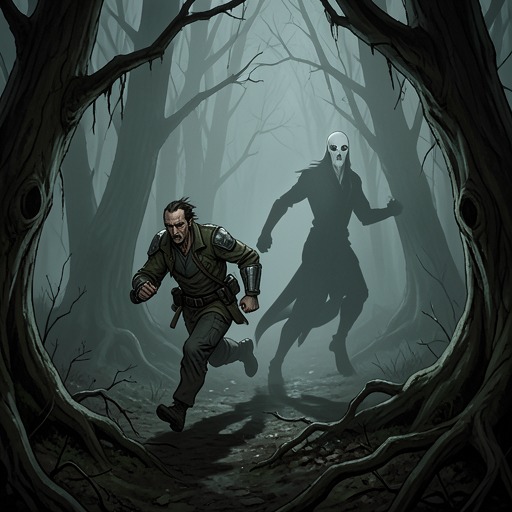
The narrator leaves the church and later reaches the court containing his apartment. The inhabitants have gone into the street, and the court is nearly deserted beneath a few dim gas lanterns. As he steps onto the threshold of the staircase, he looks back and sees the stranger ten paces away. The man has followed him into the court and advances directly toward him. Their eyes meet again, and the narrator understands that the decisive moment has arrived.
The narrator retreats backward, intending to escape through the entrance on the Rue du Dragon, while the stranger advances in perfect silence. The movement is slow enough to become oppressive but purposeful enough to deny escape. The court changes as the pursuit proceeds. What should be an ordinary passage toward shelter becomes an enclosed route into danger, and the narrator's apartment, which ought to offer refuge, is left behind as the destination shifts toward the street and then beyond the street's familiar reality.
At the apparent archway, the narrator discovers that the shadow is not an archway at all but a vault. The great doors on the Rue du Dragon are closed, their iron clamps cold and immovable. The architecture has become an active instrument of confinement: the vault, the sealed doors, and the darkness all favor the pursuer. With his back against the barred doors, the narrator can do nothing but defy the approaching figure. The pursuit thus reaches its physical climax as an escape narrative whose promised exit has been transformed into a prison.
Body, Soul, and Unreliable Space
The most important reversal occurs when the narrator realizes that the chase has not been taking place solely in the visible church or court. His body is still safe in the cheerful church, but the stranger has been hunting his soul in the Court of the Dragon. The narrative therefore separates bodily location from spiritual experience. The scene is neither simply a hallucination described from outside nor an ordinary pursuit with supernatural decoration; it is presented through the narrator's perception as a simultaneous event in two incompatible spaces.
The church's sensory details become gateways into that second reality. The organ breaks out overhead, a dazzling light fills the building, and the altar, arches, vaulted roof, and people disappear. In their place appear the black stars, the wet winds from Lake Hali, the moon dripping with spray, and the towers of Carcosa rising beyond it. The transition is not explained by a change of scene. It is an inundation in which sound and light erase the human setting and expose a cosmic landscape.
The pursuer's identity is finally understood through recognition rather than introduction. Death and the abode of lost souls have altered him for every other eye, but not for the narrator's. The narrator states that he recognized him almost from the first and that he had never doubted what the stranger had come to do. This knowledge makes the earlier strangeness retrospectively meaningful: the impossible return, the hateful gaze, and the sealed vault are stages in a punishment or reckoning whose cause lies in the narrator's past weakness.
Ending and Significance
The pursuit ends with the narrator's collapse beneath the intensifying radiance. He hears the stranger's voice swell through the flaring light as waves of flame pour over him, and then he sinks into the depths. The final whisper comes from the King in Yellow, who declares, "It is a fearful thing to fall into the hands of the living God!" The statement gives the chase a theological and judgmental force. The pursuer is not merely a hostile apparition; he is the agent or manifestation of a larger condemnation.
The event's structure resembles a pursuit, an escape attempt, a revelation, and a descent at once. Its first value shift is from ordinary safety to inexplicable hatred; its middle reversal turns apparent escape into continued captivity; its recognition scene reveals that the narrator already knows the pursuer and that the attack concerns the soul rather than the body. The final movement denies any return to normal life. The narrator does not reintegrate the supernatural experience into the civic, religious, or domestic world. Instead, the church is erased, the earthly architecture gives way to Carcosa, and the action concludes in spiritual submersion.
The Dragon's Court pursuit also gains force from its contrast with the surrounding institutions. The narrator has previously been confined by Dr. John Archer after falling from his horse and being judged insane, though the doctor later declares him cured. The episode repeats the problem of disputed sanity in a more terrifying form: the narrator's account is precise and self-aware, yet the world it describes obeys no stable physical logic. The ordinary church, with its clergy, choir, ceremonial officer, congregation, and organ, cannot contain the experience. The pursuit's lasting significance lies precisely in that failure of containment: a public religious space becomes the threshold to a private judgment, and the apparent protection of the body proves powerless against the claim made upon the soul.