The Yellow Sign
The King in YellowThe Yellow Sign is the story’s most concentrated recurring emblem: a mark whose possession appears to confer authority, whose recognition spreads dread, and whose final removal coincides with catastrophe. It is presented as both a physical sign and a force that reorganizes perception, binding the political fantasies of Hildred Castaigne to the private tragedy of Tessie Reardon and the narrator. Its decisive significance lies in this double function: the sign promises entry into a hidden order while exposing everyone who accepts or encounters it to that order’s violence.
Political Emblem and Instrument of Authority
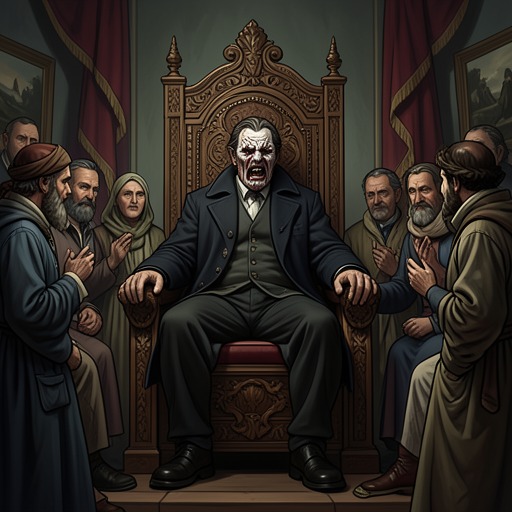
The Yellow Sign first appears within the manuscript and political scheme surrounding the Imperial Dynasty of America. Hildred Castaigne tells Osgood Oswald Vance that thousands of names have been recorded and that every person on the list has received the Yellow Sign, which no living human being dares disregard. In Hildred’s understanding, the sign is therefore not a private ornament but a command recognized by an entire civic structure. It is the token through which the imagined dynasty can make a city, a state, and the whole land rise before the Pallid Mask.
This political meaning is inseparable from Hildred’s claim to absolute legitimacy. After Mr. Wilde has instructed Vance in the genealogy and mythology of the Imperial Dynasty of America, Hildred argues that he alone deserves the crown and that his cousin must be exiled or die. He also insists that the cousin must never marry, especially not the daughter of the Marquis of Avonshire, because such a marriage would bring England into the question. The Yellow Sign supplies the imagined law behind these demands: it converts dynastic speculation into an authority capable of punishment. Hildred’s first writ of execution, signed as Hildred-Rex, is thus prepared in the same atmosphere in which the sign is treated as an inviolable summons.
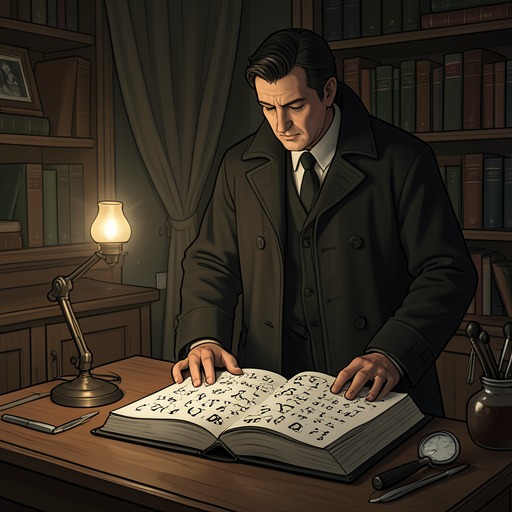
The emblem’s political force also derives from the mythology that Mr. Wilde attaches to it. His explanation moves through Carcosa, Hastur, Aldebaran, the Hyades, Cassilda, Camilla, Demhe, and the Lake of Hali before reaching the story of the Last King. The Yellow Sign is consequently placed at the intersection of genealogy, heraldry, cosmic geography, and imperial succession. It does not merely identify a faction; it makes the hidden history seem present and actionable.
The Sign as Recognition and Threat
The sign’s power depends on whether it is recognized. Hildred gives a blank piece of paper bearing the Yellow Sign to a starving outcast near the Lethal Chamber. The recipient looks at it stupidly, then folds it with exaggerated care and places it in his bosom. The gesture is ambiguous: it may indicate fear, reverence, or an obedience the recipient cannot articulate. The scene nevertheless establishes a recurring pattern in which the sign passes between people as though it were a message whose consequences exceed ordinary comprehension.
The same ambiguity appears when Hildred unfolds a scroll marked with the sign before Louis Castaigne. Louis sees the mark but does not recognize it, and Hildred angrily identifies it as the Yellow Sign. Louis’s casual response intensifies Hildred’s rage because it denies the emblem the authority Hildred believes self-evident. Recognition is therefore not a neutral act of reading. To Hildred, it is submission to a hierarchy; to Louis, the mark is initially an unexplained object; to the reader, the gap between those positions produces suspense.
The phrase associated with the sign returns as a verbal intrusion. After encountering the watchman’s muttering, the narrator hears the question repeatedly in his mind: "Have you found the Yellow Sign?" The exact words recur three times before sleep, and their repetition changes the event from a passing encounter into an obsession. The narrator first treats the question as an insult or meaningless provocation, but the memory becomes more distinct while he lies awake. The sign thus operates through delayed recognition: its meaning is not explained at once, but its recurrence makes ignorance increasingly untenable.
Gift, Attachment, and Forbidden Knowledge
For the narrator, the Yellow Sign becomes a tangible object when Tessie gives him a black-onyx clasp. A curious gold symbol is inlaid in the stone; it is neither Arabic nor Chinese and does not belong to any human script. At first, the clasp is framed as a modest keepsake, the only gift Tessie has to offer. The object’s emotional meaning therefore begins in intimacy rather than coercion. The narrator tells her that he will prize it and wear it always, and she fastens it beneath his lapel.
The clasp changes significance when the narrator and Tessie understand that the symbol is the Yellow Sign. Tessie begs him to throw it away, but he refuses despite being certain that he wishes to destroy it. His inability to remove the clasp is one of the sign’s most important effects: possession becomes compulsion, and a keepsake becomes an attachment that the will cannot master. The narrator cannot explain what prevents him from tearing the sign from his breast and casting it into the fire, so the object exposes a division between conscious intention and action.
The sign also accompanies the couple’s conversation about The King in Yellow. As they speak of the Pallid Mask, Hastur, Cassilda, the Hyades, the Phantom of Truth, and the Lake of Hali, ordinary domestic space is absorbed into the mythology surrounding the emblem. Their exchange makes the sign a threshold between knowledge and danger. Understanding appears to bring emotional and intellectual intimacy, yet that same understanding leaves them vulnerable to the force they have named.
The Watchman and the Final Pursuit
The sign’s threat becomes physical in the final sequence. A black-plumed hearse arrives outside the house while the narrator and Tessie sit together in the gloom. The narrator hears movement in the hall and believes that the approaching creature has come for the Yellow Sign. Although he bolts the door, he knows that locks cannot keep the visitor out. The sign’s authority has now become predatory: it is not merely carried by a person but serves as the object of a pursuit that disregards ordinary barriers.
The unseen visitor enters and envelops the narrator in a cold, soft grasp. The narrator struggles, but his hands are useless; the creature tears the onyx clasp from his coat and strikes him in the face. The removal of the sign is not liberation. It coincides with Tessie’s cry and the flight of her spirit, while the narrator falls and longs to follow her. The emblem’s final action therefore reverses the hope implicit in its role as a token of belonging: possession had been dangerous, but surrender is fatal as well.
The aftermath complicates the supernatural event without resolving it into a conventional explanation. The people in the house find one living person and two dead bodies, while the doctor admits that he has no theory or explanation for the decomposed corpse of the church watchman. The watchman’s body connects the muttered question, the pursuing creature, and the physical remains, but does not settle whether the supernatural account is literal, delusional, or both. The Yellow Sign remains the point at which testimony, evidence, and terror fail to coincide.
Narrative Function and Significance
As a recurring expression, The Yellow Sign organizes the story’s movement from public fantasy to private horror. It appears in Hildred’s revolutionary mythology, on the paper given to an outcast, in the confrontation with Louis Castaigne, in the watchman’s repeated question, on Tessie’s onyx gift, and in the final struggle. Each recurrence narrows the distance between symbol and event. What begins as an emblem invoked by an unstable political imagination becomes an object in the narrator’s home and then the apparent cause of death.
Its meaning is produced through contrast. The sign is opposed to blank paper, ordinary human scripts, rational explanation, locked doors, and the social world represented by the city outside. It is also opposed to the narrator’s desire to preserve the clasp and his later desire to destroy it. Because the story never supplies a stable translation of the symbol, its force depends less on a fixed dictionary meaning than on the reactions it provokes: obedience, anger, fascination, repetition, refusal, and terror.
The Yellow Sign also sustains the story’s uncertainty between psychological disturbance and supernatural intrusion. The narrator’s perceptions are shaped by obsession, exhaustion, and the disturbing literature associated with The King in Yellow, yet the decomposed watchman’s corpse gives the haunting a material residue that the medical authorities cannot explain. The emblem consequently functions as both a sign of mental capture and a possible instrument of an external power. Its final significance is not that it answers the mystery, but that it makes every attempted answer inadequate: once the sign has been seen, the boundary between interpretation and contamination has already collapsed.