The Yellow Sign watchman's attack
The King in YellowThe Yellow Sign watchman's attack is the decisive catastrophe of the narrator's confession: a hearse arrives at his house after he and Tessie Reardon have recognized the mystery surrounding the Yellow Sign, an unseen assailant enters despite every physical defense, tears the sign from the narrator's coat, and kills Tessie. The attack converts an atmosphere of literary and religious dread into an inexplicable material fact, while its aftermath leaves the narrator beyond human hope and exposes the church watchman's impossible death.
Causes and Ominous Background
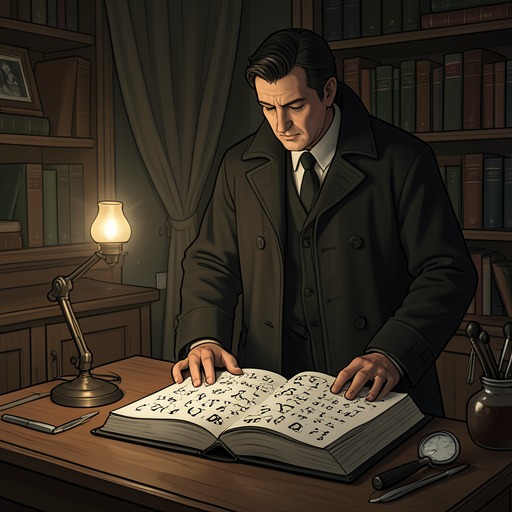
The attack follows the narrator's prolonged engagement with The King in Yellow. Exhausted and mentally disturbed, he and Tessie Reardon have been speaking about the King in Yellow, the Pallid Mask, Hastur, and Cassilda; the narrator wears a black onyx clasp inlaid with what they now understand to be the Yellow Sign. Tessie repeatedly begs him to remove it and throw it into the fire, and he is certain that he wishes to do so, yet he cannot bring himself to obey. His refusal makes the clasp more than an ornament: it becomes the object around which desire, fear, and compulsion converge.
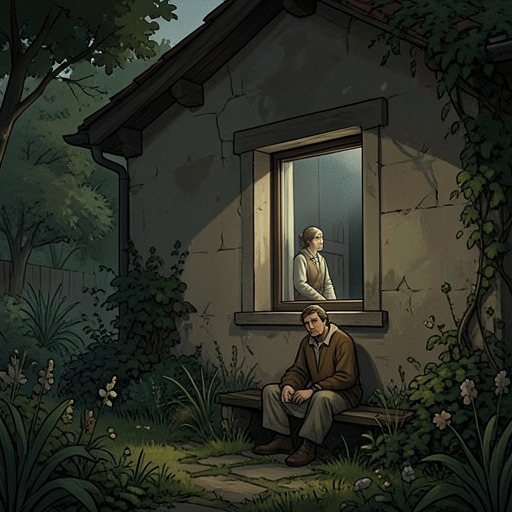
The immediate prelude is a moment of apparent understanding. In the silent house, Tessie and the narrator hold hands and exchange thoughts without speaking; they understand the mystery of the Hyades, and the Phantom of Truth has been laid bare. That recognition does not bring relief. Instead, the shadows stir, and a sound begins far away in the streets. The narrative turns knowledge itself into a summons: once the hidden meaning has been understood, the thing associated with it comes to claim its sign.
Course of the Attack
The approach is announced through sound before the attacker is seen. The narrator hears the dull crunching of wheels growing nearer through the mist, then stopping outside the door. At the window he sees a black-plumed hearse. The gate opens and shuts, and he retreats to his door, bolts it, and understands that ordinary locks cannot protect him from the creature coming for the Yellow Sign. The scene moves from public street to private house, but the house provides no meaningful refuge; its boundaries are crossed as easily as the barrier between the visible and invisible worlds.
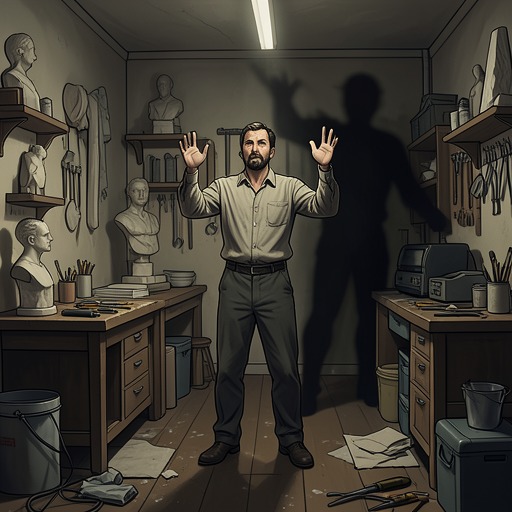
The intruder advances softly along the hall and reaches the door. The bolts rot at his touch, and he enters. The narrator cannot see him even when he comes into the room. The attack is therefore experienced first as contact rather than sight: a cold, soft grasp envelops him, and he struggles with deadly force while his hands prove useless. The assailant tears the onyx clasp from his coat and strikes him full in the face. The object that had seemed to bind the narrator through fascination is physically removed only through violence.
At the moment the narrator falls, Tessie Reardon cries out softly and her spirit flees. The narrator longs to follow her, believing that the King in Yellow has opened his tattered mantle and that there is now only God to call upon. The assault consequently joins three forms of violation: the breach of the locked house, the seizure of the Yellow Sign, and the destruction of the narrator's closest human bond.
Discovery and Immediate Consequences
The narrator survives long enough to write his confession, but he is past human help or hope. A doctor gathers his powders and phials while a priest is beside him, and the narrator understands the doctor's vague gesture without needing an explanation. His account is framed as testimony written at the edge of death, with medical authority and religious authority present yet unable to reverse what has happened.
The household's other witnesses know only the visible outline of the tragedy. After an infernal scream, people rush into the room and find one living person and two dead bodies: Tessie Reardon and the church watchman. The narrator emphasizes that outsiders, newspapers, and investigators may reconstruct the scene but cannot cross the boundary of the confessional. The attack thus produces both a public mystery and a private revelation that the narrator claims cannot be transmitted to the outside world.
The most concrete and disturbing consequence is the condition of the watchman's body. The doctor points to a horrible decomposed heap, a livid corpse on the floor, and admits having no theory or explanation. He says that the man must have been dead for months. The corpse is therefore both the apparent attacker and a contradiction of the attack's immediate chronology: the being that entered the house and tore away the clasp has acted in the present, while the body identified as the church watchman has already been decomposing for a long period.
Religious and Gothic Structure
The event is set against religious imagery that intensifies rather than resolves the horror. Earlier, the Church of St. Barnabé contains vespers, clergy, choir-boys, a uniformed Suisse, and Monseigneur C——, while its organ music seems to pursue an escaping victim beneath the surface of the service. The church's ordered ritual and the watchman's later intrusion create a sharp contrast between sacred enclosure and profaned return. The watchman is associated with a church, yet he arrives through fog with a hearse and becomes the agent of a force that ordinary Christian protections cannot hold back.
This opposition between ritual and invasion recurs elsewhere in the book's supernatural imagery. In The Demoiselle d'Ys, a traveler falls before a crumbling shrine for Our Mother of Sorrows and reads the memorial to Jeanne d'Ys after the enchanted court disappears; in The Sacrifice, a woman pours blood over flowers and declares that she has killed the man she loved. Those scenes connect religious signs, death, and sacrificial exchange, but the watchman's attack gives the pattern its most compressed form: a hearse replaces procession, the locked room replaces sanctuary, and the final appeal to God comes only after the monstrous visitation has already taken its human victim.
Narrative Frame and Significance
The attack is presented through the narrator's first-person confession, written while he is dying, so the event remains deliberately unstable between eyewitness testimony and a report shaped by delirium. The narrator openly concedes that he cannot explain what happened, while the doctor supplies a material fact that is no less impossible than the supernatural account. This withheld explanation is central to the event's force: the reader receives the consequences—Tessie dead, the watchman decomposed, the narrator dying—without a rational mechanism that can reconcile them.
Its decisive value shift is from shared recognition to irreversible loss. The narrator and Tessie begin the sequence united by their understanding of the Yellow Sign, holding hands and answering one another silently; the hearse's arrival transforms that intimacy into separation and death. The sign is removed, but removal brings no release. Instead, the narrator loses Tessie, loses physical control of his own body, and loses access to ordinary explanation. The attack therefore functions not merely as a shock scene but as the point at which fascination becomes possession, interpretation becomes catastrophe, and the private world of the confession closes against the curiosity of the living.