War state
The King in YellowWar in the narrative is not merely a contest between armies but a condition that reorganizes public life, private feeling, and the meaning of survival. It appears as official history, as bombardment heard through domestic walls, as hunger and cold in the streets, and as the disintegration of military order at the gates of Paris. Its decisive significance lies in the contrast between orderly governmental rhetoric and the bodily, chaotic experience of those who endure its consequences.
Political Background and the Illusion of Stability
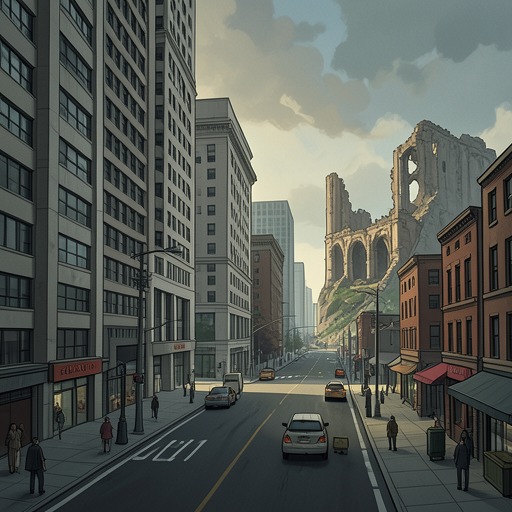
The American account of war is framed by an apparently tranquil national future. By the end of 1920, the United States had recovered from its war with Germany over the Samoan Islands, forgotten the temporary occupation of Norfolk, and taken pride in naval victories and the collapse of General Von Gartenlaube's forces in New Jersey. Military preparedness had become a central guarantee of prosperity: the army had grown to 300,000 men with a territorial reserve of one million, while six squadrons of cruisers and battleships patrolled the navigable seas.
That stability is defined against a wider international catastrophe. Germany, Italy, Spain, and Belgium are described as suffering under Anarchy while Russia watches from the Caucasus and subdues them one by one. The United States therefore appears secure not because war has disappeared, but because military organization, territorial power, and centralized government have kept its violence at a distance. The same historical account presents urban reconstruction, parks, underground railways, and public institutions as signs that national order has survived the international collapse.
The chronology makes war part of a continuing political transformation rather than an isolated crisis. The dismantling of New York's Elevated Railroads occurred in 1899, the Removal of the Dodge Statue followed in 1900, and the repeal of laws prohibiting suicide eventually produced the first Government Lethal Chamber on April 13, 1920. Against this background, the government's claim to manage death appears as another extension of the authority that manages war: both convert individual suffering into an administrative problem.
Bombardment and Domestic Life
In the Paris narrative, war enters the home through sound before it becomes visible. A loud humming makes the windows vibrate, and a shell screams across the sky while a girl works on a baby garment in the gathering darkness. Her interrupted sewing gives the siege an intimate scale: the future represented by the garment is repeatedly placed beside the immediate threat of destruction.
The surrounding city is subjected to a physical pressure that reaches beyond spectacular explosions. Bitter cold turns yesterday's slush to flint, makes every street sound metallic, and renders breathing painful and movement difficult. The winter atmosphere spreads through Paris, from the river and bridges to the squares, avenues, palaces, and narrow streets of the Latin Quarter. Cold, darkness, sleet, and artillery do not form separate hardships; together they create an environment in which the city itself seems to bear the weight of the siege.
The war also produces a brutal economy among the poor. On an almost deserted street, women wrapped in tattered military capes move through the freezing city while a badly dressed gamin hovers over a sewer hole with a still-warm, bleeding rat hanging from the rope around his waist. He reports that another rat remains below and asks Trent how much he will pay. The scene reduces food, commerce, and human dignity to the exchange value of scavenged vermin, revealing deprivation more starkly than a military report could.
Public Expectation and the Siege Mentality
The besieged population lives by waiting for uncertain signals. As bombardment intensifies, people gather in the streets, shivering and talking with sunken eyes, while rockets flare above the horizon and the fortresses burn like bonfires. The spectacle of war becomes a public event, but the crowd does not know whether the signals announce a sortie or another stage of starvation.
A man's description of the Parisians captures the moral pressure of the siege: they are sick, starved, freezing, and still waiting; if ordered to make a sortie, they go willingly, and if required to starve, they starve. The question of whether they are heroes is less a settled judgment than an expression of exhaustion and disbelief. War has narrowed the available choices until obedience to danger and submission to hunger appear as equally compulsory forms of endurance.
Trent occupies a conflicted position within this atmosphere. He anticipates the coming action as slaughter and is relieved that he is not going, yet he remains physically present among those waiting for news. His response exposes the gap between the language of heroism and the instinct for self-preservation. The siege makes spectatorship impossible to keep morally separate from participation: even those outside the assault are implicated by the hunger, fear, rumors, and collective expectation surrounding it.
Collapse at the Gates of Paris
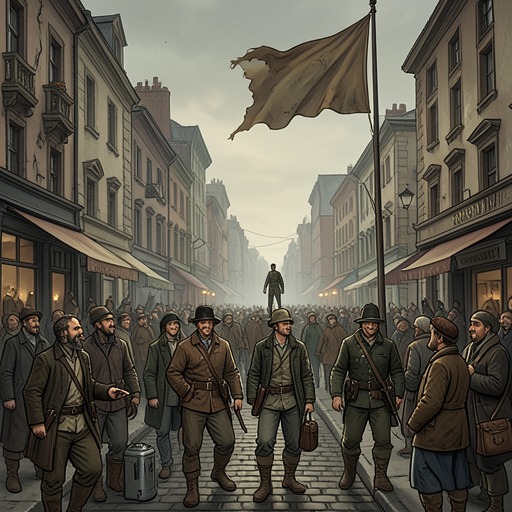
When midnight sounds from the belfry of St. Sulpice, the gates of Paris are still blocked by fragments of what had once been an army. The returning forces enter as a sullen, exhausted mass, initially quiet but increasingly confused as cavalry, artillery, infantry, ambulances, officers, and men without officers struggle for passage through the freezing streets. The sequence replaces the ideal of an army with a damaged social body whose former divisions no longer guarantee order.
The crowd watches the returning troops in silence as the military remnants become a spectacle of misery. A skeleton of a regiment attempts to preserve formation beside riotous Mobiles, plunging horses, jolting caissons, and ambulances whose wheels groan under their loads. The repetition of military units and broken formations gives the retreat a cumulative force: defeat is not represented by one decisive image but by the prolonged arrival of bodies and machines that can no longer function as an army.
The collapse spreads beyond the gates into the city's streets. Braith, West, and Colette escape through a damaged cellar while fires and shell flashes illuminate buildings and pillagers move among the debris. They encounter drink-crazed women and men marked by blackened faces and hands, evidence that destruction has created its own predatory population. At the Seine, Braith turns back because he is unsure of Jack and Sylvia, while the others witness Hartman's passage behind a file of bayonets and then hear a volley from the barracks. The war's violence is therefore both external and institutional: civilians loot and rage amid ruins, while military authority carries out a controlled execution.
The defeated procession ends in a cry that travels through the city: lost, lost. Trent then emerges from the ragged ranks, white with terror, and West recognizes him with a cry. The encounter makes the battlefield's consequences personal without restoring order. Recognition briefly reunites individuals, but it cannot reverse the annihilation represented by the returning battalion.
War as a Total Social Condition
The narrative places military spectacle beside churches, hospitals, government ceremonies, studios, and domestic rooms, showing that war changes every institutional setting it touches. In the United States, military display surrounds the Lethal Chamber's inauguration: lancers form a hollow square, hussars guard the tribune, and senior civil, military, naval, police, and medical officials gather beneath the rhetoric of state management. In Paris, by contrast, church ritual continues amid an atmosphere whose order is fragile, while the city's streets become corridors for soldiers, refugees, scavengers, and the dead.
Even spaces apparently devoted to art and education retain the pressures of social conflict. At Julian's, students fight over places, palettes, brushes, portfolios, bread, and cigarettes; unpaid students are hunted down, and cries for Jules rise when the internal revolution becomes acute. The studio is not a battlefield, but its scarcity, quarrels, and improvised authority reproduce the siege's larger pattern: competition for resources, unstable hierarchy, and temporary peace imposed by a mediator.
War consequently operates both as an event and as a durable structure of feeling. It is heard in the shelling, measured in hunger and cold, announced through rumors, embodied in wounded or exhausted people, and rationalized by officials who promise that organized violence will preserve society. The contrast between those registers is central to its force. Public order may describe war as policy, victory, or national defense, but the scenes in Paris reveal its deeper result: the remaking of time, space, appetite, loyalty, and identity under conditions in which survival itself becomes the dominant political fact.