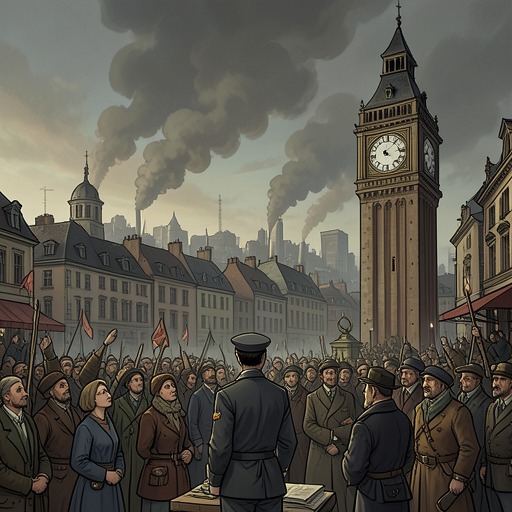
War with Germany over the Samoan Islands
The King in YellowThe War with Germany over the Samoan Islands is the geopolitical conflict that helps establish the alternate United States of The King in Yellow. Germany’s seizure of the Samoan Islands provokes war, while the territory’s later value as a coaling station turns the conflict into both a military episode and an imperial investment. By the end of 1920, the war has been absorbed into an official narrative of prosperity, preparedness, and national success, even as the book’s wider scenes expose the violence and instability beneath that confident public order.
Causes and Strategic Context
The immediate cause of the war is Germany’s seizure of the Samoan Islands. The American response is presented as successful rather than traumatic: the conflict has left no visible scars upon the republic, and the temporary occupation of Norfolk by the invading army has been forgotten amid repeated naval victories and the later collapse of General Von Gartenlaube’s forces in the State of New Jersey. The language of recollection is deliberately reassuring, turning invasion and battle into facts that prosperity has supposedly rendered harmless.
Samoa is not treated merely as territory recovered from an enemy. Its strategic value is explicitly affirmed as worth the cost of the war because it serves as a coaling station. The conflict therefore belongs to a larger history of expansion in which military victory, overseas investment, and naval logistics reinforce one another. The United States emerges not chastened by war but strengthened by the possessions and infrastructure that war has secured.
Military Consequences and National Preparedness
The war is one of the reasons the United States can be described as being in a superb state of defence by the end of 1920. Every coastal city has received substantial land fortifications. The army, organized under the General Staff according to the Prussian system, has grown to 300,000 men, supported by a territorial reserve of a million. Six squadrons of cruisers and battleships patrol the navigable seas, while a steam reserve remains available to control home waters.
These details give the war a continuing institutional afterlife. Although the conflict itself is no longer a daily subject of public anxiety, its lessons have been translated into permanent military capacity. Naval victories are remembered as evidence of national competence, and the army and fleet become visible instruments of a state that believes security, expansion, and administrative efficiency can be engineered together.
Official Memory and the Politics of Prosperity
The war is recalled in a retrospective account of a country that appears tranquil, prosperous, and orderly. The narrator places it beside the successful settlement of the Tariff and Labour questions, profitable Cuban and Hawaiian investments, the rebuilding of Chicago after the Second Great Fire of Chicago, and urban improvements in New York. Within this catalogue, the war becomes one achievement among many in a national story of modernization.
That calm retrospective frame is significant because it contrasts with the book’s later representation of wartime life in Paris. In the Paris siege narrative, cold enters homes and streets, food is scarce, people wait while sick, starving, and freezing, bombardment rolls across the city, and shattered troops return through the gates. The American war is not shown directly in comparable scenes; instead, it is filtered through triumphal public memory. The contrast suggests that national narratives can preserve victory while suppressing the human texture of conflict.
Relation to the Book’s Political World
The conflict helps define the political world in which the Government of the United States can regulate life and death with extraordinary confidence. In the same future society, the laws prohibiting suicide have been repealed, and the Government establishes a Lethal Chamber in every city, town, and village. At its inauguration in New York, the Governor presents state-managed death as a public benefit and declares the chamber open before military and civic authorities.
This juxtaposition makes the war part of a broader pattern of centralized power. Military organization, imperial acquisition, public works, and the administration of death all belong to a state that claims to have solved disorder through planning. The war with Germany over the Samoan Islands supplies the victorious precedent: external conflict is converted into stronger institutions at home and greater strategic reach abroad.
Historical and Narrative Significance
The War with Germany over the Samoan Islands functions less as a fully dramatized campaign than as a foundational fact of the alternate history. Its decisive effects are political and ideological: Samoa becomes a useful imperial possession, naval victory validates expansion, and the United States acquires the confidence to imagine itself secure, prosperous, and globally organized. Yet the retrospective serenity surrounding the war is unstable. The wider work repeatedly places polished institutions beside madness, execution, siege, hunger, and death, making official success appear less like a final resolution than a surface under which violence continues to circulate.