laws prohibiting suicide
The King in YellowThe laws prohibiting suicide define the boundary between private despair and public authority in the imagined political order of the narrative. Their repeal does not simply decriminalize self-destruction; it authorizes the Government to recognize death as a possible remedy for physical suffering and mental despair, then places that remedy inside a disciplined national institution. The result is a stark inversion of older law: the state no longer threatens punishment for an attempt at self-destruction, but offers a painless death and invites those who can no longer endure life to seek it under official supervision.
Legal Repeal and Historical Development
The repeal emerges from a broader movement toward centralized administration and social calm. The narrative describes the agitation for repeal as beginning in the winter after the removal of the Dodge Statue in 1900, with the campaign finally bearing fruit in April 1920. The change is therefore presented as the outcome of a long political process rather than a sudden response to one individual crisis. Its culmination is the establishment of the first Government Lethal Chamber on Washington Square in New York.
The law is framed as a measure of collective policy as much as individual liberty. The Governor states that the former laws, which prohibited suicide and punished attempts at self-destruction, have been repealed because the Government acknowledges a person's right to end an existence made intolerable by bodily suffering or mental despair. He further claims that the community may benefit when such people are removed from its midst. This language places compassion and social exclusion side by side: the person in despair is offered relief, yet is also described as someone whose continued presence burdens the community.
The Government Lethal Chamber
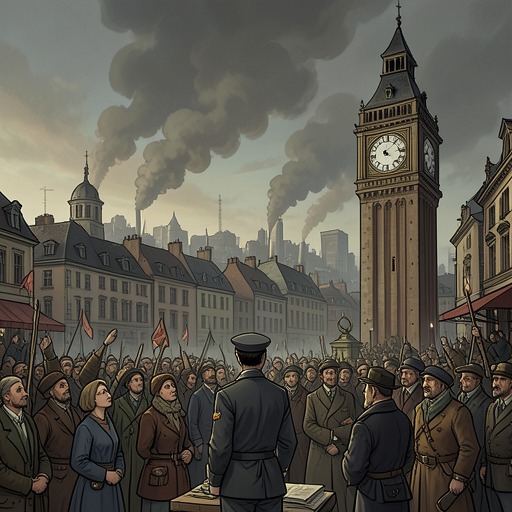
The legal principle becomes concrete at the inauguration of the Lethal Chamber on Washington Square. The ceremony is surrounded by military and civic authority: United States lancers form a hollow square around the building, hussars guard the tribune, and the Governor appears with the Mayor of New York and Brooklyn, senior police and military officers, naval command, medical officials, senators, and the Commissioner of Public Works. The institution is thus introduced not as a private clinic or charitable refuge, but as a national project displayed through the full pageantry of government.
The Governor's speech presents the Chamber as a controlled alternative to unregulated suicide. He says that, since the repeal, the number of suicides in the United States has not increased, and announces that a Lethal Chamber is to be established in every city, town, and village in the country. The policy therefore combines statistical reassurance with administrative expansion. By distributing the institution throughout the nation, the Government seeks to make authorized death accessible everywhere while also making it visible, standardized, and governable.
The ceremony ends with a formal declaration that the Chamber is open. The Governor turns toward the white structure, declares that a painless death awaits anyone who can no longer bear life's sorrows, and invites such a person to enter if death is welcome. He then proclaims the Lethal Chamber open before the assembled citizens. The crowd remains silent until military commands break the hush; the procession departs, leaving the narrator to contemplate the white marble Death Chamber as an object of public astonishment.
Social Meaning and Contradictions
The repeal is governed by a contradiction at the heart of the new order. It is described as humane because it removes punishment and provides painless relief, but it also institutionalizes the judgment that certain lives are better removed from the social body. The law recognizes a right while simultaneously classifying its potential users as a desponding class from whose ranks victims of self-destruction have traditionally fallen. Its compassion is therefore inseparable from management: suffering becomes a condition to be processed by the state.
The public inauguration intensifies this contradiction. The Chamber promises privacy-like relief from unbearable existence, yet its opening is a spectacle of lancers, hussars, governors, generals, admirals, senators, and police. Death is made peaceful inside the institution but ceremonious outside it. The contrast suggests that the state's claim to mercy depends upon demonstrating its power to define, authorize, and organize the boundary between life and death.
Relation to Insanity and Institutional Authority
The law's political logic parallels the narrative's treatment of mental illness. The narrator has previously been confined by Dr. John Archer after a fall from a horse, when the doctor judged his brain affected and placed him in a private asylum for insanity. Although the narrator insists that his mind was sound, the medical authority's mistake deprived him of ordinary freedom until he was declared well. The Lethal Chamber belongs to the same institutional world in which experts and officials decide which forms of suffering require confinement, treatment, removal, or release.
Other scenes sharpen the instability of such judgments. Mr. Wilde is repeatedly regarded by others as insane despite the narrator's conviction that he is as sane as anyone else, while Vance appears as a terrified man who says he had been in a madhouse and fears that he will go mad again. The text therefore places legal reform beside unreliable distinctions between sanity and insanity. A government that claims to identify intolerable suffering may be compassionate, but the narrative's surrounding episodes warn that institutions can misread the mind and convert contested judgments into coercive action.
Narrative and Political Significance
The laws prohibiting suicide mark a decisive transformation in the story's imagined United States. Their repeal is part of a program that claims to produce national calm and prosperity, yet the policy's most visible symbol is a chamber devoted to death. The new law presents itself as rational progress, but its ceremonial language and militarized setting reveal how closely humanitarian administration can approach sovereign power.
The rule also forms a structural contrast with the private violence elsewhere in the narrative. Mr. Wilde's world turns imperial fantasy into execution orders, knives, threats of exile, and claims over who may inherit a crown; the Government's world turns despair into a legal procedure. In both cases, powerful authorities decide whose life may continue and whose death can be justified. The difference is that the Lethal Chamber gives such power a public, medical, and legal vocabulary.
By the time the first Chamber opens, death has ceased to be merely a prohibited act or a personal catastrophe. It has become an official service, a declared right, and a tool of social policy. The law's significance lies precisely in that ambiguity: it appears to liberate individuals from punishment while extending the state's authority over the most intimate decision a person can make.