
The White Rose and Political Memory
The King's CurseThe white rose connects Margaret’s private family identity to public memories of Yorkist legitimacy and to the hopes of those who oppose Tudor policies.
increasing Bearing strength in each event
 decreasing
Bearing strength in each eventdecreasingA Name Hidden by Marriage

Concealed Identity
The Pole Name
Margaret uses her married name to avoid openly declaring her Plantagenet birth. Her brother’s execution reminds her that the white rose can rally supporters and attract danger.
A Private Emblem
She keeps her identity alive inwardly, even as she performs the role of a modest Tudor servant. Concealment cannot make her forget the family she represents.
Restoration in Public
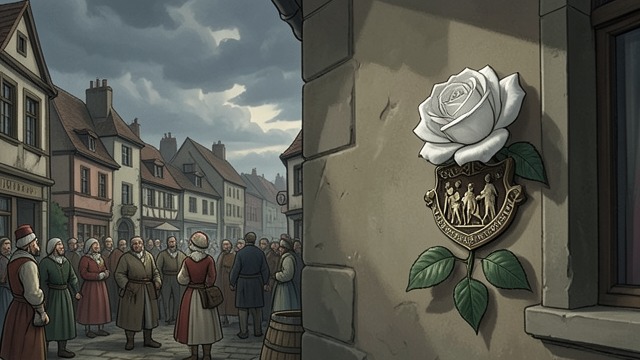
The Rose Displayed
Arms and Estates
After Henry restores her lands, Margaret places her family arms across her houses. The white rose publicly declares that her brother was no traitor and her family remains honorable.
A Political Signal
The emblem is more than decoration: it recalls the old royal line and the possibility that Plantagenet descendants might again matter in national affairs.
A Badge for the Pilgrims

The Five Wounds and the Rose
A Shared Token
Thomas Darcy gives Margaret a badge combining the Five Wounds of Christ with the white rose. She keeps it as a symbol of faith and family identity.
Political Affiliation
During the Pilgrimage of Grace, the badge connects the old royal house to the rebels’ religious cause. Margaret’s private keepsake becomes evidence when the government searches her home.
À Warwick in the Streets

Public Memory Survives
A Welcome in Peterborough
After Katherine’s funeral, residents cheer Margaret and invoke the old Warwick cry. Their response shows that the Yorkist past has not disappeared from popular memory.
A Threat to Henry
The crowd’s affection for the former queen and white rose alarms the government. Margaret understands that public memory can challenge the king even without a formal rebellion.
The Badge as Evidence

A Symbol Criminalized
Cromwell’s Display
Thomas Cromwell presents the embroidered badge at Parliament as evidence of Margaret’s treason. No specific crime is proved, but the symbol helps justify her imprisonment.
Meaning Reversed
The white rose once announced family honor and hope; now the Crown presents it as proof of conspiracy. Margaret’s identity is turned against her by the power that fears it.
1499 to 1502
1512 to 1518
1532 to 1536
January 1536
Summer 1539
