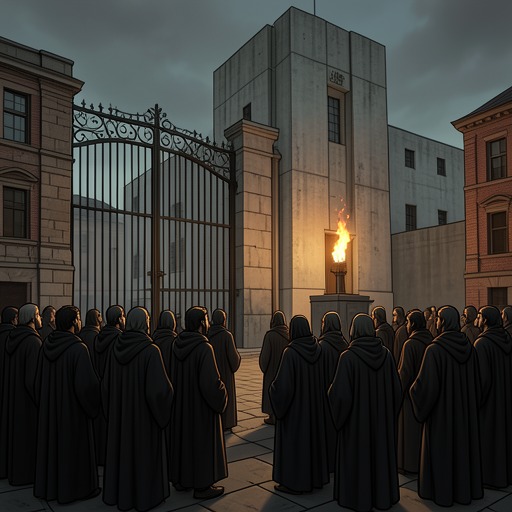
Arrest and Execution of Edward Stafford, Duke of Buckingham
The King's CurseThe arrest and execution of Edward Stafford, Duke of Buckingham, turn on a prophecy, a contested chain of testimony, and the collapse of an expectation that kinship and loyal service would protect a powerful courtier. Buckingham was accused of treason after reports associated him with a prophecy favoring his own accession and predicting that Henry VIII would have no legitimate male heir. Henry refused to pardon him. For Margaret Pole, Buckingham’s death exposed how quickly royal affection could yield to fear, while his family’s punishment showed both the reach and the limits of the king’s suspicions.
The Prophecy and the Accusations
The reported prophecy was said to be kept in the library at Sheen Priory. It foretold that people would acclaim the duke as king and that Parliament would offer him the crown, as it had offered the crown to Henry Tudor. A further allegation was that Buckingham had called the king accursed and predicted that he would have no legitimate son and heir. These were reported claims, not something Margaret witnessed him say. She learned of them from Sir Thomas, who also relayed an allegation that one of the queen’s ladies had spoken of a curse on the Tudor line and the absence of a son.
The identity of that lady mattered to Margaret. She feared that the accusation might implicate someone close to her family, and asked whether her daughters had said anything of the kind. Sir Thomas told her that neither daughter was named: the evidence came instead from Buckingham’s confessor, steward, and servants. Margaret insisted that a confessor could not repeat what had been said in prayer. She was told that Thomas Wolsey now held that a priest’s duty to the king outweighed his oath to the Church. In her account, the disputed testimony therefore involved more than the truth of the alleged words: it also raised the question of whether a sacred obligation could be set aside to furnish evidence against a political rival.
Arrest and Royal Judgment
Buckingham was arrested and held in the Tower on a charge of treason. Margaret’s account connects Wolsey’s gathering of evidence to a long struggle for the king’s favor and attention. She understood the cardinal’s role as a campaign against a rival, and saw the confessor’s testimony as part of that effort. The book does not establish that every allegation was true; it presents them as accusations carried through servants and other witnesses, under a changed interpretation of the confessional oath.
The outcome nevertheless became clear. Thomas Howard, Duke of Norfolk, Buckingham’s friend and kinsman, pronounced the sentence of death. Margaret recalls that those around the duke expected a pardon until the last moment, because Buckingham was Henry’s kinsman and constant companion. He had also been the greatest duke in the realm, a favorite of the king’s grandmother, and one of Henry’s leading courtiers and supporters. None of those connections secured his release. Henry sent him to the scaffold as an enemy rather than sparing him as a relative and former ally.
Execution and the Family’s Fate
The execution did not bring the same fate upon every member of Buckingham’s family. His son was attainted and lost both his fortune and dukedom, but was released. Margaret’s son Montague was also released without charge. The family was banished from court during a moment of fear, yet, as Margaret later observes, Henry did not continue pursuing suspicion through the generations. Once the family was out of sight, the king returned to calmness; Margaret hoped that he would eventually summon her back to court and allow her to return to Princess Mary.
This distinction shapes Margaret’s account of the aftermath. Buckingham paid with his life, while his son and Montague survived, though the loss of status, wealth, and access to court remained consequential. Margaret does not claim that the king’s restraint erased the damage or made the arrest just. Rather, she contrasts Henry’s temporary fear and banishment of the family with the more persistent punishments she associates with his father’s rule. The episode leaves the family alive but newly aware that their security depends on the king’s changing judgment.
Margaret’s Response and the Event’s Significance
Margaret says that she made no defense of Buckingham and remained silent. Looking back, she wonders whether she too should be blamed for what she and others saw as a new shadow falling over Henry. As he turned thirty, she perceived him becoming harder in both appearance and feeling. She imagines Buckingham as an accidental victim of that change: a proud, confident man who, in her interpretation, touched Henry’s concealed fear that he was not good enough. This is Margaret’s explanation of the king’s decision, not proof of his private motive; its force lies in the contrast between the warmth she remembers and the execution she witnessed.
The event also unsettles Margaret’s earlier ideal of Henry as a golden prince who could do no wrong. She admits that such an expectation placed too high a demand on any young man, but continues to hope that the king she loved as a child will recover his former warmth. Her uncertainty gives the execution a lasting importance beyond Buckingham’s fate. A courtier once celebrated as kin, companion, and supporter could be condemned despite the expectation of mercy, while the surviving family had to measure every return to court against the possibility of renewed suspicion. In Margaret’s narrative, the execution is at once a personal loss and an early sign that royal affection could no longer be relied upon as protection.