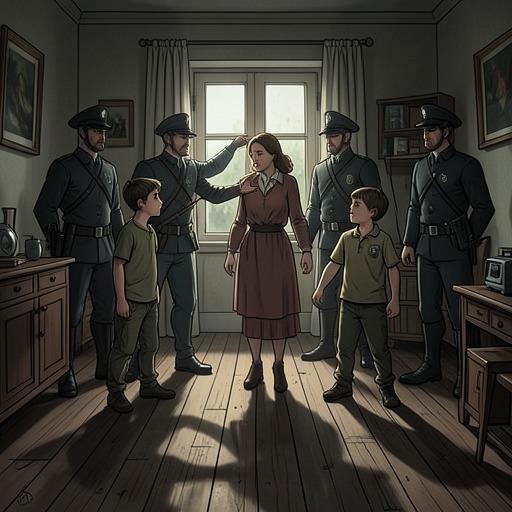
Arrest of Hugh Holland
The King's CurseThe Arrest of Hugh Holland is a sudden act of royal force witnessed by Margaret Pole and Geoffrey Pole in the summer of 1538. The king’s men take the London corn merchant from Montague’s household without explaining why, leaving Holland bound and injured, Geoffrey alarmed, and the family unable to demand an account of the arrest.
Encounter on the Road
Margaret and Geoffrey are riding toward Montague’s home at Bockmer House when a mounted royal guard comes rapidly along the highway. Twelve armed men, wearing breastplates and carrying swords and lances, surround a prisoner whose hands are tied behind him and whose feet are lashed beneath his horse. His jerkin is torn at the shoulder, and a bruise darkens his cheekbone. The pace jolts him as he struggles to hold on to the horse’s crupper.
Geoffrey recognizes him as Hugh Holland. The king’s men ride past without slowing, and their captain gives Margaret’s party a suspicious look, as if he suspects they might try to rescue the prisoner. Margaret raises a hand in acknowledgment of the captain’s authority. Seeing her standard and her men’s livery, Holland calls to Geoffrey that Geoffrey will come after him. The escort has already passed before Geoffrey can answer.
Arrest at Bockmer House
At the house, the family learns the immediate circumstances of Holland’s seizure. The king’s men broke tables, settles, and benches in the great hall while arresting him. Holland fought back and ran around the hall as they pursued him. The scene’s disorder contrasts with the controlled speed of the escort on the road: the arrest has disrupted the household before its purpose has been made clear.
Margaret’s daughter-in-law Jane retreats to her private room in tears. Montague oversees the servants as they set the tables back up and tries to make light of the disturbance, though Margaret can tell that he is shaken. Geoffrey bursts in demanding to know why Holland has been taken and what reason the king’s men gave.
An Unexplained Seizure
Geoffrey says that Cromwell had been satisfied and that they had explained matters. His protest conveys the family’s belief that Holland’s case had already been addressed, but the arrest shows that this apparent resolution has offered no protection. Margaret suggests that the seizure might concern something else, though she doubts it, and proposes asking Montague.
Montague’s answer makes the limits of their position plain: the king’s men do not have to give a reason. The account does not disclose the charge against Holland or what becomes of him after the escort carries him away. Instead, it fixes attention on the arrest’s immediate effects: a bruised and bound prisoner, a damaged hall, and a household left to restore its furniture while the authority behind the seizure remains unanswered.