Badge of the Five Wounds and White Rose
The King's CurseThe Badge of the Five Wounds and White Rose is an embroidered emblem that joins the suffering of Christ to the dynastic identity of the narrator’s family. Lord Thomas Darcy gives it to her as political and religious danger gathers around the court. First intended for a crusade that came to nothing, the badge survives as a kept token of an unrealized mission; later, laid flat on a table, it becomes the focus of a family oath of secrecy.
Design and making
The badge is embroidered with two hands whose palms bleed, two stabbed and bleeding feet, and a bleeding heart. Above these wounds sits a white rose, arranged like a halo. The image places the Passion of Christ and the White Rose of York within a single design. The narrator is struck both by the quality of the work and by the way its imagery links Christ’s suffering with her house.
The emblem was made when Lord Thomas Darcy was planning an expedition against the Moors. He recalls it as a crusade, a mission that came to nothing, and explains that he had this particular badge made for the narrator’s cousin, who was riding with him. He kept the badges despite the expedition’s failure. Its survival therefore carries the memory of an intended undertaking without suggesting that the undertaking ever occurred.
The badge is also designed as a martial sign: Lord Thomas Darcy describes it as something a man might pin to his collar before going into battle. Yet when he gives it to the narrator, it passes into her keeping. She tucks it into her gown and says she will keep it with her rosary and pray on it. The movement from battle insignia to a privately kept devotional object changes how it functions without erasing the cause for which it was made.
Gift and religious allegiance
Lord Thomas Darcy gives the badge while the narrator is afraid for her sons and recalls the danger to her brother and cousin. His gift answers that fear with an emblem of shared religious and family allegiance. He hopes, grimly, that he will never have to issue it in wartime. The last time he distributed such badges, his men were sworn to die defending the Church against the infidel; now he prays that they will never have to defend against heresy at home.
That contrast gives the badge its immediate political charge. Its design recalls an earlier, outward-facing religious mission, while Lord Thomas Darcy’s warning turns attention toward conflict within England. He does not describe a battle already fought: the anxiety is precisely that defense of the faith may become necessary in the country itself. The narrator’s promise to keep the badge beside her rosary makes prayer, family identity, and the prospect of resistance coexist in one small object.
The badge as an oath object
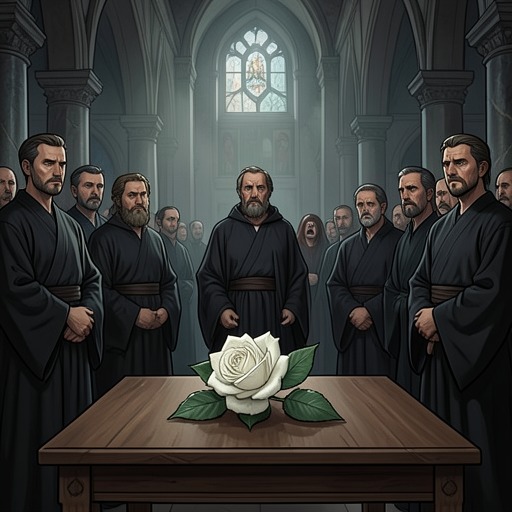
Later, the narrator takes the badge out and spreads it flat on a table before asking her sons to swear that a secret will remain hidden. The ceremony is physical and deliberate: Lord Montague places his hand on the badge, the narrator places hers on his, and Geoffrey places his hand on top. He then swears. The emblem that had once been prepared for men going into battle now anchors a pledge among family members who fear what disclosure could bring.
When Lord Montague asks what it is, the narrator identifies its maker and purpose: Lord Thomas Darcy had it made on crusade as the badge of a defender of the Church against heresy, and had one made for their family. Lord Montague confirms the political closeness signified by the gift, noting that Darcy is with them and spoke against the divorce at the last Parliament. The narrator replies that he had been with them long before they were. In this exchange, the badge’s meaning is not merely decorative: its history marks an allegiance that predates the present crisis, while its use at the table makes that allegiance part of a private bond of silence.
Meaning amid a contest for authority
The badge’s rose and wounds hold together two kinds of loyalty: to the narrator’s family and to the Church whose suffering the emblem depicts. As the king claims authority over the Church, the narrator’s family encounters pressure to accept the king’s account of marriage, succession, and religious jurisdiction. The badge does not itself settle those disputes, nor is it presented as a public challenge to the king. Its force is more intimate: it gives visible form to convictions and affiliations that the family cannot safely make public.
The difference between its intended and later uses sharpens that significance. Made for a crusading expedition that never happened, it is first a promise of possible armed defense; given to the narrator, it becomes an object of prayer and memory; placed on the table, it witnesses an oath made under threat. Its embroidered wounds and white rose thus connect religious devotion to inherited identity, while its changing role traces the movement from anticipated conflict to the guarded solidarity of a family trying to protect its own.