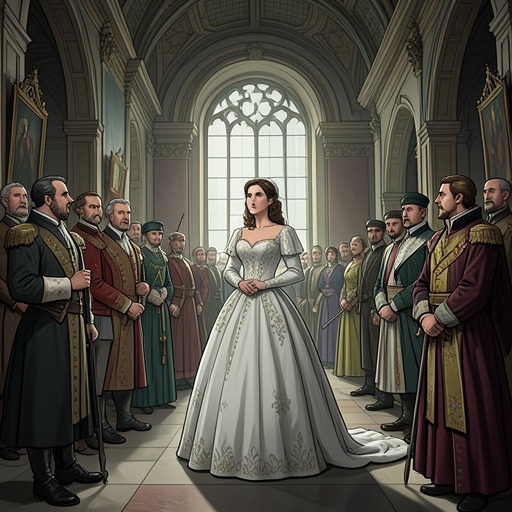
Battle of Flodden
The King's CurseThe Battle of Flodden, fought in 1513, is narrated as a victory won in England’s defence while Henry VIII was away campaigning in France. Scotland’s invasion left Katherine of Aragon and Thomas Howard to organize the response at home. Their successful strategy, James IV’s death, and the dispatch of his bloodstained coat to Henry made the battle both a military triumph and a public demonstration of Katherine’s authority as queen and regent.
Causes and the crisis at home
Henry VIII’s fleet had scarcely set sail when James IV of Scotland invaded. The attack came despite a sacred, permanent peace sealed by James’s marriage to Margaret Tudor, Henry’s sister. England therefore faced a sudden threat while its king and army were occupied across the Channel. The narrator emphasizes the imbalance: the English army was in France, Henry was abroad, and the kingdom still had to be defended.
Thomas Howard, Earl of Surrey, was the senior commander left in England and the one man available to lead the campaign. At seventy, he was described as an experienced soldier; Katherine, meanwhile, was pregnant. Their partnership put the work of national defence in the hands of an elderly commander and a queen whose capacity to act was not limited by her condition. The account presents the invasion not as an abstract border dispute but as an immediate test of whether England could protect itself without its king.
Planning the defence
The preparations took place in the presence chamber at Richmond Palace. The room’s usual musical and courtly materials gave way to maps of England and Scotland, muster lists, and records of landlords expected to supply tenants for the northern campaign. The queen’s ladies also examined the men in their households and reported on the condition of border castles. This detail shows how the defence reached beyond the army: the court became a centre for gathering information and organizing resources.
Katherine and Howard planned their forces together. Their strategy called for Howard to attack the Scots in the north while Katherine held a second line in the Midlands, ready in case he was defeated. The narrator connects Katherine’s grasp of the military situation to her early life among parents who had fought to defend their kingdom. She is not shown simply lending her name to Howard’s command. She shares in the decisions, understands the danger of the battlefield and the deployment of troops, and prepares to continue the defence if the northern action goes badly.
Katherine then rode out to address the army, despite being pregnant. She wore cloth of gold and rode a white horse, making her presence a public act as well as a personal risk. Her speech praised the English as a nation capable of fighting better than any other. In the narrator’s eyes, the woman who had once seemed homesick and vulnerable at Ludlow had become a queen militant: her authority rested not only on office but on her willingness to appear before the soldiers and claim responsibility for the kingdom’s defence.
Victory and its symbols
The plan succeeded. Howard sent Katherine the bloodstained coat of James IV, who had been killed in the battle. His death carried a dynastic consequence as well as a military one: Margaret Tudor was left a dowager queen with a seventeen-month-old child. The narrator describes the victory in expansive terms, imagining Scotland as open to English possession; this is the triumphant language of the moment, rather than evidence that England actually took the kingdom.
Katherine responded with exuberance. She danced and sang a Spanish battle song, then demanded James’s head. Those around her persuaded her that a monarch could not act with such ferocity. The account therefore sets the first rush of victory against the restraint expected of a queen: Katherine’s delight is fierce, but her public conduct is redirected toward a more acceptable display of power. Instead of the king’s head, she sent Henry James’s bloodstained coat and torn banners in France. The objects carried proof of the victory to an absent monarch and presented Katherine as the guardian who had defended his realm in his absence.
The court celebrated her as a heroine and as a queen who had both held the kingdom and carried a child. Yet the triumph does not close the episode on uncomplicated celebration. That night Katherine became ill, and the narrative turns from victory to a new crisis surrounding her pregnancy. The shift makes the cost of her double position visible: the queen had taken an active part in public affairs while also facing the dangers of pregnancy.
Public memory and narrative significance
The battle’s significance in the book lies in the contrast between the king’s absence and Katherine’s visible command. Henry’s campaign in France leaves a vacuum; Katherine and Howard fill it through planning, mobilization, and the queen’s appearance before the troops. Flodden thus changes how the narrator understands Katherine. The girl remembered from Ludlow is replaced by a political leader whose decisions help secure the kingdom and whose victory can be sent, in the form of banners and a king’s coat, to the monarch abroad.
Later scenes offer evidence of continuing public attachment to Katherine, her daughter, and the white rose, though they do not present that attachment as a direct commemoration of Flodden. In 1536, as Margaret Pole travelled into Peterborough, townspeople blessed the late queen, the princess, and the white rose, and some also blessed Margaret and her house. Read alongside the account of Katherine’s wartime leadership, that later reception underscores the reach of her public image beyond the court. Flodden becomes the clearest scene in which the narrative shows her earning that image through action: she helps defend the realm, announces the victory, and sends its material tokens to Henry.