Birth of Elizabeth I
The King's CurseThe birth of Elizabeth at Beaulieu in September 1533 was a dynastic turning point as Margaret Pole understood it: Anne Boleyn had produced a daughter rather than the son Henry VIII wanted, and Margaret expected the king to restore Katherine of Aragon and Princess Mary Tudor. Instead, the birth sharpened the conflict over marriage, religious authority, and succession, while the hoped-for reversal never came.
The birth and its immediate meaning
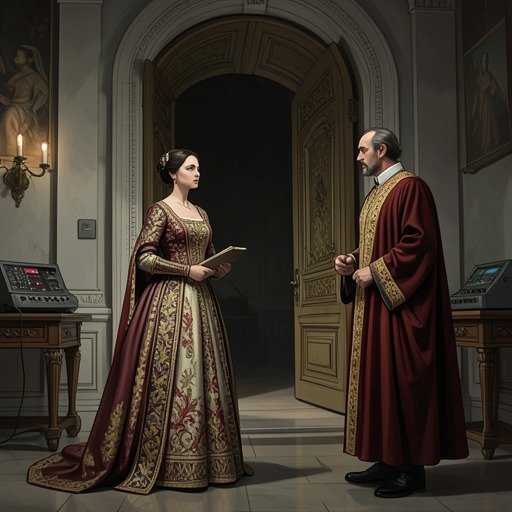
At Beaulieu, Margaret received the news that the child was a girl and had been named Elizabeth. The announcement brought relief to those who opposed Anne Boleyn’s position: in Margaret’s interpretation, a male heir would have seemed to vindicate Henry VIII’s choice of marriage and his defiance of the Pope, whereas a daughter left the succession question unresolved.
Margaret reasoned that the king had no legitimate son to displace Princess Mary Tudor. She therefore expected him to return to Katherine, restore her to court, and confirm Mary as heir. The Boleyn family’s political gamble, as Margaret saw it, had failed to deliver the son that might have settled the king’s dynastic anxieties. Yet this was an expectation, not an outcome. Henry did not reconcile with Katherine, and Anne retained her place at court.
Marriage, church authority, and the succession
The birth unfolded amid a dispute over whether Henry’s marriage to Katherine was valid. Margaret had earlier been pressed to attest to what she had observed about the couple’s marriage, and she had refused to give the testimony demanded of her. The opposing claim was that Katherine’s marriage to Arthur Tudor had not been consummated, a point that could permit Henry to seek papal dispensation to marry her. Margaret’s refusal made her a target of anger from those who believed that support for Katherine endangered their family and the king’s future.
By the time Elizabeth was born, the Pope had declared the marriage to Katherine lawful and the marriage to Anne a charade. Margaret took that decision, alongside the child’s sex, as evidence that the political tide was turning: she expected Anne to lose her crown and Katherine to return to hers. The mismatch between that expectation and what followed exposes the limits of papal judgment in a conflict where Henry continued to determine events in his own realm. The birth did not settle which marriage would govern the succession, nor did the ruling bring Katherine back to court.
Family networks and political resistance
Margaret’s hopes were bound to a wider network of kinship and political obligation. She describes the Plantagenet relatives as numerous, linked by marriage and blood, and spread across England; their connections could sustain shared influence, but could also be interpreted suspiciously as a faction or conspiracy. Her own family’s intermarriages concentrated lands and ties among cousins, making kinship both a resource and a political liability.
That network shaped the response to Henry’s treatment of Katherine and Mary. Lord Montague proposed sending Geoffrey Pole through Calais to meet Reginald Pole, carry information to the Pope, and convey a message to Katherine’s nephew, the King of Spain. He hoped papal intervention would compel Henry to take Katherine back. Margaret recognized that few at court would openly challenge the king: potential counselors were constrained by earlier executions, family connections, or banishment. She nevertheless accepted that she had a duty to defend the queen, her friend, and Princess Mary, who was in her care. In this account, the family’s allegiance was not simply opposition to the king; Margaret also believed Henry was damaging his own inheritance and honor by setting Mary aside.
Margaret’s standing and the limits of influence
Margaret’s capacity to act had changed over time. Henry had restored her family lands, granted her a title, given her prominent rooms at court, and trusted her with the education of Princess Mary. She understood these favors as public signs that she was a favored royal kinswoman. Later, however, she noticed that Henry’s older relatives were being edged away from his private circle as younger companions known as the minions gained access. Her account links the birth and succession crisis to a court where proximity to the king—and the ability to influence him—was shifting.
Her record also shows the material limits beneath aristocratic status. After her husband’s death, the king controlled the income from her sons’ estates while they were minors, and Margaret’s widow’s share was only a third of rents and profits. At one point, she described the income from Stourton and the estates at Medmenham and Ellesborough as insufficient to maintain her household; she dismissed servants, took on dairy work, and worried about having enough grain for bread. These hardships do not determine her response to Elizabeth’s birth, but they make clear that royal favor, family standing, and independent resources were not the same thing. Margaret could claim a place in the dynasty’s political argument while remaining vulnerable to decisions made by the Crown.
The birth therefore marks a moment when hope and authority diverge. Elizabeth’s arrival seemed to Margaret to strengthen Katherine and Mary’s position, and the Pope’s ruling appeared to confirm that reading. But Henry’s refusal to restore his wife or daughter showed that neither kinship, papal judgment, nor the absence of a son could by itself compel the king to change course.