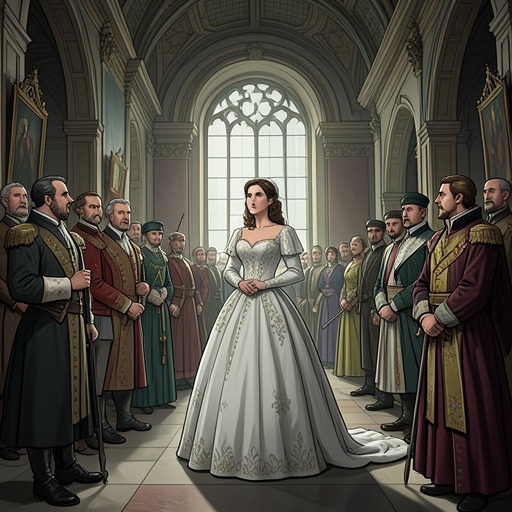
Blackfriars hearing
The King's CurseThe Blackfriars hearing was the public confrontation over the validity of the marriage between Katherine of Aragon and Henry VIII. As reported by her son Montague to Margaret Pole after the hearing in June 1529, its decisive moment came not from a ruling but from Katherine’s direct appeal to the king: she asked how she had failed him, asserted that she had come to him an untouched virgin, and walked out after asking to appeal to Rome. The hearing exposed the private marital dispute as a contest over who could define the marriage—and whose authority would be recognized in England.
Causes and Setting
The hearing took place amid Henry VIII’s effort to have his marriage to Katherine of Aragon annulled. At issue was whether their marriage had been consummated and whether it could stand. The dispute was not merely a question of private conduct: it touched the legitimacy of the royal marriage and the standing of the royal family. Earlier, Margaret had been pressed to confirm that Prince Arthur had been taken to Katherine’s room each week, evidence invoked in the argument over consummation. Katherine’s own position, as reported at the hearing, was that she had come from Spain a virgin.
The scene reaches the reader through a report rather than through direct narration from inside the courtroom. Montague travels from London to Richmond Palace on the family barge to tell Margaret what happened. She has shut herself in her private room with him and kept Princess Mary occupied away from visitors from London, hoping to shield her daughter from the crisis unfolding nearby. The hearing had drawn a tightly packed crowd; Montague compares the press of spectators to a public execution, where people crowd around a scaffold. That comparison conveys both the event’s public appetite and the strain of watching a royal marriage put on trial.
Katherine’s Appeal and Departure
Before Thomas Wolsey and Girolamo Campeggio, Katherine ignored the cardinals sitting in judgment and walked past them to kneel before Henry VIII. She asked what she had done to displease him. She reminded him that she had treated his friends as her own and done what he wanted, and said that her failure to give him a son was not her fault. The appeal made the dispute personal in the most public possible setting: instead of addressing only the judges, she confronted the husband whose claim had brought her before them.
Katherine then stated that Henry had found her an untouched virgin when she came from Spain. According to Montague, Henry said nothing. She asked how she had failed him as a wife; he remained silent. Margaret’s account emphasizes the force of that silence against the history of their life together: Katherine, she reflects, had been everything to him for twenty years. In that instant, the king’s inability to answer became part of the scene’s meaning, while Katherine’s testimony made her own account of the marriage audible to the assembled court.
Katherine asked whether she might appeal to Rome. She then rose and left the courtroom, returning to her rooms as if the cardinals and their proceedings had no power to detain her. Those in the court called after her to come back, but she continued out. Montague describes her departure as the hearing’s greatest moment and, in his judgment, her finest moment as queen. The decisive action was not a verdict: it was her refusal to remain within a proceeding she had challenged, and her appeal beyond the court to Rome.
Audience and Political Meaning
The packed courtroom made the hearing a public performance of authority as well as a legal proceeding. Montague reports that the spectators were stunned; some longed to laugh or cheer, but did not dare while Henry sat present. Outside, common people cheered Katherine and blessed her name, while condemning the woman they blamed for the trouble. Their response showed that the king’s position did not command universal assent, even as the people inside the courtroom measured their reactions against his presence.
The hearing also unfolded against the visible rise of Anne Boleyn at court. At a masque, Katherine watched Henry dance hand in hand with Anne while the queen’s attendants prepared to withdraw. Margaret initially thought Anne had simply failed to observe the court’s established order of precedence. But Anne did not join the queen’s train; Henry allowed her to remain, and Katherine did not order her away. The episode belongs to the wider crisis surrounding the hearing: court ritual was making the challenge to Katherine’s position visible even before the dispute over the marriage was resolved.
Aftermath and Significance
The hearing’s report does not give a judgment by the cardinals. Its immediate force lies instead in Katherine’s public testimony, Henry’s silence, and her departure. In 1534, the conflict had widened into a dispute over the authority of the Church and the Crown. The Pope publicly ruled that Henry and Katherine’s marriage was valid, while Henry claimed that the Pope had no authority in England. At Westminster Palace, nobles were summoned to swear an oath of succession reflecting the king’s position; Margaret understood the demand as requiring them to accept the king’s declarations about his wife, Anne Boleyn, and their daughter Elizabeth.
The later struggle makes the hearing’s unresolved character especially significant. Katherine’s appeal to Rome placed the marriage within a competing structure of authority, while Henry’s later claim to rule the Church in England asserted the Crown’s power to determine the matter at home. Yet at Blackfriars, the confrontation had already made the conflict legible in human terms: a queen knelt before her husband, asked what she had done wrong, and left when she sought an appeal beyond him. Montague’s account preserves the scene as both a crisis of jurisdiction and an act of royal self-possession.