Death and funeral of Queen Catherine
The King's CurseKatherine of Aragon’s death and funeral joined a private farewell to a public reckoning with Henry VIII’s rule. Margaret Pole remembers Katherine meeting death with religious preparation and dignity; at the funeral, the queen’s household, her friend Maria de Salinas, and mourners from the surrounding county honor her even as the king controls her burial and possessions. The contrast between Katherine’s remembered standing and the modest ceremony makes her funeral a measure of both personal loss and political change.
Death and preparation
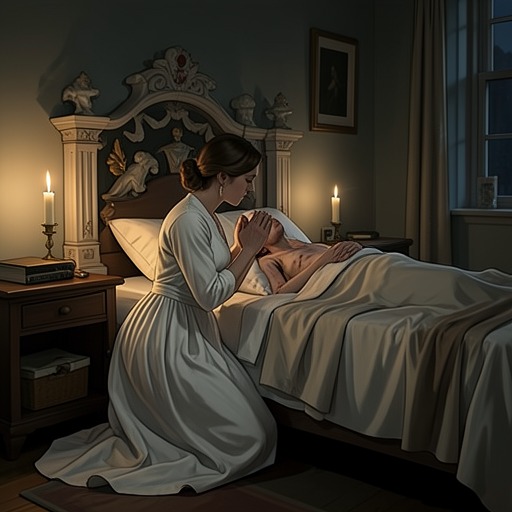
Katherine prepared for death through acts that accorded with her unshakable Catholic faith. Before she died, she spoke at length with her ambassador, received the company of Maria de Salinas, who had traveled through winter weather to reach her, and wrote to her nephew and Henry VIII. As Margaret understood the message to the king, Katherine affirmed that she had always loved him and signed herself as his wife. The wording preserved, at the end of her life, a claim to a marriage and identity that Henry’s actions had repudiated.
Katherine also prayed with her confessor, who anointed her and administered extreme unction. She died in the early afternoon, having made the religious preparations she believed necessary. Margaret takes comfort in the queen’s dignity and readiness, and imagines her reunited in the next life with Arthur, her first husband. That reunion is Margaret’s expression of hope and faith, not a public resolution of the losses that shaped Katherine’s life.
The scene carries the weight of the succession anxieties that had long surrounded the royal household. Earlier, Margaret had been told that she would raise the next king of England, only for the expected future to end with the death of a newborn. Later, the possibility that Katherine might bear a son again made her labor a focus of courtly hope: a male heir, Margaret reflects, would have overturned judgments that the queen was weak or cursed and changed Henry’s attention to her. These earlier hopes do not cause Katherine’s death, but they show how the royal family’s private bodily fortunes had been made to bear the burden of political succession.
News and personal mourning
Margaret is praying for her friend when Montague comes to tell her that Katherine is dead. The news reaches her not in a public ceremony but in a private chapel, where she has placed Katherine’s soul in God’s care. The abrupt transition from prayer to confirmation gives the death a personal immediacy: Margaret has been preparing to pray for Katherine, but must now understand that her friend is gone.
Her memory turns to their first meeting, when Katherine was a young woman anxious about becoming Princess of Wales and illuminated by her first love. Margaret sees that earlier figure alongside the queen who endured a hard and thankless life, and remembers her as one of England’s finest queens. Her grief is therefore also a judgment on the distance between Katherine’s early promise and the treatment she received at the end of her life.
At the abbey guesthouse, Maria de Salinas runs down to embrace Margaret. Their reunion recalls Maria’s long friendship with Katherine and gives their mourning a shared, embodied form. Maria tells Margaret that Katherine was at peace and had sent her love. She also says Katherine wished to give Margaret one of her rosaries, but Henry had ordered that everything belonging to the queen be taken into his keeping. Margaret asks about the bequests; Maria answers that the king has taken everything, as she supposes he has the right to do. The thwarted gift turns royal seizure into a small, intimate loss: even a keepsake meant for a friend cannot pass freely from the dead queen’s hands.
Funeral and public response
Katherine’s coffin is drawn to the abbey by six black horses, followed by her household and a large company from the surrounding county, walking with their heads bare in the cold. The procession is accompanied by public blessings for the queen. Margaret understands why Henry did not have Katherine buried at Westminster Abbey: he feared the city’s response, and believes that London might have risen in mourning. In her account, the crowd’s grief has political force. People remember the queen as a martyr and a saint, and cheer Margaret as a member of the old royal family while turning against the House of Tudor.
The ceremony itself is restrained in comparison with Katherine’s rank and history. Four bishops receive the coffin in the abbey church, where hundreds of candles burn. The coffin is draped in black velvet edged with cloth of gold. Heralds carry banners displaying Katherine’s own crest, the royal arms of Spain and England, and the two royal arms together. Her motto, Humble and Loyal, is set in gold beside the coffin. These emblems preserve her royal identity within a funeral that Margaret considers insufficiently grand for a queen, an Infanta of Spain, and the victor of the Battle of Flodden.
After the requiem Mass, the coffin is lowered into the vault before the high altar. Margaret stifles her sobs; she had never expected to see Katherine buried so quietly, far from the city that had been proud to call her its queen and home. The ceremony honors Katherine, but its location and scale also register the limits imposed on her after Henry denied her title and removed her from power.
Wishes denied and lasting meaning
The funeral does not follow the wishes Katherine set down in her will. She had requested burial in a church of the Observant Friars, with their congregation offering memorial Masses for her. Henry’s decision to close the friars’ houses had already deprived that wish of its intended setting. Margaret nonetheless believes Katherine has a place in heaven without those prayers, and that the friars will continue to pray for her even if they are left wandering the roads. Her faith separates the queen’s spiritual worth from the recognition the king withholds.
The funeral thus ends with a distinction between official treatment and remembered identity. Henry controls Katherine’s title, burial arrangements, and possessions; he cannot determine how Margaret, Maria, or the mourners remember her. For Margaret, she remains Katherine, Queen of England. The later image of Henry grieving the death of his son Henry FitzRoy and asking whether a curse has taken those he loves echoes the novel’s recurring language of loss, but does not undo the political and personal injury represented by Katherine’s final treatment. Her funeral leaves her death at once a family bereavement, a contested royal act, and a public sign of resistance to the king’s religious and political changes.