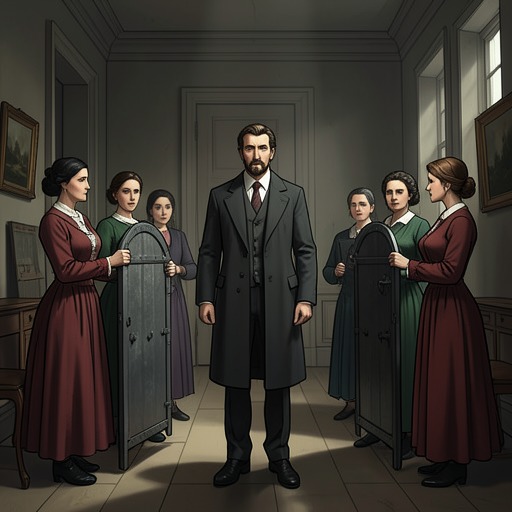
Death of Jane Seymour
The King's CurseJane Seymour’s death, two weeks after the birth of Prince Edward, reverses the triumph associated with the arrival of a living male heir: the child survives, but his mother does not. In Margaret Pole’s account, the loss is both intimate and dynastic, and the king’s grief soon gives way to preparations for another marriage.
Dynastic Hopes and the Birth
The birth of a son carried political weight beyond the nursery. Before the delivery, the possibility that Katherine of Aragon might bear a boy is imagined as a reversal of the doubts cast on her strength and fertility, and as an answer to Henry VIII’s need for a son. The birth of Prince Edward therefore brings the king the male child for whom the court has waited.
The account later reports that the baby is thriving and has been christened Edward. Princess Mary Tudor carries him during the ceremony. His survival makes him the new Tudor heir, while Margaret recognizes the uncertainty still surrounding succession: a healthy infant is not necessarily a future king. The new heir’s arrival thus offers a political promise, not a guarantee.
Illness and Death
The physicians are summoned back to Hampton Court, but their return is not prompted by the baby’s condition. It is Jane who has fallen ill. Margaret goes to her chapel to pray for the queen; Jane dies that night, only two weeks after giving birth. The account gives no specific diagnosis, keeping the cause of death unstated while making clear that the danger after childbirth has shifted from the infant to the mother.
The contrast is stark: news had established that Prince Edward was well and thriving, yet the household’s attention turns back to the queen. His christening confirms the survival of the dynastic hope; Jane’s death makes that hope inseparable from a personal loss. For Margaret, who recalls having shared Katherine of Aragon’s four pregnancy losses, the child’s health does not erase the precariousness of royal births.
Grief and the King’s Response
Reports reaching Margaret describe Henry VIII as devastated by the loss of the mother of his child. They present Jane as the woman he truly loved and as the only wife he regarded as perfect. Margaret reflects that Jane’s death has made her seem perfect in a way no living woman could be: the ideal is produced by loss, rather than tested in the ordinary course of life. In her telling, the king’s image of a flawless wife becomes an image of his own making.
The narrative places this bereavement beside another episode of Henry’s grief. After the death of Henry FitzRoy, Henry asks Margaret whether a curse explains why he loses those he loves. That earlier response does not establish what he thinks about Jane’s death, but it gives the later reports of his sorrow a recurring context: personal losses are repeatedly interpreted against the Tudor fear of a curse and the fragility of the royal line.
Aftermath and Narrative Significance
The account quickly sets grief against the prospect of remarriage. Less than a month after Jane’s death, Henry is reportedly considering a new bride from among the princesses of France or Spain. Montague, dressed in full mourning, tells Margaret that the king has asked the French princesses to come to Calais so that he can choose the prettiest. The abrupt movement from mourning to selection makes the distance between the king’s public idealization of Jane and the practical continuation of dynastic marriage especially conspicuous.
Jane’s death therefore closes one hope without resolving the succession. Prince Edward is alive and recognized as heir, but the queen whose child he is has died, and Henry is already looking toward another marriage. The sequence makes the royal body’s vulnerability part of political life: a birth may secure an heir, yet it cannot secure the mother’s survival or settle what the heir’s future will be.