Death of Queen Catherine
The King's CurseKatherine of Aragon’s death is both a personal bereavement and a political turning point. For Margaret Pole, it means losing a friend whose life she recalls with reverence; for Princess Mary Tudor, it removes the mother Margaret believes has restrained Henry VIII from moving against her. The account presents the death as carefully prepared for, then shows how grief quickly becomes a question of protection, allegiance, and danger.
Background and the Burden of Succession
Katherine’s position had been shaped by the failure to produce a surviving son. Margaret reflects that a boy might have silenced those who called the queen weak, infertile, or cursed, and might have secured her precedence over the women surrounding Henry VIII. Instead, the queen’s pregnancies had brought repeated losses. On one occasion, Margaret had been entrusted with an infant after Henry VIII indicated that she would raise the next king; the child died in the cradle. Later, when Katherine’s labor ended with a stillborn girl, the hoped-for son again did not arrive. These losses give the queen’s death a dynastic context: Princess Mary Tudor remains her daughter, but there is no living son to settle the succession.
The book also places Katherine’s story amid a wider language of sickness and curse. In earlier scenes, Margaret fears that an illness among her children might be the Sweat, an outbreak associated in her mind with the Tudor army and the king’s arrival. She even urges a doctor not to name that feared disease. The account of Katherine’s death, however, supplies no medical cause and does not identify the Sweat as responsible. The distinction matters: the narrative links illness, loss, and dynastic anxiety without making an unsupported diagnosis.
Final Days and Death
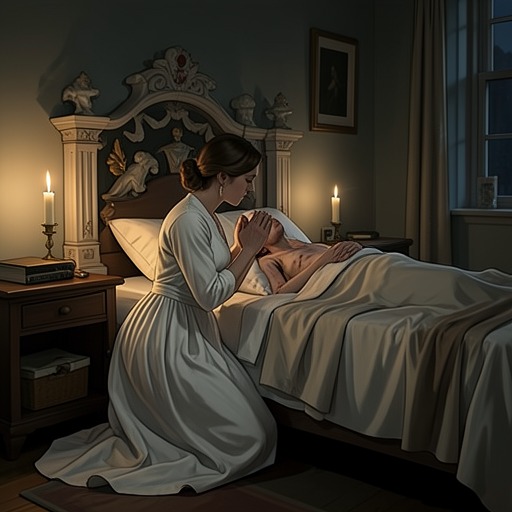
As Katherine nears death, Margaret is conscious of her own helplessness and turns to prayer. She asks God to receive her friend in a state of grace and without pain, then goes to her chapel and entrusts Katherine’s soul to God. Margaret is there when Lord Montague brings word that the queen has died. The report locates the death in the early afternoon, after a final period in which Katherine had prepared herself according to her faith.
Katherine had spoken at length with her ambassador and written both to her nephew and to Henry VIII. In her letter to the king, she expressed enduring love and signed herself as his wife. The account thus places a declaration of marital identity beside the approaching end of a marriage whose status had become a matter of royal and religious conflict. Her confessor prayed with her; he anointed her with holy oil and administered extreme unction. Margaret understands these rites as leaving Katherine ready for death in accordance with the faith she held without wavering.
Maria de Salinas, Katherine’s close companion, had ridden through winter weather to be with her. Margaret takes comfort in the dignity of Katherine’s preparations and in the company she received. She imagines her friend reunited in the next life with Arthur Tudor, her first love and husband, and remembers the five children she describes as following Katherine to heaven. This ending is not presented as an escape from suffering so much as a conclusion Margaret can understand through Katherine’s religious convictions.
Margaret Pole as Witness and Friend
The death is narrated through Margaret’s intimate knowledge of Katherine, not through an impersonal account of court affairs. Margaret remembers first meeting her as a young woman anxious about becoming Princess of Wales and illuminated by her first love. At the other end of Katherine’s life, Margaret’s own response is prayer, grief, and recollection. Her judgment that Katherine was one of England’s finest queens is explicitly part of this loving remembrance, revealing both the strength of their bond and the perspective through which the death is told.
That perspective makes the loss personal without separating it from public consequence. Margaret does not describe herself as able to alter what is happening to Katherine; prayer is the action she can take at the bedside’s distance. Yet once she receives the news, grief gives way to urgent deliberation. The contrast between kneeling in the chapel and deciding to act for Princess Mary Tudor shows how Margaret’s private loyalty becomes a political commitment.
Consequences for Princess Mary Tudor
Margaret and her sons recognize that Katherine’s death changes Princess Mary Tudor’s position for the worse. Lord Montague calls her a protector and a witness: while Katherine lived, he believes Henry VIII would not have moved against their daughter, since doing so would have required him to proceed against the queen first. With Katherine gone, Mary is, in Margaret’s assessment, the only person left in England who refuses to swear to the king’s oath.
Margaret concludes that Mary’s life is in danger and that the moment to act has arrived. She remains in London while Lord Montague and Geoffrey Pole choose a guard to reach Mary at Hunsdon, plan a route around London, and arrange for a ship to wait at a Thames-side village such as Grays. They decide not to involve the Spanish ambassador, whom Margaret considers too fearful to withstand arrest and interrogation. The plan is an immediate consequence of the changed political circumstances: Katherine’s death removes the protection Margaret thought she provided, and the family responds by attempting to take Mary out of England.
The Death’s Wider Meaning
Katherine’s death exposes the vulnerability of a royal household in which the queen’s private body and the kingdom’s succession are inseparable. Her failure to leave a surviving son has already made her position precarious; her death leaves Princess Mary Tudor more exposed to the king’s demands. At the same time, the rituals surrounding Katherine’s final hours assert a spiritual order distinct from the political contest over her marriage and her daughter’s standing.
The book later returns to the language of a curse when Henry VIII grieves for Henry FitzRoy and wonders why he has lost those he loves. That later episode does not establish a cause for Katherine’s death, but it echoes the pattern that has shadowed the royal family: bereavement is read not only as individual loss but as a sign of disorder around the Tudor line. Katherine’s death gives that pattern a human center. Margaret remembers a friend, a mother, and a queen; the court inherits a new danger for Mary.