Elizabeth Barton
The King's CurseElizabeth Barton, the Holy Maid of Kent, is a Benedictine nun whose visions challenge Henry VIII’s marriage policy and sustain hope for Princess Mary Tudor’s return to the throne. In Margaret Pole’s account, Barton’s authority rests on her claim to speak under divine command; the same claim makes her a politically exposed figure when her words and associations become matters of suspicion at court.
Identity and Introduction
Barton enters Margaret’s story through the family’s political and religious network. Geoffrey Pole identifies her as the nun called the Holy Maid of Kent, and Montague urges Margaret to meet her, noting that Henry VIII himself has already heard her. Archbishop William Warham had brought Barton to the king, who listened and spoke with her. Her reputation, then, precedes her arrival: she is presented not simply as a local religious woman but as someone whose pronouncements have reached the highest level of government.
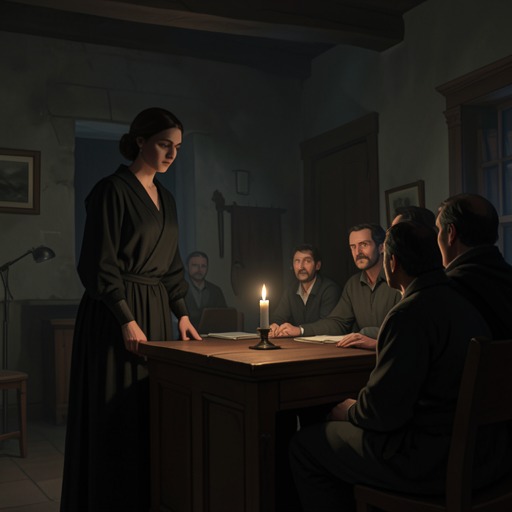
Margaret’s first impression of Barton’s appearance differs from the weight attached to her words. Barton wears the cream wool robe and gray scapular of the Benedictine Order, with her hair covered by a wimple and veil. Margaret sees an ordinary country woman rather than the imposing figure the title of prophetess might suggest. This contrast keeps Barton’s authority rooted not in outward grandeur but in what she says and in the consequences others attach to it.
Visions and Political Warnings
Barton tells Margaret that the Mother of Heaven has commanded her to say that Princess Mary Tudor will come to her throne, whatever happens. She insists that Margaret must assure Mary of this future. The prediction is particularly charged because Margaret is Mary’s guardian, placing Barton’s message inside a relationship of care as well as a dispute over succession.
Barton also recalls speaking directly to Henry VIII about his marriage. According to her account, she warned him that if he left his queen and pretended to marry another woman, he would not survive even a day after the false wedding. She says that Henry argued with her but did not forbid her to speak, and that he thanked her advice before sending her home. These details make her warning more than a private vision: she presents it as a message already delivered to the king, who heard it without changing course.
When Margaret says she cannot hear such matters, Barton distinguishes her own preference from what she considers her duty. She says she is not directing the prophecy at Margaret personally; she is speaking aloud because God has told her to do so. Her refusal to silence herself gives her speech a moral certainty that sits uneasily beside the court’s political power. Margaret’s caution, in turn, shows the danger of receiving a message that challenges the king’s decisions.
Associations and Disappearance
Barton’s connection to Margaret continues through prayer. When Montague later reports that Barton has disappeared from Syon Abbey, he fears that Thomas Cromwell has taken her and will press her to name friends of the queen, making her contacts appear to form a plot. Margaret says she has seen Barton once since their earlier meeting: Barton came with Gertrude Courtenay, and they prayed together. The exchange makes an otherwise devotional encounter politically consequential. The question is no longer only what Barton prophesied, but whether association with her can expose others to suspicion.
The evidence presents Montague’s belief that Cromwell may have taken Barton as a fear, not a confirmed account of her fate. Her disappearance nevertheless marks a change in the conditions surrounding her speech. Previously, she had been brought before the king and says she left after advising him; now her absence raises the possibility that the state is seeking testimony about the queen’s circle. The text leaves unresolved what happened to Barton after she vanished from Syon Abbey.
Narrative Role and Significance
Barton’s predictions connect religious vision to the practical anxieties of inheritance and royal marriage. Her promise concerning Mary answers a question of who might rule, while her warning to Henry VIII casts his choice about the queen as a matter with consequences beyond the court. Against a background of concern that the queen’s failure to bear a son could weaken her position, Barton’s message offers a counterclaim to the king’s power to determine the future by changing his marriage.
Her later disappearance also sharpens the contrast between the authority she claims and the authority that can act against her. Barton says she speaks because God commands her; Montague fears that Thomas Cromwell may turn her relationships into evidence of conspiracy. Elsewhere in the narrative, Henry VIII himself speaks of a curse when mourning those he has lost. That recurring language gives Barton’s earlier warning an ominous resonance, without establishing that Henry later connects his grief to her prophecy.