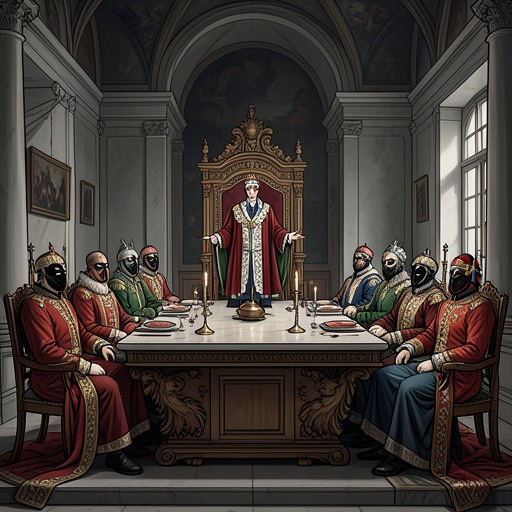
English royal court
The King's CurseThe English royal court is more than a royal household: it is the place where public rank, private counsel, family connection, and the future of the dynasty repeatedly meet. Its ceremonies and offices can display apparent harmony between the Tudors and the Plantagenets, but its shifting circles of favor also reveal how quickly that harmony can give way to exclusion and suspicion. Through Margaret Pole’s experience, the court’s changing character is measured in practical terms: who may approach the king, whose counsel matters, which family is trusted, and who is expected to secure the next heir.
A household of rival dynasties
The court can make political reconciliation visible. Edmund de la Pole, Duke of Suffolk, is presented as a Plantagenet who has become a loyal servant and close companion of Henry VII. His standing at court, his reputation as a jouster, and his place in the king’s confidence make him a living emblem of the possibility that York and Tudor might coexist. In this image, his service turns family history into a public sign of concord: a Plantagenet serves a Tudor, and the royal household presents the relationship as familial rather than adversarial.
That appearance rests on a much broader web of kin. Margaret’s family understands itself as an extensive network of cousins and kinsmen, joined by blood and marriage across England. Such connections can support mutual trust and collective standing, but they also make the family politically legible as a potential faction. The court is therefore not merely the setting around dynastic politics; it is where kinship acquires public meaning and can be recast from a source of solidarity into grounds for suspicion.
Margaret’s own return to favor shows how access can restore a person’s material and familial position. When Henry VIII comes to the throne and marries Katherine of Aragon, Margaret again becomes senior lady-in-waiting to the Queen of England. A grant of one hundred pounds a year allows her to settle debts, and she regains access to royal clothing, jewels, and the precedence of following only a Tudor into dinner. The king also offers places in his household to her sons Henry and Arthur, and supports Reginald Pole’s education. Court favor here has tangible consequences: it can relieve financial hardship, provide service and education, and help reunite a family with prospects for the next generation.
Counsel, ceremony, and the work of rule
The court’s business is not confined to favor and display. During preparations for war with France in 1513, Thomas Wolsey proves effective at turning royal ambition into practical arrangements. He directs the gathering of troops and the provision of equipment, transport, and supplies, attending to details that other nobles neglect. The contrast gives the court an administrative dimension: royal authority depends not only on the king’s intentions but on the labor of people able to organize the means of carrying them out.
Katherine of Aragon also takes an active part in this work. She meets with commanders to discuss provisions, discipline, and the troops’ health, and confers with Wolsey about routes, messengers, and coordination between commanders. Her experience of warfare is recognized at court, while her pregnancy makes her simultaneously central to the military household and the dynastic future. Her status is thus not reducible to ceremony: she participates in practical counsel even as the court watches for the birth of an heir.
The difference between public honor and private influence becomes sharper as Wolsey’s power grows. He takes the place of Katherine and other advisers in Henry’s private councils, while his workload and control of offices and fees make him dominant in the machinery of government. The king continues to honor Katherine at dinners and major occasions, and still looks to her for an heir, but the respect and intimacy she once enjoyed diminish. The court can preserve a queen’s visible rank while removing her from the decisions that shape policy; its ceremonial order does not necessarily reveal where authority has moved.
Access, exclusion, and the king’s circle
Under Henry VIII, access to the king becomes a measure of political standing. Margaret observes that her older relatives, including Edward Stafford, Duke of Buckingham, and George Neville, are gradually moved out of the privy chamber and into the presence chamber. The distinction between the king’s intimate circle and those who wait outside it turns physical proximity into a sign of favor. Meanwhile, Henry’s younger companions, known as the minions, occupy the space once held by older councillors.
Their conduct makes the change difficult to dismiss as simply a difference in age or taste. The minions ride horses up palace stairs, arrange for an ambassador to be drenched by a jug placed above a doorway, and stage a raid on the kitchens to seize dinner and demand its return. They also disrupt a London market. Margaret’s older kinsmen see more than youthful mischief in these episodes: while the king is occupied with his companions, Wolsey handles government, and serious councillors find themselves excluded from the king’s presence. The court’s disorder and its political consequences unfold together.
Margaret’s concern becomes personal when Henry suggests that some of her Somerset manors should belong to the Crown. Her former closeness to the king has not made her property immune from challenge. The moment brings together the court’s dependence on royal favor and the insecurity of that favor: restoration, wealth, and position can be granted by the king, but can also be questioned by him. Margaret answers him directly, while her son Montague listens, making the exchange a test of whether her family can still defend its interests in the royal presence.
Succession and the vulnerable royal body
The court’s central dynastic responsibility is to produce and recognize an heir. When Henry entrusts Margaret with raising the next king, the promise of continuity appears to rest on a living child. But the nurse calls Margaret when the baby is found lifeless. The child’s death overturns the expectation attached to Margaret’s appointment and gives private grief an immediate political consequence: the anticipated line of succession has failed again. The court’s nursery and the queen’s chambers are therefore not separate from the state’s future; what happens there reshapes the prospects of the dynasty.
The same pressure surrounds Katherine’s later pregnancy. With Princess Mary flourishing as a young child, the court silently imagines how a son might change the queen’s standing, answer doubts about her ability to produce an heir, and redirect Henry’s attention from other women. The birth is premature, and the child, a girl, is already dead. Margaret must carry the news from the queen’s chamber through the palace and into the king’s presence. The route itself connects intimate loss to the public court: courtiers watch her face, infer that the news is bad, and wait for the king to hear it.
These episodes reveal the court’s sharp division between the ruler’s natural body and the political continuity expected of the monarchy. Henry’s authority is made to depend on heirs, yet the pregnancies and deaths that determine succession remain beyond royal command. Later, when Henry grieves for Henry FitzRoy, he asks Margaret whether a curse explains why he loses those he loves. She does not confirm his explanation. In this scene the king appears not as an untouchable office but as a bereaved father whose personal losses threaten his confidence in his own rule.
Royal supremacy and the court’s transformation
The court also becomes a setting for the transfer of religious authority. Montague tells Mary Tudor that the Church has surrendered to the king, that the Pope is to be disregarded in England, and that Thomas More has returned the seal of Lord Chancellor and resigned. Mary recognizes the breadth of the change: the king has taken the Church, its wealth, its laws, and its courts into his possession. The news alters the court’s political landscape, because service to the Crown now intersects directly with the question of who has authority over the Church.
Montague proposes that the family act in defense of the queen and the princess. His plan is to take Geoffrey with him to Calais, where Geoffrey could reach Reginald Pole and carry messages to the Pope and to the queen’s nephew, the King of Spain. The intended appeal rests on the hope that a papal ruling might force Henry to restore Katherine. This is a proposal, not a completed mission, but it shows how the court’s family networks can be imagined as channels for resistance as well as service. Montague describes the Plantagenets as the white rose and urges them to bring their cousin, the king, back to what he considers his proper course.
By the time Henry claims the title Majesty, the court registers the symbolic consequences of the king’s religious and political supremacy. The new style places him above the status once conveyed by Your Grace and presents him as an emperor-like ruler. Yet the contrast between title and body is stark: in grief, Henry has to be helped into bed by his attendants, who hesitate even to approach him. The court sustains the appearance of elevated authority while witnessing the king’s dependence and distress. Across the narrative, it is this tension that defines the institution: the court magnifies royal power through rank, access, and ritual, but it also exposes how that power is bound to fragile bodies, contested loyalties, and an uncertain succession.