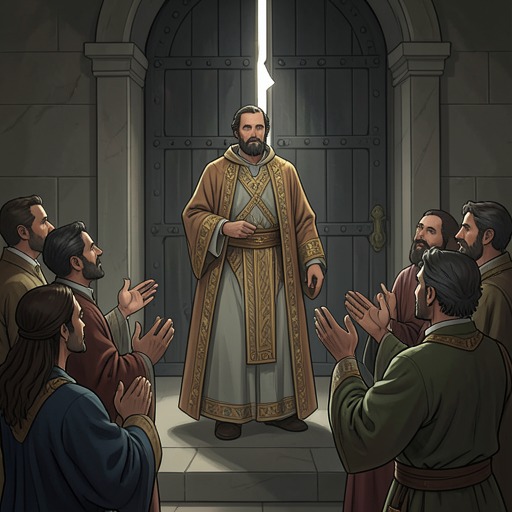
Execution of Thomas Darcy
The King's CurseThomas Darcy’s execution in June 1537 turns a promised pardon into a sentence of death. Arrested after the northern rebellion and questioned in the Tower of London, Darcy would not implicate others. The account traces how a promise of banishment encouraged the lords at his trial to find him guilty, only for Henry VIII to send him to the block as a traitor. For Margaret Pole, his death is at once a political betrayal and the fulfilment of his wish to die for his faith.
Arrest and interrogation
In spring 1537, Pole leaves London for Bisham Manor as soon as the roads are dry enough to travel. Her departure places her outside the city when Darcy is brought to the Tower of London and questioned. The distance matters: she learns of his ordeal through others, first imagining his fierce temper in the interrogation room and later piecing together the case from a letter and news of the trial.
Darcy faces Thomas Cromwell with little patience for the questioning. Though the King’s pardon is in his pocket, he is under arrest. He recognizes Cromwell as the man who will judge him and accuses him directly: “Cromwell, it is thou that art the very original and chief causer of all this rebellion and mischief.” The plainness of the charge startles Cromwell, whom the narration pointedly identifies as a blacksmith’s son. Darcy then predicts that if only one nobleman remains alive in England, that lord will behead Cromwell.
The inquiry is long and detailed, and its threats are petty and vindictive, but it yields little for Cromwell. Darcy and John Hussey name no other man or woman. Darcy does not speak of riding with the pilgrims or opening the gates of Pontefract Castle to them. Instead, he says the pilgrim badges had been left in a chest at the castle from his earlier crusade to the Holy Land, and refuses to reveal who received them from him. His defense is captured in the blunt assertion, “Old Tom has not one traitor’s tooth in his head.” The interrogation produces no list of accomplices; Darcy’s silence protects others even as it leaves him exposed.
A promise before the verdict
The uncertainty over Darcy’s fate reaches Pole through Henry Courtenay, who writes that he has been named Lord High Steward for the trial of Darcy and Hussey. Courtenay says Cromwell has promised that, if the lords find Darcy guilty, his sentence will be commuted to banishment and he may later return home. He sees no hope for Hussey. The distinction gives the trial a seemingly narrow choice: convict Darcy, but rely on the Crown to spare his life afterward.
Pole reads the letter beside a forge while waiting for her horse to be shod. Once she understands its meaning, she plunges it into the fire, then asks the messenger whether he is going straight back to his master. She gives him a penny and tells him to say nothing to anyone else—and that the words are not hers. Destroying the letter and denying its authorship show the risks of even carrying information about a politically charged trial. Her secrecy cannot alter the sentence, but it keeps the fragile promise from becoming a public claim she might be forced to defend.
Montague later writes that Hussey is a dead man and Darcy has been found guilty but will be pardoned and spared. The report sounds like confirmation that Cromwell’s assurance has held. Pole’s next judgment overturns that expectation: it was a lie. The lords had believed they could return a guilty verdict without causing Darcy’s death, waiting for Henry VIII to change execution to banishment. Instead, the King fails him, and Darcy is sent to the block. The familiar warning, “don’t put a man’s head on the block unless you want it struck off,” becomes more than a saying: it describes the fatal gap between the sentence the lords expected and the outcome the Crown imposed.
Execution and meaning
In summer 1537, at Bisham Manor, Pole learns that Darcy has been beheaded as a traitor on Tower Hill in June. Swallows sweep from the river toward the Tower, busily building their summer nests as the news arrives. The juxtaposition sets the ordinary continuance of the season against a death made final by political authority. The details do not soften the execution; they give the news a specific place and moment in Pole’s memory.
Darcy had hoped to die on crusade, fighting for his faith. Pole concludes that, though he dies as a condemned traitor rather than on crusade, he dies for that faith as he wished. This is her interpretation of his end, not a reversal of the official charge: the account explicitly says he was beheaded as a traitor. The contrast between the legal label and Pole’s understanding makes the execution an argument over who gets to define fidelity and treason.
Political context
The episode belongs to a wider pattern in which the Crown’s authority overrides older claims of conscience, ecclesiastical jurisdiction, and personal assurance. Earlier, Margaret Pole is pressured to affirm that Arthur and Katherine were “wedded and bedded,” even though her testimony would support the King’s position against Katherine. Later, when the English Church surrenders to Henry VIII, Montague tells Pole that the King will rule the Church himself and that the Pope is to be disregarded in England. These episodes show the political stakes surrounding speech, loyalty, and the authority to determine what counts as truth.
The succession oath administered by Thomas Cromwell to the nobility at the Privy Council in 1534 sharpens that conflict. Pole knows the Pope has ruled Henry VIII’s marriage to Katherine valid, but the King claims authority to declare otherwise and to define the succession. Thomas More refuses the oath as written, and Pole recalls that Henry VIII had promised his friend he would never put him to this test; the King does not keep his word. Against that background, Cromwell’s reported assurance about Darcy’s banishment carries particular weight. In Pole’s account, an expected act of royal mercy proves as unreliable as a royal promise to a friend. Darcy’s refusal to name others, and his death despite the pardon in his pocket, make the execution a stark instance of power controlling both the proceedings and their outcome.