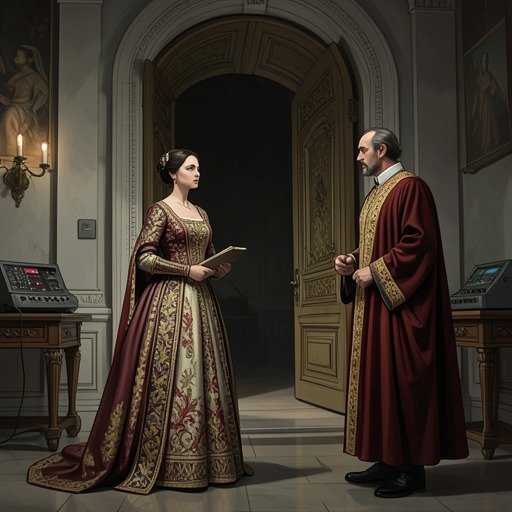
George Boleyn
The King's CurseGeorge Boleyn, Lord Rochford, was a courtier who had served Henry VIII for much of his life and was closely associated with the rise of the Boleyn family. His appointment to the Privy Chamber placed him near the king, but his position became precarious when Anne Boleyn was arrested. At her trial, George made a startling claim about the king’s capacity to father a child; he was later executed, while his wife Jane Boleyn supplied evidence against him and Anne.
Identity and Family Position
George was the son of Thomas Boleyn and brother to Anne and Mary Boleyn. His father, once Margaret Pole’s steward, rose to become Earl of Wiltshire and Ormonde; George himself was made Lord Rochford. The family’s advancement was visible throughout the court: Anne returned from France to become a prominent presence, while Mary served both as her sister’s close companion and among the queen’s ladies. George’s title and post belonged to this wider ascent, which brought several members of the family into influential positions around the king.
The narrator describes George as handsome but judges him useless, a sharp personal assessment rather than an account of any specific failure in office. More concretely, he had served Henry for almost all his life and was appointed to the Privy Chamber alongside Henry Courtenay. The post placed him within the king’s household at a moment when access and favor were powerful forms of political standing. His story consequently begins not as that of an outsider challenging the crown, but as that of a courtier whose family had become closely attached to it.
At Court During the Boleyn Rise
The court George inhabited was changing in tone as well as personnel. After the return from France, the queen’s ladies adopted French fashions and dances, and Anne Boleyn stood out among them because of her upbringing at French royal courts. The narrator presents Anne’s arrival as part of the Boleyn family’s growing prominence, with George and his father also established at court. The family’s rise was not confined to Anne’s relationship with the king: titles, household offices, and positions around the queen and king accumulated among its members.
By the Christmas season, Thomas Boleyn’s promotion had become a public occasion, and George held his own place in the Privy Chamber. The narrator’s account of these advancements is colored by her hostility toward Anne and her alarm at the family’s influence. Her response registers the court as a contest over rank and access, in which a newly elevated family could appear to displace people who considered their own status more established. George is not shown directing this broader struggle, but his title and appointment made him one of its visible beneficiaries.
Arrest and Trial
George’s position changed abruptly when Henry moved against Anne. He was arrested with her and other people from her court, including Thomas Wyatt, Henry Norris, and a young singer from her chamber. The arrests widened the crisis beyond the queen herself. Montague, who brings the news to Margaret Pole, is bewildered that the king has accused several men and asks why Henry would allow such charges to become public. His reaction conveys the uncertainty surrounding the arrests; the account does not establish the accusations as fact.
George’s trial became one of the moments through which the book shows the strain between royal power and the possibility of impartial judgment. Montague sat on the jury with twenty-five other peers. The narrator notes that a substantial part of the panel belonged to her family’s affinity or political circle and supported Princess Mary Tudor, while the other jurors were described as men whose loyalties followed the king’s wishes. In her account, Anne had no one to speak for her, and the evidence had been assembled persuasively by Thomas Cromwell. These circumstances frame the proceedings as politically compromised, though they are conveyed through the narrator’s partisan perspective.
Among the testimony and allegations, George himself addressed the court on the king’s ability to father a child. Montague later tells Margaret that Cromwell had allowed George to make this assertion publicly. Its force lay in its collision with the case being presented against Anne and with the king’s authority: a statement about the king’s body could bear directly on dynastic legitimacy. The evidence does not resolve the truth of the allegations against Anne or establish that George’s statement changed the outcome. Montague reports that he found the case persuasive enough to vote guilty, while also expressing disbelief at the proceedings and their consequences.
Execution and Narrative Significance
Jane Boleyn, George’s wife, later appears at Jane Seymour’s court as his widow. The narrator identifies her as having supplied fatal evidence against George and his sister-in-law Anne; her presence among the new queen’s ladies makes the destruction of the Boleyn household visible in the next courtly arrangement. The family that had gained titles and access is now represented by a widow who has survived its collapse and entered another queen’s household. George’s execution is thus conveyed not through a separate scene of his death, but through its aftermath and through the testimony associated with his trial.
George’s part in the narrative is brief, yet his arrest and trial expose the vulnerability of courtly favor. His lifelong service and Privy Chamber appointment did not protect him once the king’s campaign turned against his family. His intervention at trial also brings dynastic anxiety into the courtroom: what might appear to be a private question of paternity becomes inseparable from the legitimacy of royal power. The account leaves the accusations unsettled, but makes the outcome clear. George was executed, and the Boleyn family’s rise ended in a purge whose proceedings are remembered through grief, factional suspicion, and the disappearance of any credible space for defense.