Henry Fitzroy
The King's CurseHenry Fitzroy was the acknowledged illegitimate son of Henry VIII and Elizabeth Blount, whose survival, titles, and public prominence made him both proof of the king’s capacity to father a son and a potential instrument in the succession struggle. Celebrated as a boy and raised to extraordinary rank, he was placed beside Princess Mary Tudor in court ceremony and considered as a possible heir. His death ended that political possibility and left Henry VIII grieving for a son he had treated as his heir.
Identity and Early Life
Fitzroy’s birth sharpened a contradiction at the heart of the Tudor succession. Henry VIII’s queen, Katherine of Aragon, had borne Princess Mary, but the king had no surviving legitimate son. Elizabeth Blount’s boy, by contrast, survived his first months. In the queen’s household, where the women had seen the king’s infant sons die, his survival was greeted with caution rather than certainty. At court, however, his health became significant beyond his private life: his existence offered a visible counterpoint to fears that Henry could not father a boy who would live.
The child was named Henry, despite the deaths of two earlier babies of that name, and given the surname Fitzroy, acknowledging his royal paternity. Elizabeth Blount received an allowance to raise him, and the boy was widely known as the king’s son. Cardinal Thomas Wolsey, who publicly stood as Fitzroy’s godfather, was understood by the narrator to encourage that recognition and the gossip surrounding it. The child’s identity was thus both familial and political: he belonged to the king, but not through a marriage that could make him a legitimate successor.
Elizabeth Blount’s own position changed after the birth. On leaving confinement, she was married to Gilbert Tailboys, a ward of Wolsey. The king did not return to her as a lover. Fitzroy’s birth therefore brought his mother an allowance and public acknowledgment of the child, but it did not restore her former relationship with Henry.
Titles and Public Recognition
In July 1525, when Fitzroy was six, Henry elevated him in a ceremony at the old royal palace of Bridewell. The boy received the titles Duke of Richmond and Duke of Somerset, an exceptional double elevation that made the scale of royal favor unmistakable. Thomas More read out the letters patent. The narrator, Margaret Pole, understood the honor as replacing a cousin whom the king had killed, and the sight of the golden-haired boy receiving his father’s favor carried a painful implication for Katherine of Aragon.
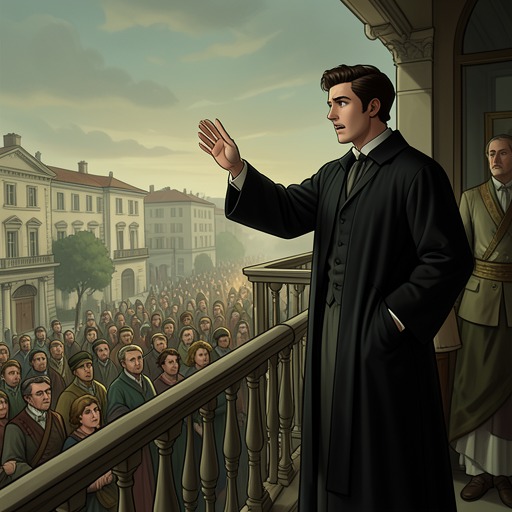
The titles did more than decorate a child. They gave Fitzroy a public standing that made his presence at court an argument about who might inherit. By the time of a later Christmas feast, he was referred to as the Duke of Richmond and was accorded precedence alongside Princess Mary. The ten-year-old Fitzroy entered the great hall with Mary, who held his hand. Their contrasting appearances—the princess slight and the boy tall for his age—made a striking pair, while the ceremony placed them together before the court.
Henry’s New Year’s gift to Fitzroy, a magnificent set of gilt cups and pots, further displayed his favor. Mary smiled and applauded as the boy received it. Margaret approved of her conduct: if the princess was expected to treat her father’s illegitimate son as an honored half-brother, she could meet the demand with dignity. The feast presented a show of family unity, but the children’s public equality also unsettled the distinction between the king’s legitimate daughter and the son whose birth could not itself establish a lawful claim.
Succession and Political Use
As Katherine’s childbearing years ended, Fitzroy’s promotion acquired greater dynastic force. The king’s favor toward the boy reminded the court that Katherine was unlikely to have more children and that Henry had a living son, though not one she had borne. When the king sought to displace Katherine and pursue a new marriage, Fitzroy stood ready in the background as a possible reserve. Elizabeth Stafford told Margaret that her daughter Mary was to be married to Fitzroy, a plan she disavowed and described as a source of shame. The proposed match connected the boy to another powerful family while making the king’s intentions harder to ignore.
The possibility that Henry might name Fitzroy heir alarmed those loyal to Katherine and Princess Mary. Margaret’s son Montague argued that the king was taking Fitzroy to France as a visiting prince, while the French king’s son, Henri, was to return to England. Montague feared that displaying Fitzroy in this way signaled the king’s plan to put the princess aside. He proposed sending Geoffrey Pole from Calais to report to Reginald Pole, carry a message to the Pope, and take a letter to the king of Spain, in the hope that papal opposition would force Henry to restore Katherine. The scheme was an effort to defend the queen and princess against a succession policy in which Fitzroy’s elevation seemed central; the evidence presents the plan, not its success as a result of Fitzroy’s actions.
Fitzroy’s later public appearances continued to signal royal investment in him. He walked before Henry at the opening of Parliament carrying the king’s cap, a conspicuous position. He received half of Henry Norris’s lands and places, and the king established him at Baynard’s Castle with his wife, Mary Howard. The narrator read the castle, lands, and ceremonial visibility as signs that Fitzroy had a distinct political establishment, while Princess Mary had only recently been released from confinement and Elizabeth was still an infant. The contrast made the illegitimate son’s resources appear more substantial than those of either royal daughter.
Relationships and Final Years
Fitzroy’s relationship with Henry VIII joined affection to political calculation. The king did not merely acknowledge him at a distance: he gave him titles, property, public precedence, and a role at court. When Fitzroy’s enemy Anne Boleyn was dead, Geoffrey reported that Henry had taken the boy into his arms and said that Boleyn would have killed both him and Princess Mary, and that the king was fortunate to have them still. The report briefly presented the king as protecting both children, although Fitzroy’s position remained different from Mary’s because his titles and possible succession depended on royal favor rather than legitimate birth.
The king’s recognition of Fitzroy as a possible heir became unmistakable in the narrator’s later account of his death. After receiving a messenger, Margaret told Montague that she thought Fitzroy might be dead; the passage then moves to Henry’s grief, confirming the loss without identifying its cause. The king wept and called Fitzroy his heir, recalling that the boy resembled him and that others had said so. Margaret answered gently that he had been. The exchange makes clear that Henry’s investment in the boy was not only strategic: Fitzroy’s death was also the loss of a son in whom he had seen himself.
Death and Dynastic Significance
In his grief, Henry asked whether there was a curse against him and why he had lost the people he loved. He specifically wondered what Elizabeth Blount had done to offend God, or what Fitzroy himself had done wrong, for the king to lose him. Margaret did not affirm the king’s explanation. The death left a political vacancy, but the scene concentrates on Henry’s bereavement and on the frightening intimacy between private loss and royal power.
That contrast reaches its sharpest form when the grief-stricken king is addressed as Majesty. Henry had claimed a title that set him above the status of a duke, yet his attendants had to lift him from the floor and help him to bed. The narrative places the authority of the king beside the vulnerability of the father: titles and sovereignty could not protect the body or preserve the son. Fitzroy’s life had been made to carry the hope of a male succession; his death exposed how dependent that political hope was on one fragile person. He remains a pivotal figure not because he ruled, but because Henry’s promotion of him made a child’s survival into a question about the future of the crown.