Henry Pole
The King's CurseHenry Pole, known in the narrative as Lord Montague, is Margaret Pole’s son and a member of the Plantagenet family. His story links the practical work of preserving family lands to the political dangers of an interwoven dynasty: he is arrested amid suspicion of conspiracy, later serves as a messenger in moments of religious crisis, and appears among the peers summoned to swear to the succession settlement. The evidence presents him chiefly through Margaret’s perspective, as a son and political ally whose family position is both a source of influence and a liability.
Identity and Dynastic Position
Margaret identifies Henry as her son and cousin to the Duke of Buckingham. His marriage to a daughter of George Neville further binds him to a network in which marriage connects households, wealth, and political influence. Margaret explains that such intermarriage keeps resources within families and joins their lands; viewed suspiciously, the same closeness can look like a faction or conspiracy.
That double meaning shapes Henry’s place in the story. The Plantagenets are described as a large, widely connected family, set against the much smaller Tudor royal line. In this context, Henry’s relationships are not merely private ties: they make him part of a powerful kin group whose cohesion may attract the Crown’s attention even in the absence of proof of disloyalty.
Arrest, Suspicion, and Release
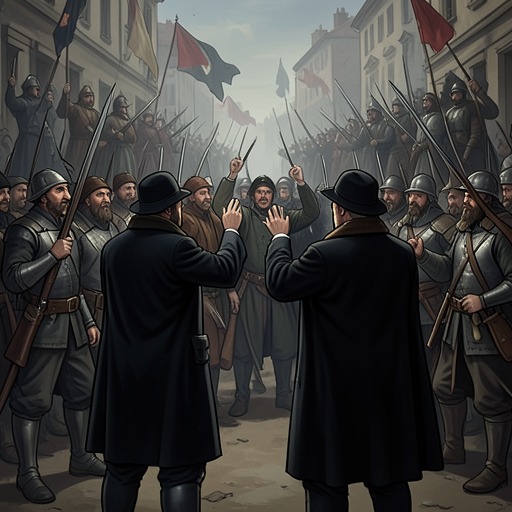
When Margaret learns that Henry has been arrested, she insists that he is innocent. Her fear is sharpened by the extent of the family’s connections: relatives and in-laws are named as people in whom a suspected kinsman might ordinarily confide, making their very familiarity appear politically dangerous. The narrative presents the family network as vulnerable to being interpreted as a coordinated threat.
The arrest forms part of a wider episode of royal suspicion. The Duke of Buckingham is attainted and loses his fortune and dukedom, while Henry is also taken into custody. Margaret later says that Henry is released without charge. The king’s response, as she recounts it, does not extend the suspicion into a continuing prosecution of the family; instead, he banishes Margaret’s household from court for a time. Henry’s release does not erase the consequences of the episode: the family has been made to feel how quickly kinship and proximity can become grounds for alarm.
Stewardship of the Family Lands
During the sweating sickness, Henry joins Margaret in restoring order to the family estate. Margaret insists that the lands belong to her son Arthur and represent the inheritance intended for Arthur’s son, Henry. If Arthur cannot pass on the fortune secured through his marriage, she reasons, his work and legacy will have been lost. Her determination gives estate management a personal and dynastic purpose: the land must be kept productive for the next generation.
Henry takes responsibility for the estate’s horses and agricultural work. He finds the animals turned out in the fields and directs the bailiff to assemble a haymaking gang for the following day, arguing in effect that neglect could leave the beasts without winter fodder. Margaret and Henry work for weeks to put the house and lands back in order. His contribution is practical rather than ceremonial: amid illness and disruption, he helps preserve the material basis of the family’s future.
Messenger in Religious and Political Crisis
In June 1529, Henry travels from Blackfriars to Richmond Palace aboard the family barge to bring Margaret news of the hearing concerning the royal marriage. She has kept Mary Tudor away from visitors from London, hoping to shield her from events unfolding nearby. Henry’s arrival makes him a trusted channel between the proceedings and the household. The hearing is described as crowded and charged, with the public gathering compared to a crowd at an execution; Henry is the one who carries its news to Margaret.
He later brings Mary Tudor news of a more far-reaching change. When he arrives at Richmond, he removes his cap and kneels before Margaret, then tells Mary that the Church has submitted to the king and that the Pope’s authority in England is to be disregarded. He also reports that Thomas More has resigned as Lord Chancellor and returned home. Mary understands the consequences as an expansion of the king’s possession and control, extending to the Church’s wealth, laws, and courts. Henry’s restrained delivery makes him an adviser as well as a messenger: he gives Mary grave news plainly, though the account emphasizes that he would spare her its burden if he could.
The Succession Oath and Narrative Role
In spring 1534, Henry is summoned with the peers to the Palace of Westminster, where Thomas Cromwell administers the oath of succession. Margaret’s account places Henry within a dispute over competing claims to authority: the Pope has ruled that the marriage of Katherine of Aragon and Henry VIII is valid, while the king asserts authority to determine the status of his marriage and the succession. The peers must decide what they will do. The evidence establishes Henry’s presence among them but does not specify how he responds to the oath.
Henry’s narrative significance lies partly in the contrast between his family’s ordinary bonds and their political interpretation. Marriage and inherited land give the Pole–Neville network practical strength; under suspicion, the same ties can be recast as evidence of a faction. Through Margaret’s recollections, Henry also appears as someone who helps sustain the family materially and carries consequential news to both his mother and Mary Tudor. The account offers little access to his private thoughts, but his actions place him at the junction of household loyalty, dynastic vulnerability, and the changing authority of the Crown.