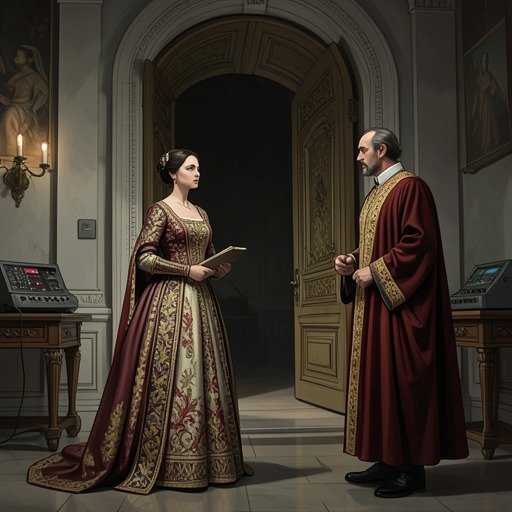
Jane Seymour
The King's CurseJane Seymour’s brief queenship changes the course of the Tudor succession: she gives Henry VIII a son, Prince Edward, but dies only two weeks after his birth. The novel presents her rise through Margaret Pole’s perspective, from a shy maid in Katherine of Aragon’s household to a queen whose rooms bear new emblems and whose death briefly redirects the king’s religious policy. Jane’s short life as queen is bound to the competing claims of dynastic need, courtly allegiance, and personal grief.
From Katherine’s Household to the Queen’s Rooms
Before she became queen, Jane Seymour served as a maid-in-waiting to Katherine of Aragon. Margaret remembers meeting her in that household as shy and rather incompetent, and recalls having scolded her for clumsiness. When Margaret later visits Jane as queen, she curtsies low and remains bowed until invited to rise, aware that the former servant may remember the reprimands. The encounter marks a reversal in their positions, though the novel gives no account of Jane seeking revenge or confronting Margaret about their earlier relationship.
Jane’s prospects become politically significant as Henry’s marriage to Anne Boleyn collapses. Margaret’s son Montague reports that Thomas Seymour has promised that, if Jane became queen, she would recognize Princess Mary Tudor, bring her to court, and restore her as heir. This is a report of a political expectation, not evidence that Jane herself made or fulfilled the promise. Montague also relates that Thomas Cromwell had asked the Bishop of London whether the king could legally abandon Anne Boleyn. The conversation places Jane’s possible elevation within a court already considering a change of queen and the succession arrangements attached to it.
The prospect turns into fact after Anne Boleyn’s execution. Margaret initially cannot imagine Henry ordering the death of his wife and the mother of his child. As she thinks of the king as wounded by shame and the loss of a woman he loved, she realizes that he has instead been courting Jane. He travels upriver by barge with lute players, dines with her, sends gifts, and plans their future as though they were betrothed. Only days after a cannon announces Anne’s death to London, Henry marries Jane and the court has a new queen. The speed of the transition replaces Margaret’s expectation of mourning with a new royal marriage.
The Queen’s Household and Court Politics
When Margaret visits Jane’s rooms, she finds that the old royal imagery has been removed. Wooden bosses that once bore a falcon or a bold A have been smoothed down; the new decoration uses a J or a rising phoenix. Jane’s ladies are embroidering the motto Bound to Obey and Serve on a Tudor-green banner. These details make the change of queenship visible in the palace itself: the signs associated with the previous household are erased, and Jane’s initial and motto take their place.
Margaret recognizes some of the women in the new queen’s household, including Elizabeth Darrell and Mary Brandon. Jane Boleyn, widow of George Boleyn, is also among them, despite having given evidence against her husband and sister-in-law Anne. Margaret regards Jane Boleyn’s appointment as alarming and interprets the ladies around the new queen as women placed there by male relatives in pursuit of patronage, fees, or the king’s attention. That judgement belongs to Margaret’s suspicious view of the court; the scene does not establish that Jane Seymour chose these women herself. Indeed, Margaret concludes that the queen’s ladies have been placed by their kinsmen rather than selected by Jane.
Jane’s possible role in Mary’s restoration also gives her household political significance beyond its ceremonies and symbols. The assurance reported by Montague offered a hope that Mary would be acknowledged and returned to court, even as the king’s treatment of her had made her position uncertain. The novel does not show Jane carrying out this plan before her death, and it leaves the promise as a possibility attached to her queenship rather than a completed change in Mary’s status.
Motherhood, Loss, and the Tudor Succession
Jane’s pregnancy and delivery take place against the court’s continuing anxiety about the absence of a living male heir. After repeated losses in Katherine’s pregnancies, Margaret understands how much a son would alter the queen’s standing: a boy would answer the doubts voiced about the queen’s fertility and place her above the women competing for Henry’s attention. Prince Edward is born and christened, with Princess Mary Tudor carrying him during the ceremony. His survival appears to make him the new Tudor heir, although Margaret’s experience of earlier royal births prevents her from treating a healthy infant as a guarantee of a future king.
Jane herself does not survive long after the birth. The physicians are called back to Hampton Court, but it is the queen, not the infant, who is ill. Margaret prays for her, and Jane dies that night, only two weeks after Edward’s birth. The event joins a dynastic success to a personal and political loss: the king has the son he wanted, but the queen who bore him is gone almost immediately. The novel reports that people say Henry is devastated and that he regards Jane as the only woman he truly loved. Margaret interprets the perfection attributed to Jane after her death as an ideal created by bereavement, rather than a quality that any woman could fully possess in life.
Grief, Faith, and the Aftermath
Jane’s death is also a loss for Princess Mary Tudor, who had hoped to find a trusted and loving figure in her stepmother. Margaret sees that Mary has not been eating properly and appears pale and tired. Mary tells her that she was deeply grieved and shocked, and that for a time she even doubted her faith because she could not understand how God could take Jane. Margaret comforts her and says they must believe Jane is with God; she adds that Masses are being sung for Jane’s soul in her chapel at Bisham.
Henry’s grief becomes an intimate scene in which Jane is present as an absence: he weeps, asks whether a curse explains why he loses everyone he loves, and wonders what his son Henry FitzRoy did to deserve death. Jane watches him in astonishment as he sits on the floor, overwhelmed. When the king is called Majesty, Margaret registers the contrast between his expanded political title and his bodily vulnerability: six attendants must lift him from the floor to his bed. The scene does not make Jane responsible for his grief or show her answering his questions; it places her beside the king as he confronts loss and interprets it through the language of a curse.
One consequence of Jane’s death is a limited reversal in Henry’s treatment of Bisham Priory. Montague tells Margaret that the king has asked him to restore the priory as a chantry for Jane’s soul, so that prayers may be offered for her. Henry makes the request in the royal gallery at Hampton Court after praying in the chapel, crossing himself, and kissing his rosary. Margaret objects that religious houses are being closed throughout the country and recalls the deaths of Robert Aske and others who tried to save them. The restoration does not undo the broader suppression of monasteries; it is a particular foundation ordered for the dead queen. That exception gives Jane’s death a public religious afterlife even as the policy surrounding it continues to transform the Church.