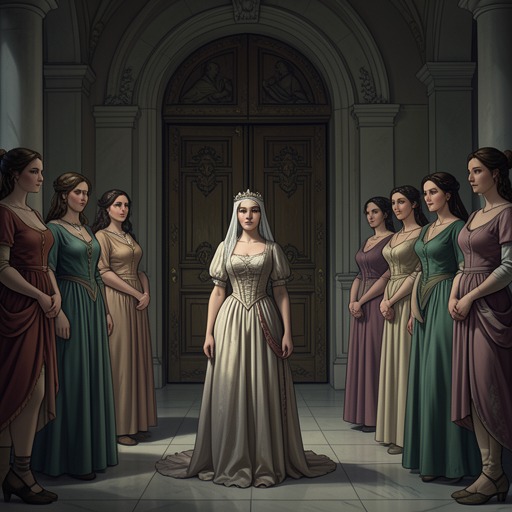
Katherine of Aragon’s effort to marry Prince Henry
The King's CurseKatherine of Aragon’s effort to marry Prince Henry was more than a plan to secure her position after Arthur Tudor’s death. She presented it as the continuation of a shared political project: by becoming Princess of Wales again, she could remain in England, guide the future king, and help shape a Tudor rule informed by the justice and compassion she associated with Arthur. The proposed marriage joined personal loyalty to dynastic necessity, while the dispute over whether her first marriage had been consummated made that union a matter of church authority as well as royal strategy.
A promise made to Arthur
After Arthur’s death, Katherine insisted that she still had a purpose in England. She had promised him on his deathbed that she would serve the country where she had been raised, and she understood marriage to his younger brother as the means to keep that promise. In her account, Arthur had known that this would be the only way for her to become Princess of Wales once more and, eventually, Queen of England. The plan, she said, had been discussed between them before his death; it was not an expedient invented only after she became a widow.
Katherine’s ambition was framed as service and tutelage. She believed Arthur had wanted to unite the Tudor and York houses in a kingship that earned respect rather than imposing obedience. Since he could no longer carry out their plans himself, she meant to advise Henry VIII and make him into a good king. Her determination did not depend on believing that the brothers were alike. Margaret Pole considered Arthur the more steadfast and substantial prince, and regarded Henry’s strengths as chiefly outward. Katherine acknowledged Henry’s youth and shortcomings but treated them as reasons he needed guidance, not as grounds to abandon the match.
Marriage as a route back to power
The practical logic of Katherine’s proposal was direct: marriage to Henry VIII would make her Princess of Wales again. When Margaret Pole warned that there was nothing left for Katherine in England, Katherine answered that the marriage would give her a place and a role. She intended not merely to return to the title but to influence the prince who would inherit the crown. She described Henry as young, vain, and spoiled, yet argued that he could be trained and advised. The plan therefore made her prospective marriage a route to political participation, with her own authority resting on her status as wife and future queen.
The Tudor court also had dynastic reasons to accept the arrangement. The narrative contrasts the numerous Plantagenet relations, whose marriages linked cousins and kinsmen across the country, with the Tudors’ narrow supply of heirs. Henry VIII was presented as their singular precious male successor, with another child still expected from the queen. In that context, Katherine’s marriage had value beyond her personal position: it could secure a connection to the Spanish power and wealth sought by the Tudors while providing a wife already established in the royal household. The betrothal of Henry VIII to the Dowager Princess of Wales thus brought Katherine’s determination into alignment, at least temporarily, with the dynasty’s calculations.
The disputed first marriage
The proposed union faced a question that could not be settled by Katherine’s resolve alone. Margaret Beaufort pressed Margaret Pole to say whether she knew that Arthur and Katherine had been lovers, pointing to the arrangements that had taken Arthur to Katherine’s room each week. Margaret Pole acknowledged that she had obeyed the instruction to bring them together, but that fact did not establish what had occurred there. The scene preserves the distinction between access and proof: Margaret Beaufort demanded testimony that the marriage had been consummated, while the evidence presented here does not resolve the question.
That uncertainty mattered because, as Margaret Beaufort argued, consummation could make Henry VIII’s marriage to his brother’s widow dependent on a papal dispensation. She accused Katherine’s supporters of helping her maintain that the first marriage had not been consummated, and treated the claim as a threat to her son and the Tudor house. Her accusation reveals how a private question about Arthur and Katherine was made to bear on the legitimacy of the proposed marriage and the future of the dynasty. The effort to marry Henry was therefore entangled with competing accounts of the first marriage, rather than proceeding as an uncomplicated agreement between a widow and a prince.
Betrothal, negotiation, and vulnerability
The marriage effort reached the point of betrothal: Margaret Pole’s husband returned from London with the news that Henry VIII had been promised to the Dowager Princess of Wales. Margaret laughed at the announcement, seeing in it the reversal by which Katherine’s persistence had prevailed. Yet the betrothal did not remove her material dependence or settle the terms on which the marriage could proceed.
After Isabella I of Castile’s death, Katherine’s position became more precarious. Ferdinand II of Aragon no longer jointly ruled Castile, and the narrative describes Katherine as having lost the standing she had possessed as the daughter of the monarchs of Spain. Visits from Henry VIII and his father became less frequent, and the money she received from the king was sometimes inadequate or not paid. The outstanding dowry became a point of dispute: Henry VII insisted that Spain pay it in full before the marriage could go ahead, while Ferdinand II of Aragon demanded the prompt payment of Katherine’s widow’s jointure. The promised marriage thus remained bound to negotiations over money and support.
Katherine asked Margaret Pole to seek her return to court, explaining that she could not manage her household expenses and was lonely. Margaret Pole replied that she too was a widow struggling financially and had little influence with Margaret Beaufort. She also withheld the reason her appeal was unlikely to succeed: Margaret Beaufort had said she would never forgive her for refusing to testify against Katherine. The episode exposes the limits of Katherine’s alliance with the English court. Her marriage plan offered a way back into royal life, but her security still depended on other people’s testimony, money, and favor.
Dynastic significance
Katherine’s effort joined a deathbed promise to the machinery of succession. She sought to preserve her place through remarriage, but also to turn that place into influence over Henry VIII’s formation as king. The Tudor need for a male heir and a politically advantageous match supported the proposal, while the unresolved status of her marriage to Arthur left its legitimacy open to challenge. Betrothal marked a real advance, not the end of negotiation: the plan remained subject to ecclesiastical judgment, royal finances, and the shifting interests of both the Tudor and Aragonese courts.