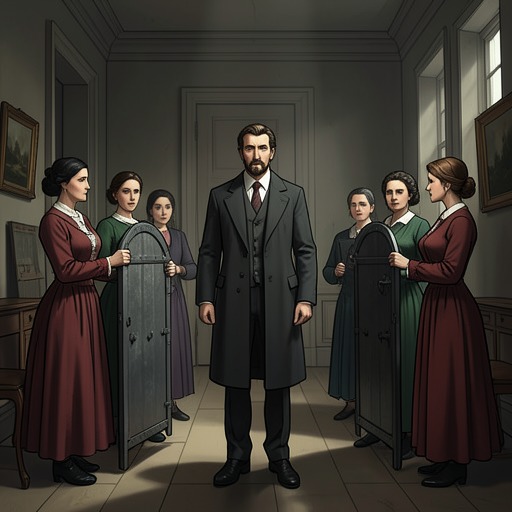
Marriage of Henry VIII and Katherine of Aragon
The King's CurseThe marriage of Henry VIII and Katherine of Aragon joined an existing dynastic arrangement to a private attachment, but its contested legal basis would make it one of the central political conflicts of Henry’s reign. The account presents the union as a long-delayed love match made possible by a papal dispensation, then shows how disagreement over Katherine’s earlier marriage to Prince Arthur became inseparable from the questions of who could define a valid marriage, name an heir, and govern the Church.
The marriage and its immediate consequences
Katherine had first entered the English royal family as the wife of Prince Arthur. After his death, her status and prospects remained unsettled. Henry, Arthur’s younger brother, later married her in haste and in private. The narrator presents the marriage as the expression of a desire that had been kept in check: Henry said that he had loved Katherine from a distance for years, while his father and grandmother, Margaret Beaufort, had enforced his silence. The private wedding therefore marks a change from restraint to a union the couple had long wanted.
The account identifies an earlier papal dispensation, arranged through Katherine’s mother, as the instrument that made Henry’s marriage to his brother’s widow legally defensible. Its wording was ambiguous, but the narrator says that it ultimately made the marriage legal beyond question. That account of the dispensation would later matter greatly: a document associated with Katherine’s family became a foundation on which the royal marriage’s validity could be defended.
The marriage also changed the fortunes of Margaret Pole. Once a poor widow who had lived under suspicion and apart from much of her family, she returned to court at Katherine’s side. She resumed the position of senior lady-in-waiting to the queen and again had access to the royal wardrobe and treasury. Henry granted her one hundred pounds a year, enabling her to settle debts to her steward John Little at Stourton, her cousins, the nuns at Syon Abbey, and Reginald Pole’s priory. He offered places in his household to her sons Henry and Arthur, and ordered that Reginald should receive a good education in his monastery. The marriage thus restored not only Katherine’s place at court but also the security and influence of the woman who served her.
The disputed marriage to Prince Arthur
The union’s vulnerability lay in the unresolved question of Katherine’s marriage to Arthur. Margaret Beaufort treated whether that first marriage had been consummated as decisive. She confronted Margaret Pole with the fact that Arthur had been taken to Katherine’s room weekly under her orders, and pressed her to affirm that the couple had been joined as husband and wife. Margaret Pole confirmed that the visits had taken place, but the account does not establish that she had direct knowledge of what happened between them. The distinction between an arranged circumstance and what it proved became the heart of the dispute.
For Margaret Beaufort, Katherine’s insistence that the earlier marriage had not been consummated threatened Henry’s position. If Katherine’s friends supported her account, Margaret Beaufort feared that the pope could grant Henry a dispensation to marry his former sister-in-law, bringing Henry and Katherine’s marriage into question and endangering her own son’s house. She demanded that Margaret Pole endorse the claim that Arthur and Katherine had been married in fact as well as ceremony. Margaret Pole’s testimony was therefore sought not as a neutral recollection but as evidence that could determine the legal and dynastic meaning of two marriages.
The conflict exposes how little a royal marriage could be separated from competing forms of authority. The claim depended on what had occurred in a private relationship, but its consequences belonged to the public realm: papal jurisdiction, the legitimacy of the king’s marriage, and the succession. The dispensation associated with Katherine’s mother and the disputed evidence about Arthur were not peripheral details. They were the materials through which opposing parties argued over what the law and the past required.
Heirs, fertility, and the pressure of succession
The marriage carried an expectation that Katherine would provide Henry with a male heir. Princess Mary was thriving as a young child, but her existence did not quiet the court’s hopes for a son. When Katherine later went into labor prematurely, the people around her understood that a boy would alter her standing and silence those who called her weak, infertile, or cursed. Her labor produced a girl who was already dead, and Margaret Pole had to carry the news from the queen’s chamber to the king. The scene makes the political burden of the marriage visible in the repeated attention paid to Katherine’s pregnancies and to the sex and survival of each child.
The pressure continued after the birth of a son whom Henry had expected to become king. The infant was found lifeless in his cradle, and Margaret Pole was called first to receive him. The account gives no explanation for his death; its significance lies in the sudden loss of the hoped-for male line. The marriage had produced a daughter and a son who did not survive, while the question of a secure succession remained open. In this setting, the king’s wish for an heir was not merely a private desire: the survival of children born within the marriage bore directly on the future of the dynasty.
From marital dispute to royal supremacy
Years later, the pope publicly ruled that Henry and Katherine’s marriage was valid and that Henry should set aside other relationships and live with his lawful wife. The ruling did not excommunicate Henry, leaving Margaret Pole and other subjects to judge what obedience required. The king, meanwhile, asserted that the pope had no authority in England and that his own declarations determined who counted as his wife and which of his children stood as a princess. The dispute had moved beyond interpretation of the dispensation: it had become a contest over who possessed the right to define reality in the kingdom.
At Westminster Palace, Thomas Cromwell administered the oath of succession to the assembled peers. The oath required them to accept the king’s settlement even though, as Margaret Pole understood it, the pope had ruled Katherine’s marriage valid. Thomas More refused to sign the oath as it stood, although he would have accepted a rewritten version, and Henry broke his promise not to put his friend to this test. More resigned as Lord Chancellor. Soon afterward, the Church surrendered to the king; Margaret Pole’s son Montague told Princess Mary that the king would rule the Church himself and that the pope would be treated in England as no more than the Bishop of Rome.
The marriage’s decisive significance therefore outlasted the private wedding. Henry’s effort to displace Katherine turned the question of their union into a test of papal authority, royal command, conscience, and the succession. The same marriage that had brought Katherine and Henry together—and restored Margaret Pole to court—became the point at which the king challenged the authority that had sanctioned it.