Pilgrims of the Pilgrimage of Grace
The King's CurseThe Pilgrims of the Pilgrimage of Grace are a mass movement whose defining act is to frame resistance to Henry VIII’s religious and political changes as a pilgrimage rather than a rebellion. Their sacred banner, large following, and brief restoration of religious houses make their challenge visible in both the language of faith and the practical pressure of an advancing army. Their eventual acceptance of the king’s pardon leaves the narrator with a sense of hard-won victory, though the settlement also marks the end of their independent campaign.
Identity and religious cause
The movement takes shape amid a struggle over who may govern the Church. When the Church surrenders to Henry VIII, the king claims authority over it in England, while Thomas More resigns as Lord Chancellor and returns the great seal. Against this background, the pilgrims present their cause as a defense of the Church and the old religious order. Their demands, as reported to Margaret Pole, include the Church’s return to Rome and the restoration of old noble advisers to the king’s chambers.
Their name carries the argument. A rebel at a gate insists that the rising is a pilgrimage, and describes its members as passing through a pilgrimage gate. The movement’s language recasts political action as a religious journey: its adherents march under the Five Wounds of Christ, and the narrator hears that no Christian could fire on them beneath so sacred a banner. The white-rose lords are included in this religious fellowship, even though their own dynastic loyalties give the identification a political edge.
The march on York
The pilgrims’ rapid growth gives their religious claim formidable force. Sir Thomas Percy has either been captured by them or joined them; even the narrator cannot establish which. Under Robert Aske, described as an honest Yorkshireman, the force reaches York in the middle of October. The city opens its gates without an arrow being shot in its defense. The pilgrims number twenty thousand—four times the force that took England at the Battle of Bosworth Field—and are described as an army capable of taking the whole country.
Their first actions in York are religious restorations. They reopen two Benedictine houses, Holy Trinity and the nunnery of St. Clement. When the bells ring at Holy Trinity, people go in to hear Mass and cry for joy. The scene makes the movement’s aims tangible: its arrival does not merely threaten royal control but briefly restores worship and institutions that its supporters believe have been taken from them.
Plans, pardon, and the end of the campaign
The northern rising prompts plans for support beyond Yorkshire. Montague tells Margaret Pole to go into the country, where she could lead in Berkshire and provide leadership, money, and supplies if the South rose for the pilgrims. Montague and Geoffrey plan to travel north with their force and join them when the time is right; Montague also intends to summon Reginald Pole. The anticipated return of Reginald at the head of a Spanish army is a hope, not an accomplished intervention. The narrator’s preparations show how the movement’s advance draws other political and family networks toward possible action, while its southern support remains conditional.
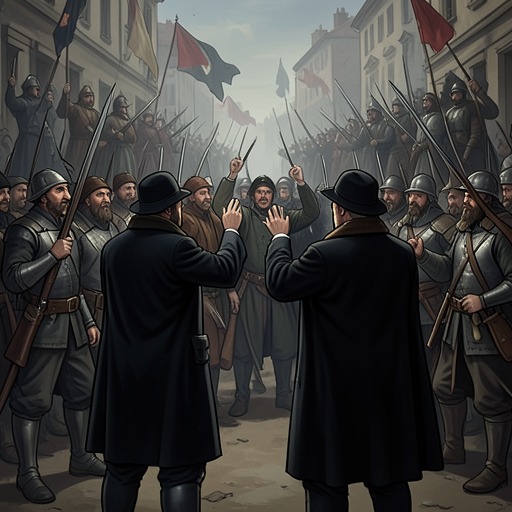
Henry VIII, the narrator hears, has been persuaded that he cannot rule England, much less the North, without an agreement with the pilgrims. He consents to offer a pardon. In freezing weather and flurries of snow, Thomas Howard rides north carrying it, then waits outside Doncaster while a herald offers it to thousands of northerners standing silently in massed ranks. Aske kneels before the pilgrims and tells them they have won a great victory. He asks them to release him from his post as captain; when they agree, he tears off the badge of the Five Wounds and promises that they will wear no badge but the king’s.
Aftermath and significance
For Margaret Pole, the change of badges makes the campaign’s ending intimate as well as political. She takes the badge Tom Darcy gave her from her pocket, kisses it, and hides it at the back of an old chest. She no longer needs it as a secret reminder of her loyalty. She believes the pilgrimage is over, the pilgrims have won, and all her sons will return home. The concealed badge thus registers both the end of a public movement and the survival of a private allegiance.
The news brings public celebration in London. Church bells ring at Christmas, and the narrator understands their pealing as celebration that the country and the Church have been saved, and that the king has been saved from himself. Yet the account presents this as the narrator’s interpretation of the settlement, not as proof that every demand has been secured. The pilgrims’ power is clearest in the king’s need to seek agreement; their campaign closes with a pardon, the release of Aske from command, and the replacement of the sacred badge with the king’s. Their story turns on that reversal: a movement that gathers under a Christian emblem ends by setting its emblem aside in accommodation with royal authority.