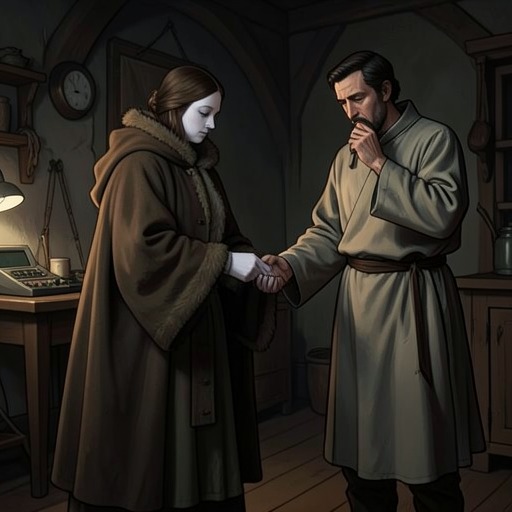
Prince Arthur's Death from Sweating Sickness
The King's CursePrince Arthur's death from the sweating sickness is a sudden loss that transforms a hopeful May into a family tragedy and, in Margaret Pole’s account, a failure of care. His illness unfolds over little more than a day: concern becomes alarm, the doctor cannot give reassurance, and the remedies at hand do not save him. Margaret’s attention to his young bride and her own promise to protect the prince sharpen the grief, while her fear that the disease is a curse connects his private death to the precarious future of the Tudor line.
The Illness Begins
The crisis arrives against expectations of a joyful May. The household has promised a dawn carol, peeled wands at Katherine of Aragon’s door, a May Queen’s crown, and dancing around a maypole. The season does not fail for lack of blossoms, birdsong, or anticipated celebration; instead, the household faces a disaster no one had imagined. The contrast makes the change in fortune immediate: the rituals of spring had offered a picture of youth and continuity, but Arthur’s sickness overturns that promise.
Margaret’s husband, Richard Pole, brings the first alarm. He hurries into her room without observing the usual formality and tells her that Arthur is ill. The prince says he is tired and aches as though he has an ague. Margaret leaves her preparations, throws a cape over her nightgown, and goes to him. The domestic details of the interrupted morning establish how quickly an ordinary day becomes an emergency, and how close Margaret is to the prince’s care.
Medical Uncertainty and Containment
When Dr. Bereworth arrives, Katherine questions him rapidly in Latin, too quickly for him to understand. Arthur rises from his chair only with difficulty; his face has lost its color. The doctor’s visible reaction tells Margaret that he suspects the danger she fears. She leads Katherine out of the bedchamber and tries to reassure her, promising that if Bereworth is concerned they will summon the king’s physician from London. The promise is an effort to protect the young bride from panic as much as an expression of confidence in treatment.
After the doctor examines Arthur, he recommends that the prince be left to sleep, but he cannot say whether the illness is the Sweat. Margaret presses him not to name that possibility. Her insistence does not resolve the uncertainty: the doctor remains unable to confirm it, and Margaret understands that he is afraid to speak plainly. In her account, the disease can kill within a night and a day, affecting the young and old, healthy and frail alike. She associates its arrival with Henry VII’s mercenary army and remembers the belief that the epidemic foretold the failure of his line. This is Margaret’s interpretation of the illness, not a diagnosis the physician confirms.
Katherine’s Visit and Arthur’s Last Hours
Margaret places her duty to England and to the possible Tudor heir Katherine may be carrying above the princess’s wish to approach the bed. She allows Katherine to come only as far as the foot of it. Inside the chamber, a table holds herbs, oils, and leeches prepared for the prince. Arthur opens his eyes as his bride enters and tells her that he loves her but asks her not to come closer. She grips the carved bedpost, answers that she loves him too, and asks whether he will recover. His shake of the head makes clear to Margaret that he expects to die.
Arthur later raises himself on one elbow and asks Katherine to promise him something for his sake. She agrees, though the account does not specify what she promises. Margaret then draws her away from the room. The separation is painful but follows the limits Margaret has set around the sickbed; it also leaves the prince and his bride with a final exchange before the end.
At six o’clock the castle clock tolls. Arthur’s confessor gives him extreme unction, and the prince closes his eyes. Margaret is meant to pray at the foot of the bed, but grief leaves her unable to do more than plead silently for him to hold on. She recalls having taught him that nothing mattered more than life itself and believes she has failed to teach him to cling to it. That judgment turns her guardianship into a source of guilt: although she has tried to protect Arthur, she cannot make him live.
Death and Its Dynastic Meaning
The herbs, oils, leeches, prayers, and other treatment do not prevent Arthur’s death. He is dead by the time the clock strikes seven. Margaret straightens his collar, closes his eyes, and draws the coverlet over him before sending for the midwives to prepare the body. These careful acts of farewell echo the ordinary gestures of a guardian caring for a child, now made final. The scene closes not with recovery or explanation, but with Margaret leaving the room after arranging for the next duties of death.
For Margaret, Arthur’s loss carries more than personal grief. She remembers promising his mother that she would keep him safe and sees his death as a failure of that promise. She imagines that the young prince has inherited the curse associated with his father’s disease, and fears that the loss will bring punishment upon the royal family. Elsewhere in the narrative, the image of a curse returns when Henry VIII grieves for Henry FitzRoy and asks whether a curse explains the loss of those he loves. The later echo does not establish a literal cause for Arthur’s death; it shows how bereavement repeatedly turns dynastic insecurity into a language of curse and blame. Arthur’s death thus joins the vulnerability of a single human life to the political hopes invested in royal heirs.