Prophecy of Mary's restoration to the throne
The King's CurseThe Prophecy of Mary's restoration to the throne is the vision attributed to Elizabeth Barton, the Holy Maid of Kent, that Princess Mary Tudor would rule England again. It offers more than a prediction of one princess’s future: it imagines the restoration of a royal line and of the religious order being displaced by Henry VIII. In Margaret Pole’s account, its promises are at once a source of hope and a perilous summons to action, binding Mary’s inheritance to the fortunes of the Pole family and the survival of the Old Faith.
The seer and the political setting
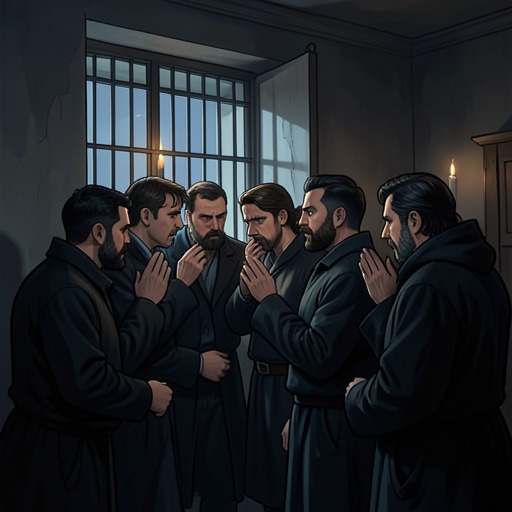
Elizabeth Barton is brought to Margaret Pole by her sons Geoffrey Pole and Lord Montague. Known as the Holy Maid of Kent, Barton wears the plain robes of a Benedictine nun; to Margaret, she looks more like an ordinary countrywoman than a prophetess. Lord Montague urges his mother to hear her, noting that Barton has spoken with Henry VIII after being presented to him by Archbishop William Warham. Margaret is Mary’s guardian, a position that makes the encounter more than a private meeting: Barton’s message concerns a princess whose status and future have become matters of political and religious conflict.
The prophecy takes shape amid a crisis over the king’s authority and his marriage to Katherine of Aragon. When Lord Montague brings news that the Church has surrendered to Henry VIII, he describes a new arrangement in which the king will rule the Church in England and the Pope’s authority will be disregarded. Thomas More has resigned as Lord Chancellor and returned home. Mary recognizes the scale of the change: the king has taken the Church, its wealth, laws, and courts into his own possession. Barton’s vision answers this upheaval with an opposing future, in which Mary’s accession and the return of the old religion would reverse the direction of royal policy.
What the prophecy foretells
Barton tells Margaret that she has been commanded by the Mother of Heaven to assure Mary that she will come to her throne, whatever happens. She also connects the princess’s future with Reginald Pole’s. If he shows exceptional courage, Barton says, he will rise through the Church and become Pope; from that position, he will see Mary crowned and the true religion restored as England’s sole religion. The vision thus makes a family’s political vulnerability part of a much larger religious forecast. Reginald’s advancement and Mary’s restoration are presented not as separate hopes but as mutually reinforcing parts of the same promised future.
The prophecy assigns Margaret an active role. Because Henry VIII appointed her to guard and support Mary, Barton tells her that she must never leave the princess and must prepare her to take the throne. She warns that if Henry does not return to his wife, his reign will not last. If Mary is not offered the crown, Barton foresees her riding at the head of her men, fortifying her residence, and entering London on a white horse to the people’s cheers. Lord Montague, she predicts, will stand beside her not merely as commander but as king consort, marrying Mary and sharing the crown. The White Rose of York becomes the prophecy’s dynastic emblem: Barton associates Montague with royal blood and the kinship ties that, in her vision, make him a fitting partner for the restored princess.
Hope, belief, and danger
Margaret is shaken by the scope of Barton’s claims. She acknowledges that Mary’s restoration is what she herself has hoped and prayed for, and Barton’s confidence persuades her that the future has been revealed to the seer. Yet belief does not make the prediction safe to repeat. Margaret ends the meeting by ordering Barton not to speak of her sons or family, calling the words dangerous. The prophecy’s specificity gives it force, but also makes it sound like a plan: it names a princess, a royal marriage, an armed following, a route into London, and a new religious settlement.
That danger shapes Margaret’s later silence. When Lord Montague asks whether Barton ever predicted that his family would take the throne, Margaret refuses to answer, even to her son. She recalls Thomas More’s warning against prophecies that promise greatness to vulnerable families. In his example, a prophecy had encouraged a duke to dream of power, and the king had then destroyed both the prophet associated with that hope and its would-be hero. Margaret therefore withholds the prediction of Montague’s marriage and the return of the Plantagenet line. Her silence preserves the distinction between hoping for restoration and openly claiming it; in a court where words about succession can attract royal suspicion, even a vision can become dangerous evidence.
Public warning and unresolved fulfillment
Barton’s warnings are not confined to Margaret’s private circle. On the return from France, Lord Montague reports that Barton passed through a crowd and the guards to reach Henry VIII while he was walking with Anne Boleyn at Canterbury. Her recurring warning, as he recounts it, was that the king’s days would be numbered if he set aside the queen. Earlier, she had claimed that warnings to Cardinal Wolsey and Warham were borne out by their deaths; her prediction concerning Thomas More remained, at that point, in the future. These reports help explain why Margaret can regard Barton’s words as credible while fearing their consequences.
The book does not present Mary’s restoration as an accomplished event. Instead, the prophecy remains suspended between the seer’s certainty and the political world’s uncertainty. Later, as Margaret travels to Peterborough, people bless the late queen, her daughter, and the white rose, suggesting that sympathy for Mary and her lineage extends beyond the household. But popular acclamation is not fulfillment: Barton’s promised accession, religious restoration, and marriage alliance remain forecasts rather than outcomes in the evidence presented. The prophecy’s narrative importance lies in that unresolved interval. It gives the dispossessed a language for imagining a different England, while making the act of imagining—and especially speaking—that future a potential threat to the reigning king.