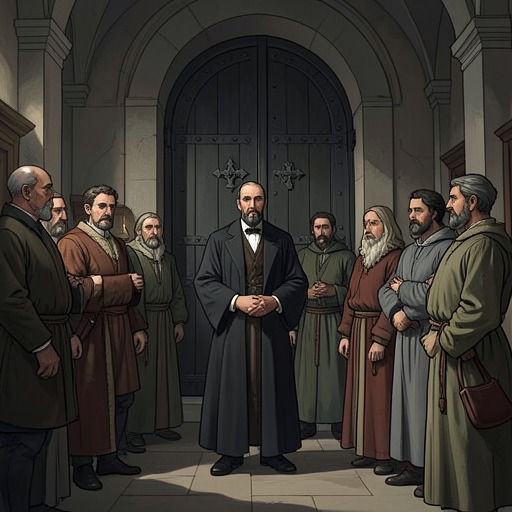
Royal Supremacy over the English Church
The King's CurseRoyal Supremacy over the English Church marks Henry VIII’s claim to govern the Church in England rather than answer to the Pope. Margaret Pole presents this change not as an abstract constitutional adjustment but as a struggle over who may define religious authority, marriage, inheritance, and truth. Its consequences are visible both in the rules announced for the Church and in the oath that Margaret and other peers are made to sign.
Meaning and Stakes
The crisis grows out of Henry’s effort to resolve his marriage to Katherine of Aragon and secure the succession. The Pope’s authority mattered because the validity of a royal marriage was not simply a matter for the king to declare. Earlier, Margaret had been pressed to attest that Prince Arthur and Katherine’s marriage had been consummated; the dispute mattered because a claim that it had not been consummated could support a request for a papal dispensation for Henry VII to marry his former daughter-in-law. The episode establishes the pressure exerted by competing claims about marriage and church jurisdiction, before Henry VIII’s later effort to make the English Church answer to him.
The dynastic stakes remain acute in Henry VIII’s reign. At the birth of one of Katherine’s children, Margaret recalls the court’s unspoken hope that a son would secure the queen’s standing and settle the question of succession. The infant is found lifeless, and that lost prospect gives concrete weight to the political importance attached to a male heir. Royal authority over the Church emerges amid this uncertainty: control of religious jurisdiction could also determine how the king’s marriage and the status of his children were publicly understood.
The Submission of the Clergy
When Margaret’s son Montague brings news to Princess Mary Tudor, he reports that the Church has surrendered to the king. The Pope is to be disregarded in England, while Henry is to rule the Church himself. Montague also tells them that Thomas More has returned the Lord Chancellor’s seal, resigned his office, and gone home. His departure makes the change personal as well as institutional: the king has lost a counsellor whom Margaret’s household regards as one of the few remaining voices capable of telling him the truth.
Montague describes the practical limits imposed on the Church. It may no longer make law, convict heresy, send its wealth to Rome, or receive commands from Rome. Princess Mary immediately grasps the breadth of the change, asking whether the king has made the Church his own, including its wealth, laws, and courts. The account distinguishes between her alarm at the scale of the seizure and Montague’s specific explanation of the new restrictions; together, they show how far the royal claim reaches into ecclesiastical government.
Mary also frames the dispute as a question of religious obedience. She invokes the belief that Jesus appointed Peter to rule the Church and asks whether England is to disobey Christ. Margaret interrupts by insisting that the matter belongs to churchmen, not to them. Mary’s look suggests that she expects a frank answer, while Margaret’s evasion reveals the personal danger of speaking plainly. The scene sets theological conviction beside political self-preservation: the issue is not only who holds power, but who can safely say that the king is wrong.
The Oath and the Authority to Define Reality
In spring 1534, at Westminster Palace, Thomas Cromwell summons the peers to the Privy Council and administers the Oath of Succession. Margaret understands the conflict behind the ceremony. The Pope has publicly ruled that the marriage of Katherine and Henry is valid and that Henry should remain with his wife, but has not excommunicated him. The king, meanwhile, claims that the Pope has no authority in England. The competing positions leave the peers to choose what they will affirm without, in Margaret’s view, being authorized by the Pope to defy their king.
The oath requires more than assent to a succession arrangement. Margaret describes it as making her pledge loyalty to the children of Henry’s marriage to Anne Boleyn and acknowledge Henry as head of the Church in England. She sees the ceremony as an exercise of the king’s power to make a declaration count as reality: he declares Katherine no longer his wife, Anne queen, and Anne’s child a princess, and his subjects are expected to affirm those designations. The oath thus joins the religious settlement to the contested status of the royal marriage and its heirs.
Margaret’s hand trembles as she signs her name. She and Montague have agreed to sign so that their loyalty cannot be doubted, hoping that better days may come. Her signature renews allegiance to the king, but she experiences it as a betrayal of what she believes to be true. The gap between inward judgment and outward profession is central to the episode: the oath produces an appearance of consent while leaving Margaret privately convinced that its claims are lies.
Conscience, Resistance, and Consequences
Margaret later learns that John Fisher refused the oath when it was brought to him in the Tower of London. He could not deny the Pope’s authority, and he was returned to prison. Thomas More also refused to sign as written, offering instead to accept a revised form that he could conscientiously affirm. Margaret remembers his restraint: he did not condemn those who had drafted or signed the oath, but would not violate his own conscience. Henry had promised that More would not be put to this test; Margaret concludes that the king broke his word to his friend.
The consequences extend beyond the signature ceremony. Montague later tells Margaret that Fisher and More have been put on trial, and he doubts that the king will spare More. Margaret still believes that Henry’s affection and earlier permission for More to withdraw from office should protect him. Montague’s response is that the king’s demand for pretence has become pervasive: people are expected to behave as though contested claims about the king, his family, and the Church are unquestionable. In this account, supremacy is maintained not only by a declaration of authority but by compelling subjects to perform agreement and punishing refusal.
Political Power and Human Vulnerability
The title attached to Henry’s authority changes along with the order he asserts. After the king claims supremacy over the Church and distances England from the Pope, Margaret notices that he is addressed as Majesty rather than Your Grace, a style she associates with imperial rank. Yet the elevated title does not make him invulnerable. When Henry grieves over the death of Henry FitzRoy, he asks Margaret whether a curse is responsible for the losses that have made him miserable. She does not answer his appeal with an explanation. The episode places the king’s immense public authority beside his private dependence and grief.
That contrast sharpens the significance of Royal Supremacy over the English Church. Henry can demand that institutions and subjects recognize his authority, and his declarations reshape the public status of his marriage and family. But Margaret’s narrative keeps visible the limits of command: assent can be compelled, while belief cannot; a royal title cannot prevent loss; and those who refuse to pretend may pay with imprisonment and trial. The settlement’s force lies in its reach into both government and conscience.