Silence and self-censorship
The King's CurseSilence and self-censorship are survival practices in Margaret Pole’s story, formed under a regime in which people fear surveillance, arrest, and punishment for their words or connections. They shape family life, restrict what Princess Mary is allowed to know, and force political communication into guarded letters, trusted intermediaries, and carefully chosen public language. Yet silence cannot fully close the network of information: rumors travel, coded messages are decoded, and political allegiances sometimes become visible in the street.
Surveillance and the pressure to remain silent
In 1508, the arrest of Margaret’s cousin George Neville brings danger close to her household. George had been keeping two of her boys, Henry and Arthur; after his arrest, the boys are left at his home in Kent. Rumors say that the king visits the Tower of London at night to oversee the torture of suspected men. A pedlar’s report of what people in the City are saying gives those fears a name: The Moldwarp, a cursed creature associated with darkness and buried things. The label circulates as hearsay, not verified knowledge, but it conveys a political atmosphere in which the king is imagined as both hidden and watchful.
Margaret wants to bring her sons away, but fears that doing so will draw attention to herself and alert the Tudor spy system to the rest of her family. Reginald is kept in silence at the Charterhouse at Sheen; Ursula and Margaret are sheltered at Syon Abbey by their devotions; and Geoffrey remains with Margaret because she believes there is nowhere safe for him to go. The perceived possibility of being watched shapes what she dares to do even before an observer appears. Silence is therefore not merely a response to direct questioning: it is anticipatory self-protection, narrowing movement and communication in the hope of avoiding notice.
The same danger reaches into the household through warnings about what might be found there. When Margaret asks whether she will be questioned, she is told that officials are bound to ask if anything is in the house. The warning expands beyond ordinary possessions to anything that could suggest royal descent or a claim to the throne: a banner, standard, bead-roll, letter, or prophecy. The advice is to clear these things out and burn them. The scene makes material evidence part of the discipline of silence: objects that could preserve family memory might also speak against their owners in the hands of investigators.
A household trained in discretion
By 1522, Margaret’s life at Bisham Manor has become almost invisible. She writes to no one and sees only her sons. George Neville, now at Birling Manor, sends occasional letters containing only harmless family news and leaves them unsealed, so that a spy who intercepts one can inspect its contents. Margaret’s reply likewise confines itself to domestic matters, including the death of Ursula’s infant son from fever and the birth of a daughter to Lord Montague and his wife, named Katherine for the queen. The form of these letters is itself a precaution: discretion is built into the channel, not left to the hope that a private message will stay private.
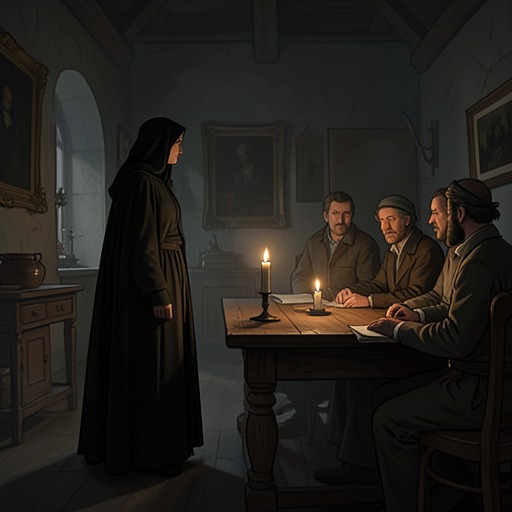
Inside Bisham, the family’s restraint becomes habitual. Margaret and her sons do not discuss the king, the court, or the princess she is no longer allowed to serve, even when they are alone after the servants have left. They do not need to renew an explicit pact; the silence has settled over them without discussion. Their ordinary family talk is kept unremarkable enough that a listener at the chimney, under the eaves, or by the door would have little reason to attend to it. The threat of possible observation thus reaches into intimate domestic life, making self-censorship a shared routine rather than an individual act.
Margaret applies a related caution to Reginald, who is safe in Padua and valued for his scholarly assistance to the king and Thomas More. Although their work on a defense of the true faith brings him into agreement with the king on biblical matters, Margaret advises him to stay away from London. His studies can continue in Padua, and she does not want him exposed while a shadow remains over the family’s reputation. The advice shows how political risk can outlast a particular accusation: even favor and useful service do not, in Margaret’s judgment, make a return home safe.
Withholding news and managing what can be said
The silence Margaret enforces at Bisham later governs what Princess Mary hears at Ludlow. By the end of the summer, the whole kingdom knows that the king is seeking to end his marriage to Katherine of Aragon, but no one speaks of it inside the state rooms at Ludlow. Margaret has established a rule over her household that keeps ugly gossip from reaching the young princess. The result is protective in intention but isolating in effect: Mary’s world is collapsing around her without her knowing it.
Margaret struggles to tell Mary herself. Several times she tries, but cannot bring the words out; the news seems so unreal that she cannot give it an account. Her hesitation is not only a barrier imposed from outside. It is also an act of self-censorship sustained by disbelief and by a wish to preserve the princess from a political crisis that has already become public elsewhere. When Margaret remembers that Katherine and Arthur had lived at Ludlow and that she had promised to support a lie about their relationship, her silence has another purpose: she fears that someone may ask whether the marriage was consummated, and hopes that practiced forgetfulness will allow her to say truthfully that she no longer remembers.
The limits of concealment become clearer when Margaret’s household has to pass a message to Katherine. Margaret shows Lord Montague and Geoffrey a folded paper that she has promised to get into the queen’s hands. Lord Montague proposes sending it through Eustace Chapuys, the Spanish ambassador, who already writes to Katherine secretly and delivers her letters to the emperor and the Pope. Margaret insists that nobody must know the message came through them. Here, silence does not mean abandoning communication: it means concealing the sender and protecting the route by which information moves.
The family also hears consequential news through constrained channels. Lord Montague’s cheerful, unsealed letter from France reports clothes, hospitality, and the success of talks, while saying nothing of the politically dangerous matters he cannot safely discuss in writing. In person, Geoffrey reports Reginald’s counsel: Emperor Charles will invade if the king publicly marries Anne Boleyn and sets Mary aside, and the family must rise and march with him. The contrast between the bland letter and the grave spoken report shows how the medium and setting determine what can be said.
Coded messages, exposure, and political speech
As danger increases, secrecy becomes more elaborate. To prepare for a possible escape for Mary, Geoffrey reports that a boatman at Grays is ready to leave and remains loyal to the princess. Margaret’s kinsman Arthur Plantagenet, Lord Lisle, can receive goods in Calais, with a warning sent to his steward in London when the consignment is due. Lord Montague brings half a dozen riding horses to court under the ordinary explanation that they are for the hunting season; news about Mary’s movements comes through a stable boy paid at Hunsdon. Each connection carries information across a different part of the network, while ordinary errands and respectable pretexts disguise the plan.
But concealment is vulnerable to interception. Geoffrey tells Reginald that Francis Bryan has been sent to capture him, disguising the warning in a message that appears to concern the price of wheat in Berkshire. Thomas Cromwell reads it and recognizes that its meaning is not about wheat. He accuses Geoffrey of disloyalty; Geoffrey is later arrested. His brother argues that warning a man that someone is coming to kill him is not treason, but the episode demonstrates that a coded message can become evidence once its cover is penetrated. Silence and secrecy protect communication only as long as the powerful cannot interpret the signs.
Not all political communication remains private. At Peterborough, people recognize Margaret’s banner and publicly bless the White Rose of York, Katherine, Mary, and Margaret’s house. Their response gives voice to an allegiance that her family often has to manage in private. During the Pilgrimage of Grace, a man recognizes Margaret and describes the movement as a pilgrimage rather than a rebellion, telling her that she too is a pilgrim with a pilgrimage gate to pass through. The naming does political work: it frames collective action in terms distinct from the language of rebellion. These scenes contrast with Margaret’s guarded correspondence and household restraint, showing that public words can also carry risk and meaning.
The costs and limits of self-censorship
Silence protects Margaret’s family by limiting what spies, officials, and casual listeners can learn, but it exacts a cost. It leaves Mary ignorant of the threat to her position, requires Margaret to suppress what she knows about the past, and makes even kinship correspondence a narrow channel for safe domestic facts. It also cannot stop information from moving through merchants, travelers, religious contacts, and rumor. Reports about the king, prophecy, and political danger continue to circulate beyond the controlled household.
The concept’s central tension is that silence can preserve a person or a plan while also helping fear govern ordinary life. Margaret’s family avoids discussing politics even in private, yet still sends folded papers, coded warnings, and carefully disguised preparations through trusted connections. When those communications are discovered, the same network that made resistance possible becomes a source of exposure. Silence in the novel is therefore neither simple passivity nor a complete refuge: it is a disciplined, unstable means of living under surveillance, continually tested by the need to know, to warn, and sometimes to speak.