Syon Abbey
The King's CurseSyon Abbey is a Bridgettine religious house at Brentford, west of London, where Margaret Pole finds shelter with some of her children after the death of her husband and the political dangers of Henry VII’s reign have left her vulnerable. It is both a practical refuge and a place marked by separation: while Margaret and the younger children live among the sisters, Reginald is placed across the River Thames at Sheen Priory. The contrast between the abbey’s communal life and the strict silence imposed on her son gives Syon a central place in the family’s story of survival, loss, and religious dependence.
Setting and religious life
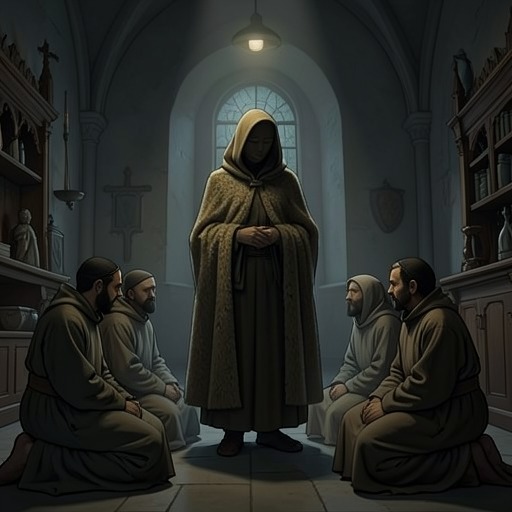
Syon is described as one of Margaret’s family’s favored religious houses, opposite the old Sheen Palace. It is governed by a Mother Abbess and attended by about fifty nuns. The sisters receive noble visitors, and their community has a life beyond its walls: they go into London to teach and pray. Unlike the nearby Carthusian house at Sheen Priory, Syon is not a silent monastery. That distinction matters acutely to Margaret, who sees the abbey as a place where her family can live together and where its religious community can provide care as well as shelter.
The house’s religious identity also shapes the limits of that shelter. Margaret is not free to invite her older sons Henry Pole and Arthur Pole to stay: she fears imposing on the sisters, who cannot readily accommodate two energetic young men in their quiet cloisters, and she cannot afford their journey. Syon offers a roof, but it cannot restore the family’s former household or overcome their lack of money. Its refuge is real, yet bounded by the rules and resources of the community that has taken them in.
Refuge and the separation of Reginald
Bishop John Fisher arranges for Margaret to stay at Syon with her daughter Ursula Pole and the infant Geoffrey Pole. He also finds Reginald Pole a place in Sheen Priory, a Carthusian monastery a few miles away across the river. The arrangement provides for mother and son in neighboring religious houses, but proximity is not reunion. Margaret imagines that a candle in her window might let Reginald see that she is thinking of him, and that a hired boatman might sometimes carry him across on feast days. Even the possibility of such contact depends on permission and on the river between them.
The separation becomes most painful when Margaret leaves Reginald at the priory. He is six years old, pale with fear, and too obedient to speak aloud; his mouth silently forms a plea to his mother as she rides away. At Sheen, the Carthusians live as hermits in individual cells, praying and working alone. Speech is generally forbidden, except on Sundays and feast days, with a quiet conversation allowed during the monks’ weekly walk. Margaret knows this discipline is ill suited to a boy who loves reading aloud, singing, riddles, and jokes. Syon is therefore not simply a refuge from political danger: it is also the place from which she must watch her child being shaped by an austere life across the water.
In spring 1507, Reginald is sent to visit her only once every three months, crossing in a hired rowing boat and staying one night. He has learned to keep his eyes down and his hands at his sides; when Margaret embraces him, he remains stiff and unwilling. The visit makes the cost of the arrangement tangible. The boy she remembers as lively and talkative seems to her almost lost to the silence of the priory, while Syon gives her only a brief chance to hold him before he must return.
Poverty, danger, and political refuge
Margaret’s life at Syon is shaped by precarious finances as well as separation. The rents from Stourton are sent to her, but she must hand them to the abbey for the family’s keep. Ursula’s secondhand gowns need repeated letting down, and Geoffrey’s boots press against his growing toes. Margaret worries about what will happen when the younger children are too old to remain there; she fears they, too, may have to enter the Church and disappear into religious life. Her prayers at Syon ask not only for protection, but for hope and money. The place that keeps the children fed also makes visible how little control their mother has over their future.
The abbey’s setting offers no immunity from the Tudor crackdown on Margaret’s kin. In spring 1508, she learns that Henry VII has arrested Thomas Grey and George Neville, Lord Bergavenny, who has been keeping Henry and Arthur. George leaves the boys at his home in Kent and enters the Tower of London. At Syon, rumors about torture and royal surveillance reach the community through a pedlar’s report. Margaret’s prayers at the chancel steps, before the crucified Christ, express her sense that the family’s suffering has become a long passage of grief. The abbey is a haven in which she can pray, but the threats beyond it repeatedly cross its threshold through news, rumor, and the endangered lives of relatives.
Syon is also where Margaret hears that Henry VII has died in April 1509. The old porteress Joan brings the news directly to her cell, waking a moment of disbelief into sudden hope. Margaret has spent years fearing for herself and her family; the king’s death appears to mean that the danger of his reign has passed. Her relief is inseparable from the abbey’s enclosed daily life: the news arrives at the door of her cell, while Geoffrey is asleep in her narrow bed and Ursula lies in a truckle bed nearby. The house that had held her through fear becomes the setting for the announcement that she may at last emerge from it.
A house remembered and revisited
Margaret’s return to royal favor changes what Syon can mean to her. At court under Henry VIII, she receives a grant of one hundred pounds a year, settles debts owed to the nuns and to Reginald’s priory, and arranges for her sons to enter the king’s household. Her earlier petition to reclaim the family fortune and title likewise frames restoration against the years in which she had to live without them. Syon remains part of the material history of that hardship: Margaret’s family had depended on the Church for lodging and support, and her later ability to repay the community marks a reversal in her circumstances.
Years later, Syon again enters Margaret’s life through Elizabeth Barton. Barton is staying at the abbey and preaches to the Carthusian brothers. She comes to Margaret’s private chapel, where Margaret meets her after hearing that she wishes to speak. When Barton later disappears, Margaret fears that Thomas Cromwell may force her to name people connected with the queen. Margaret admits that she once prayed with Barton, and the encounter places Syon within the widening danger around the queen’s friends. The abbey’s spiritual reputation can draw visitors and give them access to Margaret, but that same association becomes politically perilous.
The house is eventually closed. In 1539, as Margaret is taken by barge toward the Tower of London, she remembers the first cuckoo of spring that Geoffrey used to listen for when he was a little boy living with the sisters at Syon. The memory sets the abbey’s earlier refuge against the present: Geoffrey is now imprisoned, the community that sheltered them has been closed, and Margaret travels in an unmarked barge without the family standard. Syon survives in her recollection not as an untouched sanctuary, but as the place where her children were raised, separated, and sustained—and whose loss gathers into the larger collapse of the life and inheritance she had once recovered.