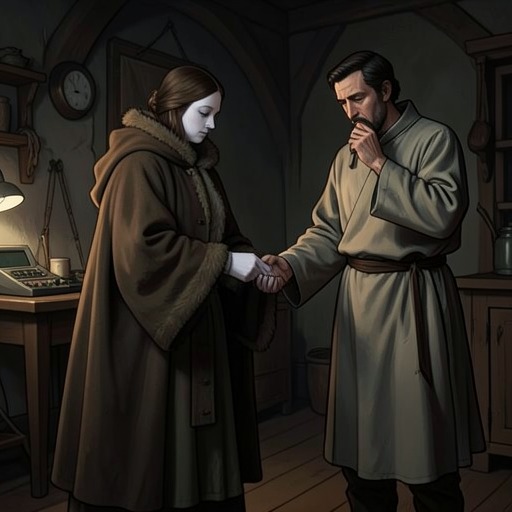
The 1517 sweating sickness epidemic in England
The King's CurseThe 1517 sweating sickness epidemic in England is presented as both a medical emergency and a test of kingship. As the disease reaches London, fear of its speed drives Henry VIII and his court from one residence to another. The king’s flight, set against the suffering of ordinary people who have no comparable refuge, turns an epidemic into a public measure of royal responsibility.
The outbreak and the fear of speed
The narrative dates the outbreak to the summer of 1517, when the sweating sickness comes to London. Its terror lies in the apparently abrupt passage from health to death: reports describe a person well at dinner, troubled by headache and heat that evening, and dead by sunset. No explanation is offered for why the sickness moves from one place to another, or why it kills one healthy person while sparing another. The disease resists both prediction and control, making ordinary signs of good health feel unreliable.
The epidemic’s reach is suggested through accounts that grow more alarming as they circulate. Thomas Wolsey contracts the disease, and people prepare for the possibility that he will die; he survives. His recovery does not reassure Henry VIII. To the king, each new report instead sharpens the danger and makes escape seem urgent. The contrast is telling: the cardinal’s survival offers evidence that the disease does not kill everyone it strikes, but the king responds less to that uncertainty than to the possibility that it might reach him.
The wider story associates the Sweat with the Tudor arrival in England. It is described as a disease that followed the Tudor army and that had previously threatened London when people assembled to welcome the king. That history gives the 1517 outbreak a political shadow: it is not only a fresh crisis, but part of a recurring fear attached to the dynasty’s rise and rule. The narrative records such associations as part of the way people interpret the disease, not as an explanation of its cause.
The court’s retreat
The royal household first withdraws from London to Richmond Palace, farther from the city’s dirt, smells, and low-lying mists. When a server there falls ill, Henry VIII fears that the sick young man may have handled his food. The court packs up again. Each head of service is ordered to examine staff members closely and ask whether they have heat, pain, faintness, or other symptoms. The precautions offer little certainty: people are reluctant to admit illness if doing so might leave them behind, and the disease can develop so quickly that an examination cannot guarantee anyone’s safety.
The court moves downriver to Greenwich, where Henry VIII orders rooms swept and washed daily and keeps others at a distance. The measures convey the limits of his supposed healing authority: although the king is associated with a healing touch, he will not allow people near him. The royal body, usually presented as a source of power, becomes a body guarded from contact and exposed to the same uncertain illness as everyone else.
An embassy from Spain briefly gives the court another focus. During the negotiations, the household maintains an appearance of normality, with feasts, celebrations, and jousts. Henry VIII is attentive to his Spanish queen, Katherine of Aragon, and listens to her speak with the envoys. This interval of ceremony does not end the epidemic. After the visitors leave, reports of sickness in the village of Greenwich prompt the king to decide that Windsor Castle is safer.
At Windsor, the court is shut down. Only Katherine of Aragon, a small group of the king’s friends, and his personal physician accompany him. Margaret Pole returns to Bisham Manor, where she hopes the disease will pass Berkshire by. The movement from London to Richmond, then to Greenwich and Windsor, is not a planned public response so much as a succession of retreats prompted by new signs of danger.
Flight and public consequence
The danger seems to follow the king into his own household. When pages serving in his bedchamber fall ill and one dies, Henry VIII imagines death tracking him. He leaves servants and friends behind and travels with only the queen and his physician, moving from house to house in search of refuge. Outriders go ahead, while the physician questions potential hosts about sickness in their households. Even after a house has been judged safe, a report of a maid’s heat or a child’s toothache can send the king onward again.
These abrupt departures disrupt the court as well as its hosts. Furniture, linen, and silverware are left behind; households that have ordered costly food and entertainment are told that the king cannot stay. The royal entourage loses the appearance of settled dignity as it rushes between residences. Henry VIII seeks certainty in a crisis that offers none, while imposing the consequences of his search on people expected to receive and serve him.
In London, the king’s absence becomes a civic grievance. Apprentices take to the streets asking where the king, the Lord Chancellor, the Lord Mayor, and the city fathers have gone, and whether London has been abandoned. Their questions make the political consequence explicit: the city does not experience the royal household’s retreat as a private precaution alone. With civic leaders and the king absent, people fear that no one is standing alongside them or directing a response.
The sickness reaches workers in the ordinary settings of their labor. Plowmen faint, brewers set aside their malting spoons to rest, and spinners lie down with fever. People who had once adored the young king turn against him, condemning his flight from an illness they cannot escape. They connect his father’s arrival with the coming of death and accuse the son of abandoning them to its effects. The narrative’s sharpest contrast is therefore between unequal mobility: the king can flee repeatedly, while workers remain exposed in their fields and workplaces.
Margaret Pole and the meaning of the episode
Margaret Pole observes the crisis from a position different from that of the royal court’s constant movement. Once Henry VIII leaves, she is released from caring for Princess Mary Tudor, who is safe in her nursery. She uses the summer to attend to her own buildings, lands, farms, and finances, and to arrange the marriage of her son Montague. The epidemic thus changes her immediate obligations as well as the court’s itinerary, giving her a rare interval away from royal service.
The episode’s account of the sickness remains bounded by what its characters can know: symptoms are observed, movement is feared, inspections are attempted, and safety is sought, but no cause or reliable protection is supplied. That uncertainty helps explain the court’s escalating precautions without making them effective. More consequentially, the king’s flight exposes the difference between authority and care. Henry VIII can command servants to inspect one another and can leave a threatened place; the people of London can neither command the king to remain nor travel beyond the disease’s reach. The outbreak therefore registers not only as a season of illness but as a rupture between ruler and subjects, remembered through the question of whether a king should share the danger borne by his people.