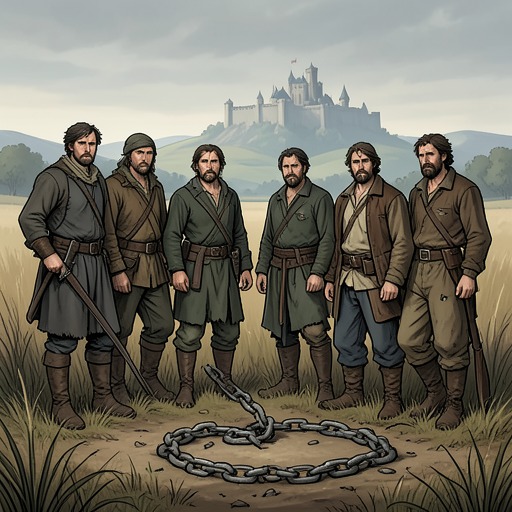
The Crown's Repression in the North After the Pilgrimage of Grace
The King's CurseThe Crown's Repression in the North After the Pilgrimage of Grace describes how the royal promise of reconciliation gave way to a campaign of punishment across northern England. Pardoned participants had begun to disperse and religious houses to reopen, but Henry VIII’s government treated renewed unrest as grounds for arrests, executions, and the destruction of the institutions the rising had sought to protect. The reversal made the pardon an uncertain safeguard and carried repression from the battlefield into courts, villages, monasteries, and family burial grounds.
From reconciliation to renewed arrests
After the Pilgrimage of Grace, the north appeared briefly to be settling. The pilgrims dispersed under pardons and swore loyalty to the king; religious communities returned to their houses, churches restored objects hidden during the upheaval, and Margaret Pole asked her steward to invite Prior Richard back to Bisham. Her grandson Harry wondered whether his uncle Reginald would return home, and she believed he might. That fragile hope is the immediate contrast against which the new prosecutions unfold.
In February, Thomas Howard, Duke of Norfolk, charged nine men with treason in York and sentenced them to death. When Margaret questioned how men could be condemned despite the pardon, Geoffrey Pole explained that Norfolk needed to demonstrate firmness to the king, even if that meant punishing some of those associated with the rising. Margaret feared that the pardon could not reliably protect anyone. Events soon appeared to confirm that fear: the commons at Carlisle mobilized against Norfolk’s army, and hundreds were killed when northern lords who had recently stood with the pilgrims abandoned them during the truce. The defeat showed how quickly the rising’s former allies could be isolated and overcome.
Martial law and punishment across the North
Thomas Howard then declared martial law, displacing the authority of local magistrates and lords. He conducted hearings in towns and imposed death sentences, while men were brought before him in large numbers. The account presents justice as compressed into the will of a single royal commander: the accused had no meaningful defense against a process in which Howard could act as judge and executioner. The punishments reached beyond those who had taken part in the latest fighting, extending the danger to communities suspected of having supported the pilgrimage.
Royal retaliation also targeted the social memory and religious practices of the rebellion. Henry VIII ordered Norfolk to visit monasteries that had resisted and make an example of their monks and canons. When widows and orphans secretly buried executed relatives in churchyards, the king ordered their families found and punished and the burials undone. The policy thus reached beyond living suspects to the treatment of the dead, denying bereaved families even the security of quiet burial. Margaret’s account makes these measures part of the same campaign: punishment was intended to deter resistance, but also to make the memory and symbols of the pilgrimage dangerous to preserve.
Monasteries, pardons, and the loss of protection
The royal pardon had encouraged people to believe the conflict was over. Its weakness became apparent as men who had accepted it faced further violence, and as support for restoring religious houses was recast as evidence of disloyalty. In Margaret’s account, Thomas Cromwell promised Sir Christopher Dacre an earldom for his service against the northern commons. The promise underscores how the suppression rewarded those who served the crown while leaving former participants exposed, even when they had previously been reconciled with it.
Norfolk closed monasteries again, including houses that had reopened after the rising. Their buildings were to supply stone for neighboring lords, while their lands were sold to nearby farmers. The consequences were both material and religious: monks and canons lost their homes, and local people lost institutions that had offered help and a focus for worship. Shrines and pilgrimages were no longer presented as sources of hope; the narrative’s recurring image of a year with no merry May gives the political reversal a seasonal as well as spiritual register. The new order did not simply suppress an armed rising. It dismantled the religious world whose restoration had helped give the movement meaning.
Arrests and the fate of former leaders
In spring 1537, Margaret was away from London when Lord Thomas Darcy and John Hussey were brought into the Tower of London for questioning. Darcy held a royal pardon, yet was arrested. He accused Thomas Cromwell of causing the rebellion and refused to identify other people or disclose who had received the pilgrim badges kept at Pontefract Castle. He maintained that the badges had come from a chest connected to an earlier crusade, and his refusal to supply names limited the usefulness of the interrogation. Hussey, once chamberlain to Princess Mary Tudor, likewise named no one. Margaret remembered his service to the princess and feared she would learn that he was imprisoned.
The prosecutions continued beyond these arrests. Eight men and one woman, including Robert Aske and two of Margaret’s distant kinsmen, were brought before juries on treason charges. Aske had led the Pilgrimage of Grace, received a full pardon, and afterward urged people to trust the king’s promise rather than take up arms. Cromwell nevertheless argued that Aske’s assurances that the pilgrimage had achieved its aims amounted to treason. His case illustrates how the government could turn the language of reconciliation itself into evidence against a pardoned leader.
Aske was taken from prison to trial and then transported north, where he was displayed in York before being hanged at Clifford’s Tower. His earlier reception at court, where the king had embraced him, stood in stark contrast to his final public humiliation and death. Margaret and several lords appealed to Cromwell for mercy for the northern men, but he refused. The outcome confirmed that neither a pardon, former service, nor an appeal from peers could reliably restrain the crown’s demand for punishment.
Significance
The suppression reveals a political order in which royal pardon offered no stable settlement once the king’s interests shifted. Men who had accepted the terms of peace could be prosecuted for trying to uphold what they understood those terms to promise; religious houses could reopen and then be shut again; even families who buried their dead faced punishment. Through Margaret Pole’s perspective, the reversal is registered not only in arrests and executions but in the destruction of ordinary trust—in a pardon, in a churchyard, and in the possibility that spring might bring renewal. The North’s defeat therefore becomes more than the end of a rebellion: it marks the replacement of negotiated restoration with royal coercion and the systematic removal of the communities and institutions that had sustained resistance.