The Curse of Elizabeth Woodville and Elizabeth of York
The King's CurseThe curse attributed to Elizabeth Woodville and Elizabeth of York is a vow of vengeance that turns the deaths of the princes in the Tower of London into a threat against the Tudor line. Revealed by Elizabeth of York to her cousin Margaret Pole, it joins family grief to the fear that the fate of a dynasty might be shaped by words spoken in childhood.
Origins and Terms of the Curse
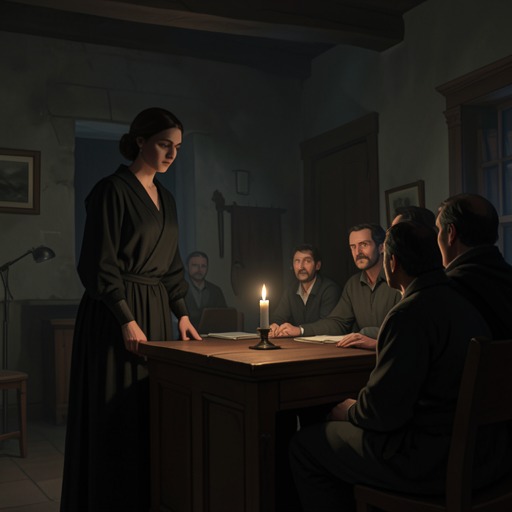
Elizabeth of York confides that she and her mother, Elizabeth Woodville, spoke the curse together when she was a girl. Its grievance was the taking and killing of her brothers, whom she describes as boys who had not yet become men or kings, though they had been born to rule. The women appealed to the river and to the goddess they associated with the founding of their family, asking that the killer's son die while still young and that his grandson die as well. The deaths of those descendants, they said, would be proof that the curse had taken effect and payment for the loss of their son.
The revelation revises Margaret Pole's first understanding of the curse. She initially assumes that it was Elizabeth Woodville's alone, but Elizabeth of York admits that she joined in it and fears that her own words may have helped endanger her family. The vow is presented not as an established cause of later deaths but as a remembered act whose meaning grows more disturbing as the succession unfolds.
Suspicions and Dynastic Fear
The women cannot establish who was responsible for the princes' deaths. In their conversation, they consider the possibility that Margaret Beaufort was involved: her husband had held the keys to the Tower, and the princes stood between her son and the throne. Their fear rests on suspicion and political circumstance, not on proof. Margaret Pole recognizes the danger in the curse's logic: if Henry VII were the murderer, then Elizabeth of York's husband and their son, Prince Arthur, might become its targets.
That fear gives the curse its intimate force. Elizabeth is not only a daughter mourning her brothers; she is also a wife and mother who imagines that her own son could be caught in the terms of her childhood vow. Margaret Pole answers by extending the possible consequence from a family to a dynasty, wondering whether the curse might leave the Tudors without sons and the kingdom with only daughters. The private confession therefore carries the pressure of England's unresolved succession into a conversation between two women bound by kinship and court life.
Later Echoes and Political Context
The narrative returns to the curse as the Tudor succession remains unsettled. After years of poverty and confinement at Syon Abbey, Margaret Pole describes her prayers changing from appeals for help and release to hopes for Henry VII's death, the restoration of the House of York, and the destruction of the Tudor line. In that silence, she comes to hope that the curse spoken by Elizabeth of York and her mother will prove true. Her response shows how a remembered vow can become a language for political resentment without establishing that it caused the events around her.
The curse also resonates against repeated anxiety over male heirs. When a royal infant dies, Margaret Pole imagines the loss as the old curse touching the line implicated in the deaths of the York princes. Later, after Henry FitzRoy dies, Henry VIII himself asks Margaret Pole whether a curse lies against him, interpreting the loss of people he loves as evidence of one. These episodes show the curse passing from Elizabeth's confession into the thoughts of others, each reading dynastic grief through its terms.
Kinship, Power, and the Curse's Meaning
The threat gains political weight because the Plantagenet family is presented as a broad, intermarried network. Margaret Pole recalls its many cousins and kinsmen in contrast to the small Tudor family, while the family's marriages bind together lands, wealth, and influence. The same connections that sustain kinship and mutual support can, under suspicious scrutiny, appear to form a faction or conspiracy. In this setting, the curse's focus on descendants makes family continuity itself feel vulnerable.
The narrative does not confirm the supernatural power of the vow. Instead, it follows how fear, bereavement, and political insecurity make the curse available as an explanation for losses and a vocabulary for resistance. Its force lies in that uncertainty: a childhood act of vengeance returns whenever the survival of a family and the legitimacy of a ruling house seem to depend on the fragile lives of their heirs.