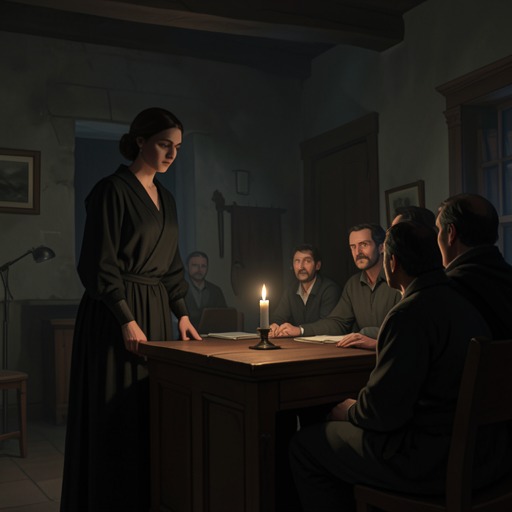
The King’s Curse
The King's CurseThe King’s Curse is the novel’s recurring image of a dynasty unable to secure its future: an alleged curse against the House of Tudor that turns the deaths of children and the absence of a lasting male heir into political as well as personal calamities. The book leaves the curse suspended between invented prophecy, Tudor-era rumor, and a modern medical hypothesis. Its force lies not in proving a supernatural cause, but in showing how fear of dynastic extinction shapes rulers’ conduct and makes the fate of individual bodies seem inseparable from the fate of a kingdom.
Origins and meanings
The curse began as a fictional response to the disappearance of the Princes in the Tower, presumed dead. The author imagined Elizabeth Woodville and her mother, Jacquetta, cursing the line of whoever had murdered Elizabeth’s sons. That accusation leaves responsibility unsettled between Richard III and Henry VII, both of whom were suspects in the imagined history. The prophecy also provided a long reach into the later Tudor story: it foreshadowed the dynasty’s difficulty in raising a son to adulthood and carry the line forward.
The novel’s title therefore points to more than one possible curse. It can refer to the curse spoken against the Tudors, to rumors that arose as Tudor babies died, or to Henry VIII’s own belief that a curse explained his suffering. These meanings overlap without becoming identical. The fictional imprecation gives the family’s losses a narrative shape; the rumors show how those losses could be understood within the story’s world; Henry’s belief reveals how a king may turn grief into an account of supernatural persecution.
Heirs, bodies, and political danger
The curse is bound to the succession problem because an heir’s birth is never simply a private family matter. When Katherine of Aragon goes into labor, those around her imagine that the birth of a son would vindicate her fertility, restore her standing against those who call her weak or cursed, and alter the king’s attention to the women at court. The child’s sex and survival carry consequences for the queen, the king, and the political order. In another scene, a nurse finds a baby in an ornate, gold-enamelled crib no longer breathing. Margaret Pole holds the child and then enters the queen’s chamber to face the news that must be delivered. The quietness of the discovery makes the loss feel both intimate and dynastic: the line is threatened not only by open violence but by a life that simply does not continue.
That vulnerability is set against the House of Plantagenet’s extensive network of cousins and in-laws. Margaret sees the family’s intermarriage as a way to keep wealth, land, and influence together; viewed suspiciously, the same ties can look like a faction or conspiracy. Her son Montague argues that the Plantagenets must defend the queen and Princess Mary, and that, acting together as the White Rose of York, they can oppose Henry VIII’s course and bring him back to what they see as his proper inheritance. The curse is not itself presented as the cause of this opposition. Rather, the uncertainty of succession gives both Tudor fears and Plantagenet claims their political urgency.
Henry VIII’s belief in a curse
After the death of his illegitimate son Henry FitzRoy, Henry VIII asks Margaret whether there is a curse against him and wonders why he loses those he loves. His grief makes the curse personal: the king interprets loss as evidence that a hostile force has singled him out. The scene places a father’s bereavement beside the burden of rule, suggesting how a private explanation can acquire public consequences when it belongs to a monarch.
The account also contrasts Henry’s increasingly elevated royal status with his physical dependence in grief. He now claims the title of Majesty, after rejecting the older form of address used for his father, yet attendants must lift him into bed while his household hesitates to approach. The title enlarges the political body of the king; his collapse makes visible the vulnerable human body beneath it. The curse gives that vulnerability a story, but the belief does not establish that a supernatural cause exists. It shows instead how readily misfortune can be recast as persecution by a ruler who cannot control the losses around him.
Historical rumor and medical possibility
The author’s note distinguishes the novel’s invented curse from evidence about historical belief. During research, the author found rumors that the Tudor line was cursed and reports of gossip following the loss of Tudor babies that the dynasty was bound to fail. The author also discusses research by Catrina Banks Whitley and Kyra Kramer, who propose that Henry VIII may have had Kell-positive blood. If a mother had the more common Kell-negative type, that incompatibility could, according to the research described, contribute to miscarriage, stillbirth, or infant death. The author connects the proposed inheritance to Jacquetta, through her daughter Elizabeth of York, and suggests that it might account for the losses of four babies born to Katherine of Aragon and three to Anne Boleyn. This remains a proposed medical explanation, not proof of the novel’s curse.
Whitley and Kramer also propose that McLeod syndrome may have contributed to Henry VIII’s later paranoia and anger. The author notes that the condition can develop in midlife and may involve physical deterioration and changes in personality. Read alongside the fictional curse, these hypotheses create an unsettling correspondence: a literary prophecy seems to anticipate real reproductive and bodily vulnerabilities, although the novel’s supernatural explanation and the medical proposals remain distinct. The curse ultimately joins private grief to public legitimacy, while leaving its cause unresolved.