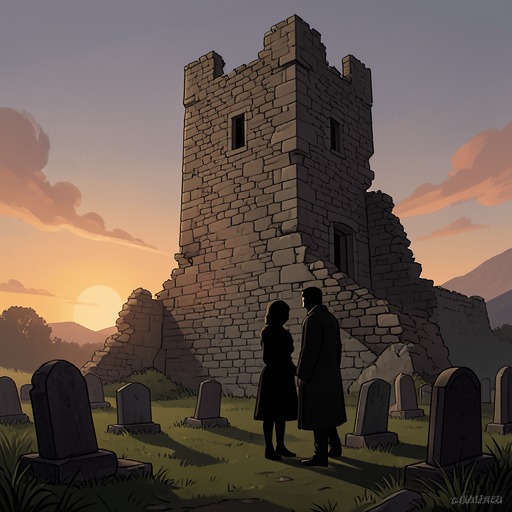
The Tower as a Plantagenet family tomb
The King's CurseThe Tower of London as a Plantagenet family tomb is a recurring image through which Margaret Pole understands the family’s persecution across generations. The fortress is at once a place where relatives are held and a destination from which, in her bleakest vision, they emerge only to die: a family seat turned into a tomb by repeated losses.
A family seat made into a tomb
After Geoffrey Pole is questioned, Montague describes the Tower as more than a prison. He calls it “our oldest and truest family seat” and imagines its graveyard as “the Plantagenet vault where we are all, in the end, going.” The quietness of his words gives the image the force of a shared inheritance: the family’s connection to the building is not one of belonging or safety, but of confinement and anticipated death.
The architecture of inherited fear
For Margaret, that image is grounded in personal loss. Her brother entered the Tower and came out only to die; her father also died there, accused of treason. She tells Montague that the thought of Geoffrey inside is like a nightmare and fears that she and her son may be taken there too. The fortress therefore holds several generations of family history in one place, making her dread of the present inseparable from what has already happened.
Memory repeated in the next generation
After Montague’s death, Margaret dreams of her brother walking to his death where her son walked to his, and of her father, who also died in the Tower. Sometimes the dream is simply of the building itself: its “square bullying bulk like a white finger pointing up, accusing the sky.” She sees it as “a tombstone for the young men of my family.” The image turns architecture into accusation: the Tower appears to mark not merely individual deaths but a recurring fate imposed on the family.
That recurrence shapes Margaret’s response to the imprisonment of the young Harry Pole and Edward Courtenay. She nearly reassures Harry that they will soon go home, reasoning that the boys are eleven and thirteen and that their only offence is having been born Plantagenets. Then she remembers that her brother was taken at the same age, for the same reason, and left the Tower only to walk to Tower Hill and the scaffold. The family tomb is thus not only a retrospective image of the dead; it makes the future of the imprisoned boys frighteningly legible.