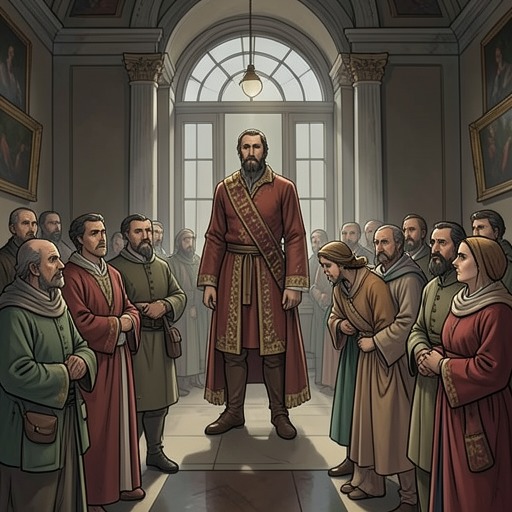
The king's power to define reality
The King's CurseThe king’s power to define reality is Henry VIII’s claim that his declarations can determine not only what the law requires but what is true: which marriage is valid, who may be called queen or princess, and even whether a child has existed. Margaret Pole’s account traces how that claim gains force through ceremony, legislation, and the compliance of those who know better. Its reach is political and intimate at once: it reshapes the church and the succession while demanding that a grieving household treat loss as though it never happened.
Naming Marriage and Legitimacy
The struggle over Katherine of Aragon’s marriage shows that royal power works by contesting evidence as well as by issuing commands. Margaret recalls being pressed to say whether Arthur Tudor and Katherine had been put together in her household each week. She confirms that the arrangement had been carried out, but that fact alone does not settle whether the marriage was consummated. The distinction matters: an observable routine is made to carry the weight of a conclusion about which Margaret is being asked to testify.
The dispute becomes more dangerous because the marriage’s validity has consequences for Henry’s own marriage and the succession. Margaret records the argument that a papal dispensation could permit Henry to marry his former sister-in-law if Katherine’s marriage to Arthur had not been consummated. Katherine’s supporters maintain that the marriage was valid; Henry’s side treats that position as a threat to his house. The pressure on Margaret is therefore not simply to recount what she observed, but to endorse the interpretation that serves the king’s dynastic purpose. The account exposes a gap between fact and the political meaning imposed upon it.
That gap later appears in the naming of Katherine and Anne Boleyn. After the archbishop declares Henry’s marriage to Katherine invalid, a herald brings Princess Mary a letter announcing Henry’s marriage to Anne. Mary checks that the sealed letter is correctly addressed to her as a princess before opening it. The careful inspection registers how precarious even a title has become: the king’s message may carry news, but its form also tests whether the old status will still be acknowledged. Mary receives it with composure, while Margaret recognizes that the change in royal language has changed the terms of public life.
Ceremony, Law, and Compelled Agreement
The court masque makes the struggle over status visible in a different way. At first, Princess Mary is the focus of the evening, appearing with seven ladies to dance with eight costumed knights. But after the queen prepares to withdraw, Anne remains among the courtiers rather than joining the queen’s train. Margaret sees that this is not an accidental breach of etiquette: Anne does not hurry to take her subordinate place, and Henry allows her to remain. The court’s order is altered through a public gesture before the new arrangement is secured in law. Ceremony does not merely reflect rank; it teaches the audience which rank the king is prepared to recognize.
The break with the Papacy makes that principle explicit. Lord Montague tells Mary that the Church has surrendered to the king and that Henry will rule it himself; Thomas More has returned the Lord Chancellor’s seal and left office. Mary understands that the change reaches beyond religious authority to the wealth, laws, and courts of the realm. At Westminster Palace in spring 1534, Thomas Cromwell administers the oath of succession to the assembled peers. Margaret knows that the Pope has ruled Henry’s marriage to Katherine valid, yet the king denies the Pope’s authority in England and declares his own settlement binding.
Margaret signs. The oath requires her to affirm the succession through Henry’s marriage to Anne and to acknowledge him as head of the English Church. She experiences the act as a betrayal of what she believes, but signs alongside Montague and expects Geoffrey to sign as well, hoping that their compliance will preserve their loyalty in the king’s eyes. Her account distinguishes inward judgment from public assent: the oath does not persuade her that the king is right, but it makes her name part of the order he is creating. Thomas More had refused the oath in its existing form, offering to sign a revised version instead. Henry had promised not to put his friend to this test, yet that promise does not protect More from the pressure of the new regime.
Denial and the Court’s Silence
The king’s claim extends from public law into private grief. After a royal child dies, preparations had been made for the expected son: a cradle was built, rooms at Eltham were altered, and the queen’s apartments were prepared for a prince. Montague later tells Margaret that Henry behaves as if the loss and the childbed never happened, denying that there had been a child at all. The household follows his lead, returning to cheerfulness and hope for another pregnancy rather than acknowledging the bereavement. The denial does not undo the loss; it changes what people are permitted to say about it.
Montague makes the mechanism plain: no one at court dares contradict the king, not even Charles Brandon or Thomas Cromwell, despite their closeness to him. The silence is not evidence that the loss was unknown. It is the consequence of having allowed Henry to determine what may count as reality in public. In Margaret’s account, courtly performance becomes a form of enforced agreement: people behave as if the king’s version were true because challenging it is dangerous.
The same pressure had shaped expectation before another birth. When Katherine goes into labor weeks early, those around her privately imagine what a son would mean: he could vindicate her capacity to bear an heir and restore her standing against the women favored by Henry. The baby is stillborn, and Margaret must carry the news across the palace to the king. The scene makes the dynasty’s political stakes depend on women’s bodies and on births that cannot be commanded. Henry’s authority can change titles and laws, but it cannot guarantee the male heir on which his dynastic security depends.
Limits of the Royal Claim
Margaret’s account does not present Henry’s power as complete. At Peterborough, as she enters the city with armed men and her banner, a woman calls blessings for the white rose, Katherine, and the princess. The public response offers a visible counter-language to the court’s settlement: popular recognition continues to attach legitimacy to the queen, the princess, and the Yorkist emblem. The moment does not reverse Henry’s policy, but it shows that royal naming has not erased every competing allegiance.
The sharpest contradiction arrives when Henry, overwhelmed by the death of Henry FitzRoy, asks whether a curse has taken away those he loves. Margaret remains silent. Later, attendants call him Majesty, a title that reflects his claim to rule England without the Pope, while his grief leaves him dependent on others to lift him from the floor and put him to bed. The contrast binds the king’s political body to his vulnerable human one: the expanded title cannot shield him from bereavement, just as his commands cannot secure the succession he desires. The concept’s force lies in the gap between what the king can make institutions proclaim and what remains stubbornly true in bodies, memory, and private conviction.