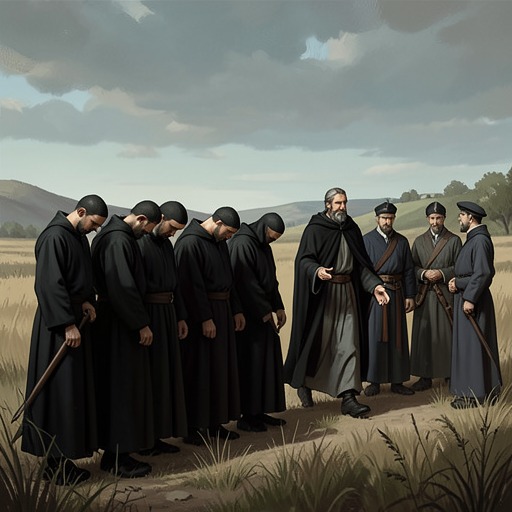
The policy of dissolving the monasteries
The King's CurseThe policy of dissolving the monasteries turns royal authority over religious houses into a means of taking their buildings, lands, and wealth. In Margaret Pole’s account, investigations presented as reform are used to displace priors and abbesses, while Bisham Priory’s repeated closure exposes the human and communal cost of a process that reaches from a family-founded house to villages that depended on monastic charity.
Royal control and the language of reform
The policy unfolds in a period when the king’s authority over the Church has been asserted against the Pope. A report to Margaret describes the Church as having surrendered to the king: the Pope is to be disregarded in England, and the king is to rule the Church himself. This shift forms the political backdrop to the Crown’s scrutiny of monasteries. The policy is not presented merely as a series of local disputes about religious practice; it is part of a larger transfer of authority to the king and his government.
Thomas Cromwell’s visitors, including Richard Layton and Thomas Legh, carry out inspections that are portrayed as a mechanism for securing resignations. Their conduct is outwardly civil, but Margaret notices their fine horses, saddlery, and livery, and connects their comfortable service to the wealth being extracted from religious institutions. The prior of Bisham tells her that the visitors have asked him to resign. Margaret answers that there is nothing wrong with the priory and that he has done nothing to warrant removal; in her view, he should remain in office. The visitors, however, give no grounds that can be challenged and offer no avenue of appeal. The decision is final, regardless of the prior’s account or Margaret’s defense.
Margaret does not deny that some monasteries have committed abuses. She acknowledges reports of fraudulent relics, lax discipline, and communities living comfortably while preaching poverty. Such abuses, she accepts, could justify honest investigation and correction. Her objection is that the process she sees at work does not distinguish a corrupt institution from a house that serves its community. Instead, investigations accuse houses of serious wrongdoing and then find against them, while resignation removes their leaders and makes the institution vulnerable to seizure. Margaret calls this destruction rather than reform: the language of correction gives official cover to a broader transfer of religious property.
Bisham Priory under inspection
Bisham is especially important to Margaret because her family founded it, and she regards its religious and charitable work as part of her own household’s life. Its rents, she says, feed the poor, and its treasures are used for worship. When the visitors arrive, she contrasts that service with the abuses known elsewhere. Her defense is not that every monastery is beyond criticism; it is that a house that serves God and the local population should not be treated as guilty by association. She commits herself to protecting the priory as she would protect her children, her home, and the princess in her care.
The first loss of Bisham is made concrete in her later account: Cromwell’s men inspect it, find it wanting, and transfer it to a prior who is rarely present and whose intention, as Margaret understands it, is to declare the house corrupt and surrender it. She sees this as a process already repeated across smaller monasteries, with the great houses likely to face scrutiny next. The transfer changes who controls the institution before its final fate is settled. Rather than allowing the existing community to defend its work, the procedure places the house in hands aligned with its prospective closure.
The material gains from suppression are visible beyond the priory itself. Margaret describes treasure moving from altars into the treasury, rich farmland and buildings passing into other hands, and neighbors buying former monastic property. The volume of wealth is such that Cromwell has had to establish a new court to administer it. At court, petitioners arrive with plans or maps, each hoping for a share as monasteries and churches are parceled out. The policy thus creates new opportunities for those able to claim or purchase what religious communities once held, while the people who depended on those communities lose both institutions and support.
Reopening and renewed closure
The priory’s story briefly appears to reverse. After the northern rising and the king’s pardons, Margaret hears that abbeys are reopening and that those who had taken part are dispersing after swearing loyalty to the king. Religious men and women return to their houses. At village level, people bring sacred objects back into view: a crystal monstrance hidden beneath thatch, carved saints rescued from woodpiles, crucifixes recovered from drainage ditches, and vestments brought out of hiding. Monks return to their cells and repair roofs and windows. Believing that the period of closure may be ending, Margaret asks her steward to find Prior Richard and invite him back to Bisham.
That restoration is temporary. Thomas Howard obeys the king and closes religious houses that had reopened. The narrative describes buildings being handed to neighboring lords for stone and lands sold to nearby farmers. The monks are left without homes, and communities lose familiar sites of worship and pilgrimage. The contrast between reopened doors and their renewed closure makes clear how little security a pardon or apparent reversal provides: a royal change of direction can restore a religious house, and another command can close it again.
Bisham is taken from Margaret for a second time. The monks who were to pray for Jane Seymour are ordered to leave, and the chantry intended to endure is silenced. Margaret understands the sequence as a reversal governed by royal will: Bisham had reopened by a Tudor decision and closes again on Cromwell’s command. This time, she does not write a protest. Her silence marks the limits of resistance after repeated loss; the earlier defense of the prior and the priory has not prevented the policy from returning to the same institution.
Consequences for local life
The consequences extend beyond owners, religious communities, and courtly beneficiaries. On a journey toward Midhurst, Margaret and her companions take two days to ride through muddy, flooded roads and lose their way several times. In the previous year, they could have stayed at monasteries along the route and received help finding their way. Now a great abbey church stands dark, its stained-glass windows broken for their lead and its roof slates stolen. The abandoned building records suppression in physical damage as well as in the absence of worshippers.
At Petersfield, the travelers find no lodging beyond a poor inn. Beggars at its kitchen door and in the street bear witness to the loss of abbey kitchens, hospitals, and charitable provision. The former houses had offered practical assistance as well as religious services; their closure removes places to stay, food for the poor, care for the sick, and aid for travelers. Margaret’s account therefore measures the policy not only by the wealth redirected to the Crown and private purchasers, but also by the everyday services that disappear from the communities around each house.
The policy’s repeated changes also sharpen the gap between official justifications and lived outcomes. Investigations may begin with recognizable abuses, and pardons may appear to permit religious life to resume, yet neither guarantees the survival of a house. At Bisham and along the road to Midhurst, the pattern is visible in a prior displaced without appeal, monks ordered away after returning, sacred objects hidden or recovered, and charitable buildings left empty. Suppression is presented as a redistribution of power and property whose costs fall not only on the monasteries themselves but on the people who had relied on them.