Tower of London
The King's CurseThe Tower of London is the novel’s most consequential prison: a place where dynastic identity becomes a reason for confinement, political accusation narrows into captivity, and royal pardon can prove as temporary as royal favor. Its high walls, drawbridge, portcullis, and water gate shape the characters’ understanding of power as both architecture and process. Some prisoners leave alive; others are executed. For families linked to the Plantagenets, the Tower makes the threat of arrest feel like a sentence that can be imposed at any moment.
A Prison for Dynastic Rivals
The Tower’s significance is established through Edward Plantagenet, Margaret Pole’s brother. The crown cannot take away his name or title, so it strips him of his fortune and lands, then his liberty. Sent to the Tower at eleven, he remains imprisoned until the age of twenty-four. Although he has lost his household, property, and education, he remains Earl of Warwick and a claimant associated with the Plantagenet line. His continued existence is presented as a reproach to the Tudor dynasty, whose rule has displaced the family’s claim.
When Edward finally leaves the Tower, the release is not a restoration to freedom. Escorted across the drawbridge to Tower Hill, he is executed. The contrast between years of confinement and the brief passage out of the fortress gives the Tower a grim double function: it holds a dynastic rival until the authorities are ready to dispose of him, then delivers him to the public site of his death. Margaret’s earlier prediction that the family would have to watch their cousin Edmund de la Pole walk to the scaffold establishes the same pattern: release from confinement may lead not to safety but to execution.
A Network of Arrests and Fear
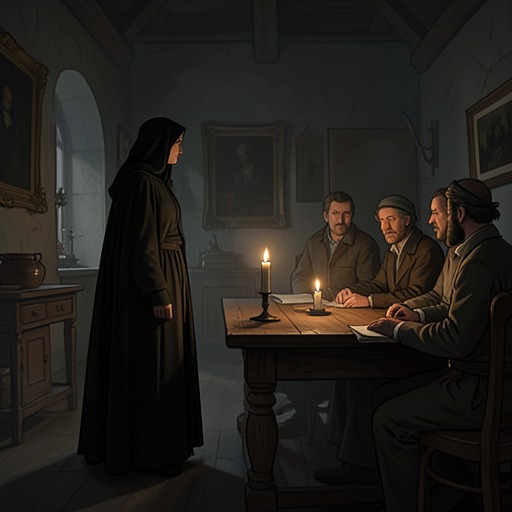
Under Henry VII, imprisonment extends beyond a single rival to relatives and associates suspected of Yorkist allegiance. After Edmund de la Pole’s flight, accusations spread through Margaret’s kin. William Courtenay is arrested and charged with treasonous plotting; William de la Pole is questioned in his cell; and Thomas Grey falls under suspicion for having once dined with Edmund. Men are held in the Tower or sent secretly to Calais Castle, while questioning and enforced solitude make one person’s associations potential evidence against another.
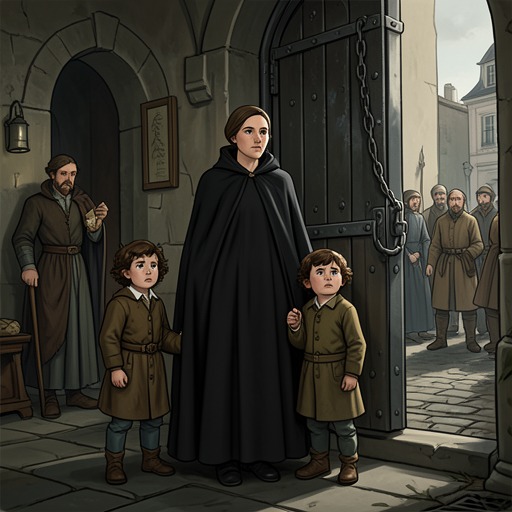
The danger reaches Margaret’s household when Henry VII arrests Thomas Grey and George Neville, Lord Bergavenny, who has been caring for her sons, Henry and Arthur. George leaves the boys at his home in Kent and enters the Tower. Rumors claim that the king visits at night to oversee the torture of suspected men. The story does not present those reports as verified fact, but their circulation shows how the prison’s reputation spreads fear beyond its walls. For Margaret’s family, the Tower is not merely a destination for the accused; it is the looming end point of an atmosphere in which kinship, old meetings, and political descent can invite scrutiny.
The threat is described as a royal power to remove people without warning. A prisoner may be carried by barge through the water gate, beneath the raised portcullis, and disappear from public view. The prison’s physical thresholds give form to a political condition: people with Plantagenet blood or an affinity to York live as if their continued liberty is granted on a revocable license. In that climate, even distant relatives’ safety becomes a matter of anxious family correspondence.
Releases, Returns, and Renewed Threats
Henry VII’s death changes the Tower’s meaning for Margaret’s family, at least temporarily. Under Henry VIII, the old king’s suspicions no longer govern the same way, and some prisoners or suspects return to their households. William Courtenay emerges with a royal pardon; Thomas Grey returns from Calais; and relatives who had avoided court begin to appear again. The change is compared to householders cautiously reopening their doors after a plague has passed. The family’s renewed contact is itself a consequence of the lifting of fear: people dare to exchange news, ask after missing kin, and return to public life.
The reprieve does not undo earlier losses, and Edmund de la Pole’s fate confirms its limits. Margaret is told that the king has ordered his execution. His brother Richard de la Pole, now treated as a potential claimant, is abroad attempting to raise an army; the surviving line of possible rivals cannot be ended by the death of one prisoner. The Tower is therefore part of a recurring dynastic struggle rather than a final solution to it. Confinement and execution may remove individuals, but their deaths can leave other claimants and deepen the family’s sense of continuing danger.
The building also becomes a visible sign of a feared future imprisonment. When Henry VIII and Anne inspect repair work at the Tower and are reported to want it hurried, the City speculates that the queen may be taken from The More and confined there. The report records public apprehension, not a confirmed plan. Yet the speed with which the Tower enters the rumor shows how readily its established role as a royal prison shapes expectations about the fate of even a queen.
Prisoners of Conscience and Political Repression
In the reign of Henry VIII, the Tower holds people accused in conflicts over royal authority and religious allegiance as well as those caught in dynastic suspicion. John Fisher, an elderly bishop and friend of Margaret, is imprisoned after refusing to swear an oath that would deny the Pope’s authority. He is brought out of his cell and presented with the oath, then returned to confinement after declaring that he cannot deny papal authority. Many people believe that a bishop cannot be executed, but that expectation offers no reliable protection.
The Pope’s decision to make Fisher a cardinal is intended as a public sign that the imprisoned churchman deserves respect and stands under papal protection. It does not secure his release. Fisher remains in the Tower, and the account of his execution reaches Margaret as an example of a steadfastness she fears she could not imitate. His story makes the prison a setting for the clash between a prisoner’s conscience and the king’s demand for submission, while also showing the limits of protection from beyond the kingdom.
Robert Aske’s imprisonment exposes another contradiction between royal pardon and royal power. After leading the Pilgrimage of Grace, he has been pardoned and has urged others to trust the king’s word. Nevertheless, Thomas Cromwell recasts Aske’s claims about a northern Parliament and the restoration of monasteries as evidence of treason. Aske waits in the Tower without money, adequate clothing, or sufficient food; no one dares send assistance, and the guards might take whatever was sent. He is eventually taken from the Tower for trial and returned to prison, then transported north and executed at Clifford’s Tower in York. The movement from courtly welcome to confinement and death shows how little a pardon can guarantee once the government interprets a former rebel’s words against him.
Thomas Darcy is also brought to the Tower for questioning despite carrying the king’s pardon. He directly accuses Thomas Cromwell of causing the rebellion and its aftermath. John Hussey, the former chamberlain to Princess Mary Tudor, is brought in as well, and Margaret fears that news of his arrest will reach the princess. These cases extend the Tower’s reach from public opponents to people connected with the royal household, making proximity and service no assurance of safety.
The Tower as a Measure of Royal Power
Across these episodes, the Tower’s meaning changes with the balance of power but never becomes secure. Under Henry VII, it concentrates the vulnerability of a family whose title and bloodline remain politically troublesome. Under Henry VIII, it also confines men whose religious or political positions challenge the king’s demands. Pardons and releases can reopen family networks, but arrests, renewed investigations, and executions repeatedly close them again.
The Tower’s physical arrangement gives this cycle a stark shape: a prisoner may enter by water, pass behind the portcullis, and remain unseen; an escorted passage over the drawbridge can end at Tower Hill rather than in freedom. The building thus stands not simply for captivity but for the uncertainty between accusation, imprisonment, pardon, and death. In Margaret’s account, its most lasting consequence is the fear it imposes on people outside it: families watch doors, guard their speech, and measure safety by whether the king has chosen, for now, to leave them alone.