English Church
The King's CurseThe English Church is the institution at the center of the book’s struggle over whether religious authority in England belongs to the Papacy or to Henry VIII. The conflict reaches beyond the king’s marriage: it concerns who may make church law, judge heresy, control church wealth, and determine which account of marriage and succession must be treated as true. The institution is thus both a spiritual community and a contested structure of government, caught between the king’s claims and the loyalties of those who continue to look to Rome.
Authority and the Submission of the Clergy
The decisive change is announced to Princess Mary Tudor by Montague, who reports that the Church has surrendered to the king. In his account, the Pope is to be disregarded in England and treated as no more than a bishop. The princess understands the breadth of the shift: if the king has made the Church his own, then its wealth, laws, and courts have also been drawn into his possession. The news connects institutional subordination to the larger concentration of royal power.
The terms of the submission make that change concrete. The Church may no longer make law, convict heresy, send its wealth to Rome, or take commands from Rome. These limits do not merely alter a title at the summit; they restrict the institution’s independent authority and its relationship with the Papacy. The king’s new position also has an immediate personal consequence: Princess Mary recognizes that control of the Church will let him rule on his own marriage.
The resulting settlement appears in uneasy form when a papal envoy returns with approval for Thomas Cranmer as Archbishop of Canterbury. Cranmer is the Boleyn family chaplain, and his reading of the Bible accords with the king’s position. His appointment therefore places a royal ally at the head of an institution whose relationship with Rome remains unresolved. Montague sees a compromise in the Pope’s acceptance of the appointment: the Boleyn choice is approved, but the English Church is preserved. Cranmer’s first sermon, however, declares the king’s marriage to Katherine of Aragon sinful and calls for a new union, making clear how appointment and doctrine can serve the king’s marital cause.
Marriage, Succession, and Competing Judgments
The Church’s authority is bound to the question of whether Henry VIII’s marriage to Katherine of Aragon is valid. Earlier, Margaret is pressed to confirm that Prince Arthur and the dowager princess were brought together regularly, and then to say that they were married and bedded. The pressure arises because the disputed consummation bears on whether the king may marry his former sister-in-law. Margaret’s account of what she witnessed is treated not as a private recollection but as evidence with consequences for the royal household and the king’s claim to remarry.
The competing judgments become explicit in 1534. The Pope has publicly ruled that the marriage of Katherine and Henry is valid and that the king should remain with his wife. Henry, by contrast, declares that Katherine is not his wife, that Anne Boleyn is queen, and that Anne’s child is a princess. The novel presents the conflict as more than a disagreement between rulers: it is a contest over which authority can make a ruling binding in England. Henry’s assertion that his declaration makes a thing so is paired with the submission of the Church to his control.
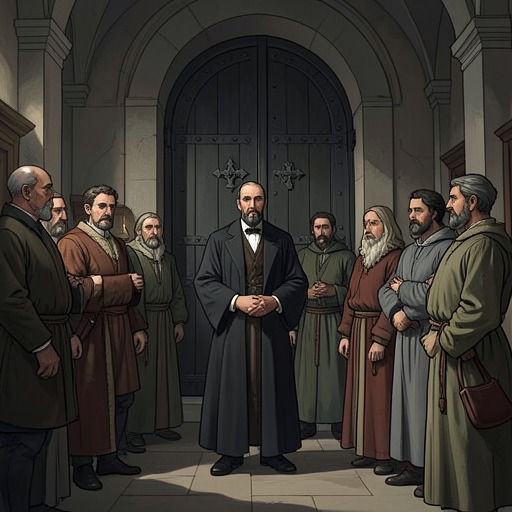
At Westminster, Thomas Cromwell administers the oath of succession to the assembled nobility. Margaret understands that signing means acknowledging the king’s account of his marriage and the children of that marriage, as well as recognizing him as head of the Church in England. She signs alongside Montague and expects Geoffrey to sign after him, hoping their compliance will demonstrate loyalty and leave room for better days. Yet she privately regards the oath’s claims as lies. The act therefore records an institutional change while exposing the difference between public assent and personal conviction.
Royal Supremacy and the Limits of Conscience
The oath places individuals inside the same conflict that has transformed the Church. Margaret’s hand trembles over the written document; she signs, but afterward wishes she had possessed the courage to refuse. John Fisher, brought from the Tower, will not sign because he cannot deny the authority of the Pope. Thomas More also refuses the oath as written, though he would accept a revised version that did not require what he could not affirm. The king had promised More that he would not be tested in this way, but does not keep that promise. Their different responses show how the new settlement makes fidelity to conscience collide with demands for political obedience.
Henry’s own language of authority grows more expansive. After grief, he speaks of a curse and asks why he has lost those he loves; in another exchange, he insists that his son’s challenge to his right to rule his Church is an insult and treason. Margaret recalls that Henry now claims the title of Majesty rather than the form of address once sufficient for a duke. The elevation of the king’s religious position thus appears beside his vulnerable human condition: his authority is presented as increasingly imperial even as grief leaves him dependent on others.
The royal claim also creates anxiety among Henry’s servants. Montague explains that Thomas Cromwell fears excommunication, because if the Pope excommunicates the king and Cromwell, people may cease obeying their commands. Cromwell also fears sharing Wolsey’s fall. The account shows that control of the Church is not treated as settled simply because the king has asserted it: papal authority continues to matter to the political standing of the king’s advisers and to the obedience they can expect.
Religious Practice and Resistance
At L’Erber, Margaret’s household attends Mass while the Bible the king has ordered placed in every church remains untouched. The household understands God’s presence through Latin worship, the priest, the bread and wine, and the established liturgy; English is associated with ordinary daily life rather than sacred authority. Yet the household does not openly defy the king. This juxtaposition gives the institutional dispute a domestic scale: royal policy enters the church, but familiar practice and belief persist within the household even when they are not made into public resistance.
The threat to monasteries makes the conflict material. When Margaret hears that royal authority is being used to close religious houses, she objects that no one had sworn an oath to destroy them, remove stained glass, take gold from altars, or end Catholic communion. Her protest distinguishes the oath’s stated purpose from the consequences she sees unfolding under the king’s power. The English Church’s subordination is therefore associated not only with jurisdiction but with the loss of religious institutions, objects, and forms of worship that her household considers integral to the faith.
The northern rising briefly appears to offer a different outcome. Margaret hears that Queen Jane Seymour pleaded with the king to restore the abbeys and that Lincolnshire has risen in their defense. After the king’s pardon reaches the northern ranks, Robert Aske lays aside the badge of the Five Wounds and urges the pilgrims to bear only the king’s badge. Margaret puts away the badge Tom Darcy gave her, believing that the pilgrimage has ended and that her sons will come home. In London, church bells ring at Christmas; Margaret and her household watch the court’s progress and the crowds celebrate what they understand as the saving of the country, the Church, and the king from himself. This is the people’s hope and interpretation of the moment, not proof that the institutional conflict has been permanently resolved.
Narrative Significance
Across these episodes, the English Church is where abstract questions of authority become decisions about marriage, inheritance, office, property, and personal conscience. A papal ruling can contradict the king; an oath can demand that nobles recognize the king’s account instead; an appointment can place a royal ally in the highest church office; and resistance to the closure of religious houses can gather people into a northern movement. The institution’s changing status gives these otherwise distinct conflicts a common cause and stakes.
The book also emphasizes the gap between formal submission and lived belief. Margaret signs an oath she inwardly rejects, her household leaves the royal Bible unread while continuing its accustomed worship, and the people celebrate a perceived rescue of the Church even as the king’s control has already narrowed its independence. The English Church remains a focus of attachment and public hope, but its freedom to act is increasingly defined by the ruler who claims authority over it.