Henry VIII's Marriage Annulment Crisis
The King's CurseHenry VIII's Marriage Annulment Crisis, also known as the King's Great Matter, transformed a contested royal marriage into a struggle over religious jurisdiction, dynastic succession, and the power to declare what counted as lawful truth. Henry VIII sought to end his marriage to Katherine of Aragon, while she maintained that their union was valid. As the dispute widened, the question of whether the Pope or the king could decide the matter became inseparable from the fate of Princess Mary Tudor and the authority of the Church in England.
Background: Marriage, succession, and disputed evidence
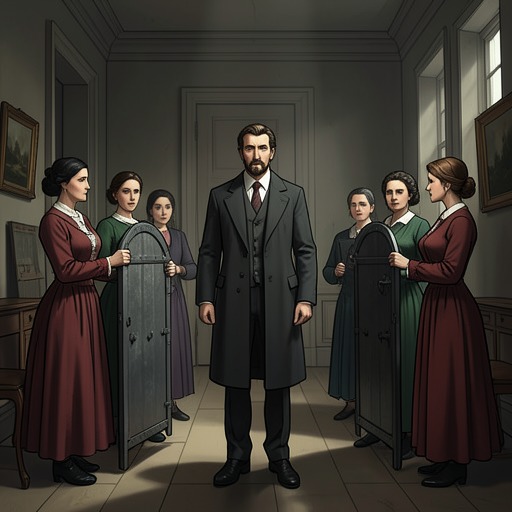
The crisis had an earlier, intimate legal fault line: whether Katherine of Aragon's first marriage, to Prince Arthur, had been consummated. In an earlier dispute, Margaret Pole was pressed to affirm that Arthur and Katherine had been put together in their rooms each week. She confirmed that the arrangement had been carried out, but that did not establish what had occurred between them. Margaret Beaufort treated the claim that the marriage had not been consummated as a lie, and argued that a papal dispensation could permit Henry VII to marry his son's widow. The episode shows how disputed private knowledge could be made to bear the weight of royal succession and the legitimacy of a possible marriage. The succession question grew more urgent as the royal children died. After Henry VIII had told Margaret Pole that she would raise the next King of England, a nurse found the baby in his ornate, gold-enamelled crib, warm but no longer breathing. The loss made the prospect of a male heir more than a matter of status: the king's expectation of an enduring line collided with the vulnerability of individual lives. Later, during another premature labor, those around Katherine imagined how a living son might silence doubts about her strength and fertility and secure her place at court. The child was a girl, already dead before birth. These losses formed part of the context in which Henry interpreted the condition of his marriage as a matter with consequences beyond the couple themselves.
Henry's case and Katherine's resistance
In 1527, Henry VIII confided to Thomas More at Hampton Court that he feared his marriage was invalid. He presented the deaths of his children as signs that the union was not blessed by God. More did not simply endorse this interpretation: despite his doubts about the king's claim of divine revelation, he promised to form a considered legal opinion. The king's personal conviction thus began to acquire the outward shape of a legal and theological campaign. By the end of the summer, the effort was widely known, but Margaret Pole kept the news from Princess Mary Tudor at Ludlow Castle. She had established a household in which gossip from outside was not carried to the young princess, whose world, unbeknownst to her, was already under threat. Margaret found it difficult to tell her: the proposed ending of the royal marriage seemed so improbable that she could scarcely make it real to herself. The silence was protective, but it also isolated Mary from the conflict that would determine her status. The political circumstances briefly appeared to favor Katherine. Her nephew, Charles V, invaded Rome and captured the Pope, leaving him effectively under the Spanish ruler's power. Margaret understood that a Pope held by Charles V was unlikely to rule against Katherine, the Spanish Queen of England. Katherine, for her part, was expected to maintain that God had called her to marry Henry and that their union was valid. The crisis therefore depended not only on arguments about marriage but on the independence of the authority meant to judge them.
The hearing and the widening court conflict
In June 1529, Margaret's son Montague arrived at Richmond Palace from Blackfriars to report on the proceedings. The hearing before Thomas Wolsey and Cardinal Campeggio had drawn such a crowd that Montague compared the packed court to a public execution. The spectacle made the royal dispute a public event even as its consequences remained uncertain. The hearing was expected to continue for days or weeks, with theologians called to give their views and books and manuscripts gathered from across Christendom to support the king's case. Katherine did not accept Wolsey's judgment in an English court and appealed to Rome. Henry VIII responded by sending Reginald Pole to Paris to obtain books and consult scholars, seeking learned support beyond England. Margaret and Montague recognized that the familiar political and religious order was shifting: the king's effort was no longer confined to a domestic adjudication but reached across borders in search of authorities who might strengthen his argument. Courtly ceremony registered the conflict in another form. At a masque, Princess Mary Tudor initially commanded attention as the central figure in a successful performance. But when Katherine withdrew after midnight, Anne Boleyn remained among the courtiers rather than joining the queen's train. The customary order of precedence made the refusal unmistakable: Anne, a knight's daughter, did not follow the queen out, and Henry VIII allowed her to stay. Margaret saw the gesture as a change in the balance of the court, visible before any final judgment on the marriage. The queen's position was being challenged not only in legal proceedings but in the rituals that displayed rank and favor.
Royal supremacy and the consequences of the dispute
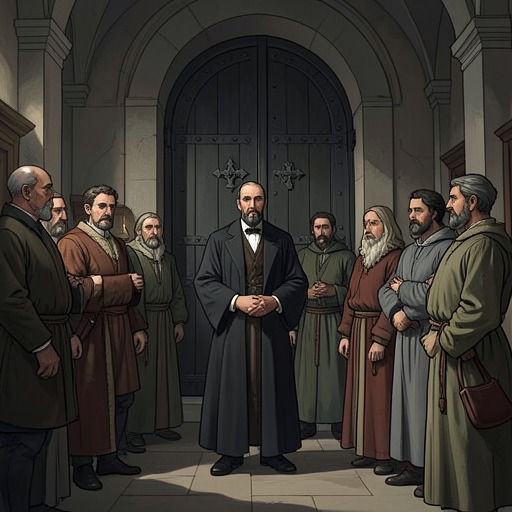
The conflict reached a constitutional turning point when the Church surrendered to the king. In reporting the change to Princess Mary Tudor, Montague explained that the Pope would be disregarded in England and that Henry VIII would rule the Church himself. Thomas More had resigned as Lord Chancellor and returned the great seal. Mary understood the consequences as an expansion of royal possession to the Church's wealth, laws, and courts; neither Margaret nor Montague contradicted her. The issue was no longer simply whether the king's marriage could be annulled. It was also whether the king could place the Church's institutions under his own authority. In spring 1534, Thomas Cromwell summoned the peers to Westminster Palace to administer the oath of succession. The Pope had publicly ruled that the marriage of Henry VIII and Katherine of Aragon was valid and that the king should remain with his wife. Yet, because the Pope had not excommunicated Henry, the peers were not formally authorized to defy him. The competing claims left individuals to judge what they could accept: Rome asserted the marriage's validity, while the king claimed that papal authority had no standing in England and declared Katherine no longer his wife, Anne Boleyn queen, and Anne's child a princess. Thomas More refused the oath, offering to sign a revised version but not the text as it stood; he said he could not sign it for the sake of his soul and did not condemn those who did. Henry VIII had promised More that he would never make him face this test, but did so nonetheless. Margaret remembered More's refusal with regret and felt the burden of her own failure to stand beside him. The oath turned an abstract contest of jurisdiction into a personal demand for assent, and the king's broken promise exposed the human cost of the new settlement. The crisis also left signs of loyalties the Crown could not simply decree away. In January 1536, as Montague rode toward Peterborough Abbey with armed men, townspeople watched resentfully until they recognized his banner. A woman called for blessings on the white rose, Katherine, and the princess. The welcome registered public attachment to the queen and Princess Mary Tudor even after the king's religious and political claims had altered their official standing. The crisis's decisive outcome was therefore not just the attempted annulment: it was the Crown's bid to make royal declaration override papal judgment, established procedure, and the private consciences of those required to accept it.